Horus God: The Ancient Egyptian Deity of Kingship and Sky

Introduction
The deity Horus in the ancient Egyptian pantheon was far more than simply the god of the sky or warfare; he was a concept of divine order, legitimacy, and perpetual renewal. To truly understand Horus is to grasp the interwoven fabric of Egyptian cosmology, where the celestial realm directly informed the political and social structure of the land. Unlike a deity who existed purely in myth, Horus was intimately tied to the practical functions of the state, serving as the blueprint for kingship and the ultimate guarantor of safety 1. This article explores how Horus transitioned from a celestial hunter to the foundational archetype of the earthly ruler, examining the myths, symbols, and functions that allowed him to shape ancient Egyptian life.
The Living Pharaoh: Horus on Earth
In the core of Egyptian belief, the relationship between the divine and the human was absolute, and Horus occupied the pinnacle of this link. The pharaoh was not merely a mortal leader; he was understood to be the earthly embodiment of Horus (2, 1). This divine association meant that the pharaoh’s power was not arbitrary but mandated by the cosmic order. As Horus represented kingship itself, the pharaoh’s primary role was to maintain *Ma’at*—the concept of truth, justice, and balance—ensuring that chaos remained at bay. This divine mandate granted Horus the cultural function of a protector and a representative of the ruling power. The early recordings of Horus’s tutelary influence were specifically tied to the ruling pharaoh in Upper Egypt, establishing the pattern: the king lived as a manifestation of Horus during his reign, but in death, he transitioned into the eternal presence of Osiris 1. This duality meant that Horus provided the living structure of governance, while Osiris provided the promise of eternal life, with the pharaoh serving as the bridge between the two states.
The Divine Conflict: Origin of Order and Protection
The foundational narrative of Horus is the essential myth of order prevailing over chaos. Horus is positioned as the rightful heir of Osiris, who is his father, born to the powerful goddess Isis (1, 2). The central dramatic conflict revolves around Horus challenging his jealous uncle, Set. Set, embodying chaos, attempted to undermine his brother and, ultimately, murdered him (1, 2). This battle established Horus as the champion of truth and rightful succession. His successful, albeit often violent, defeat of Set validated the cosmic order. However, the conflict had a significant cultural fallout that led to one of Egypt’s most potent symbols. During the struggle, Horus’s eye was wounded. This event gives rise to the profound cultural significance of the Eye of Horus, or *Wedjat*, which was subsequently restored by the god Thoth 1. The scar and the healing process became a narrative template for restoration and ultimate victory of divine law.
The Celestial and Multifaceted Nature of Horus
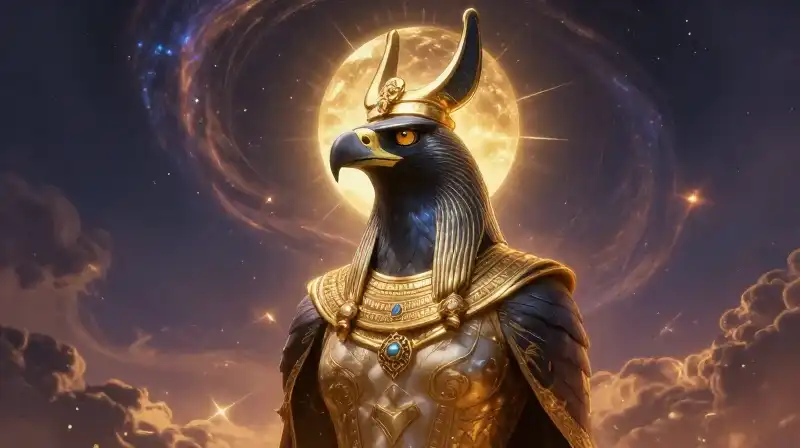
The scope of Horus’s power extended beyond the royal courts and into the very fabric of the heavens. He was intrinsically linked to the cyclical nature of the cosmos. Ancient accounts describe him as being tied to the celestial bodies, representing the dynamic motion of the universe. The sun, for instance, was represented by his right eye as he traversed the sky, while the moon was reflected in his left eye 1. Because his function was so broad, Horus was not always rendered in a single form. Scholars recognize that he possessed various manifestations, including Heru, Heru-ur, and Hor-Akhti (Horus of the Two Horizons). These forms suggest that Horus was a multi-layered deity capable of adapting his divine energy to serve different needs—be it as a god of war, a celestial guide, or a subtle regulator of societal balance 1. This adaptability allowed the tradition to incorporate diverse needs, cementing his status across different periods of Egyptian religious practice.
The Wedjat: A Symbol of Perpetual Protection
Perhaps the most visible and universally understood aspect of Horus’s legacy is the Eye of Horus, or *Wadjat*. This symbol transcended simple mythology; it was a powerful tool of cultural protection and political power. Originally originating from the wound inflicted by Set, the Eye of Horus evolved into an ancient talisman representing health, restoration, and royal power (1, 2). For the community, the Wedjat was a symbol of divine oversight and guardianship. It served as a powerful protective amulet, ensuring safety in life and guiding the deceased through the perils of the afterlife 1. The symbol’s power lay in its narrative: it was the representation of a divine being who was damaged by chaos but whose wound was ultimately healed by cosmic forces. It is, therefore, an enduring cultural reminder that order can always be restored.
Synthesis: Horus as the Arbiter of Existence
Ultimately, Horus is defined by his role as the architect of continuity. He is the convergence point between the raw energy of the sky, the political necessity of kingship, and the eternal promise of rebirth. Whether depicted as the hunter battling Set, or as the radiant celestial presence of the sun, he consistently represented the necessary imposition of divine law upon a chaotic world. His functions—as protector, king, and cosmic guide—demonstrate that the tradition he upholds is not merely about gods, but about the vital processes of governance, cosmic maintenance, and the cyclical nature of life and death. To understand Horus is to understand the ancient Egyptian vision of a world where divine order was continually earned and maintained through action and vigilance.
References
Footnotes
Related Articles