Horus in Egyptian Mythology: Kingship, Protection, and the Sky

Introduction
The world of Ancient Egypt was governed not by isolated myths, but by a vast, integrated cosmological framework. Within this intricate tapestry, very few figures held the weight of significance as Horus. More than merely a god, Horus was a living principle—a symbol of kingship, order, protection, and the dynamic forces of the sky. To understand Horus is to understand the Egyptian concept of sovereignty: that the divine was not a distant force, but something present, essential, and deeply embedded in the structure of the cosmos and the rule of the living.
The Living Divine: Horus and the Pharaoh
In pharaonic ideology, the distinction between ruler and deity was often conceptual, not purely ceremonial. The Pharaoh was understood not simply as a powerful monarch, but as the earthly embodiment of Horus 1. This connection served a critical purpose: it elevated the monarch’s status from mere leader to a sacred manifestation of divine authority. Through the living Pharaoh, Horus ensured the continuity of *Ma’at*—the cosmic order and truth—on earth. The very act of ruling was, in this sense, a divine performance. This relationship had profound spiritual implications for the afterlife. The transformation of the Pharaoh’s identity was central to their passage. While alive, the king reigned as Horus, the vigilant, earthly manifestation of the sun’s strength. Upon death, the pharaoh’s identity shifted, leading to the unification of these powerful figures into Osiris, who represented the ruler in his state of resurrection and eternal kingdom 1.
The Great Rivalry and the Preservation of Order
The most recognized cultural narrative concerning Horus centers on his lineage and the struggle for legitimacy. The common account positions Horus as the son of the deceased god Osiris and the powerful goddess Isis (1, 2). He is also framed as the rightful heir, destined to avenge the murder of his father at the hands of the rogue god Set 1. This conflict is more than just a story of a family feud; it functions as a cosmological explanation for natural phenomena. The fierce rivalry between Horus and Set serves to justify the imperfections of the natural world, such as why the moon is not as brilliant or luminous as the sun 1. By establishing this eternal struggle and its resolution, the tradition solidified the ultimate triumph of order over chaos. The myth itself is deeply rooted in the ancient understanding of creation and restoration. According to certain narratives, after Isis successfully resurrected her husband, she conceived Horus by gathering his dismembered parts (1, 3). This emphasizes the power of divine will and maternal devotion in restoring and maintaining the cycle of life.
The Wedjat Eye: A Symbol of Protection and Royal Power
Few symbols of Egyptian heritage are as universally recognized as the Eye of Horus, or the *Wedjat*. This eye is far more than an artistic motif; it is a profound expression of divine protection and royal potency. It is often utilized on funerary amulets, acting as a safeguard for the soul and the body during the perilous journey into the afterlife 1. The tradition surrounding the *Wedjat* is rich with complexity. While it is frequently associated with the king and the solar cycle, the original symbolism traces back to the all-seeing eye of Wadjet. Over time, this symbol became associated with multiple important deities, including Bastet, Hathor, and Mut 1. Culturally, this meant that the Eye of Horus was a universal emblem of safety and wholeness, representing the restored and perfect state of being—the “whole one.”
The Horus Celestial: King of the Skies
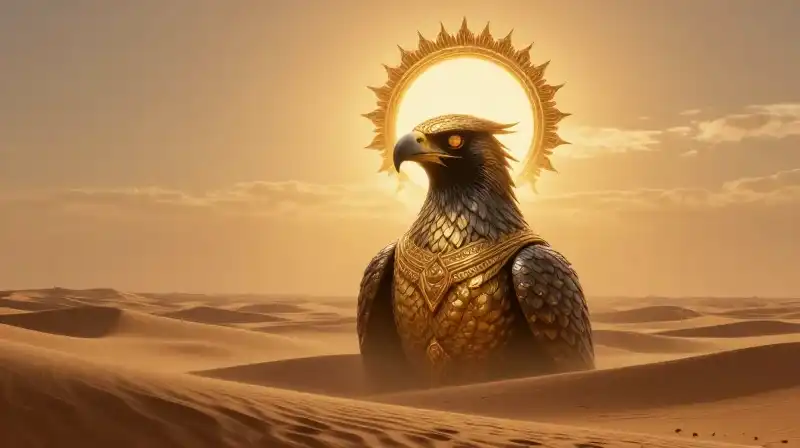
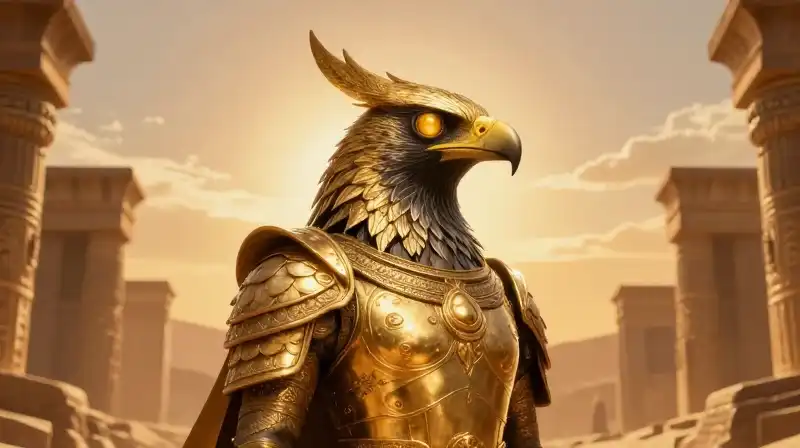
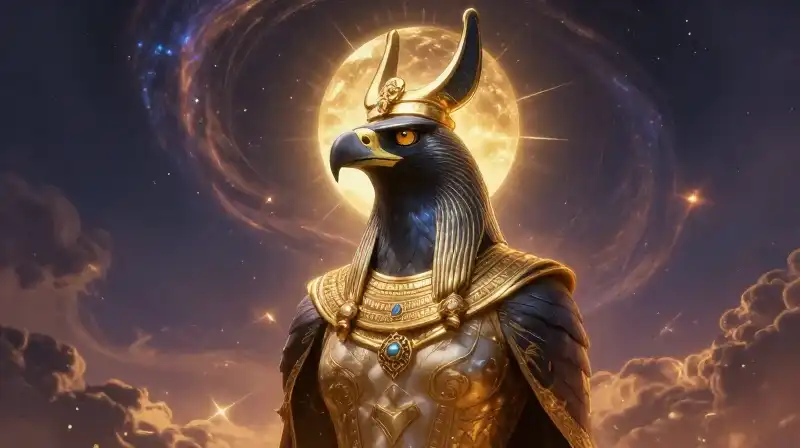
The association of Horus with the sky and the elements is intrinsic to his character. Unlike many gods who merely preside over a domain, Horus was seen as a creature *of* the heavens. His frequent artistic depiction as a falcon—specifically a lanner or peregrine—or as a human figure bearing a falcon’s head, reinforces this connection 1. The falcon was a creature of great speed and aerial vigilance. This divine celestial role led to a poetic, powerful theological interpretation of the sun and moon. As Horus soared across the heavens, it was believed that the sun resided in his right eye and the moon in his left. This imagery provided a literal visualization of the sun and moon traversing the sky, not just as distant bodies, but as part of the divine anatomy of the cosmic king 1. Within the ruling class, identifying Horus as the offspring of primordial forces like Atum was a theological strategy used to solidify the Pharaoh’s control over all terrestrial and cosmic powers 1.
Navigating the Nuances: Lineage and Manifestations
To truly understand the depth of this tradition, one must look past the common narratives and explore the complexities of the deities. Scholarly observation suggests that Horus was not a monolithic entity, but possessed various forms—the Elder and Younger Horus—which may have existed to emphasize complementary attributes of the single, mighty deity 1. There is also an interesting nuance regarding his lineage that differs across various traditions. While the dominant narrative confirms Isis as the mother of Horus, some traditions or variations view Hathor as Horus’s mother or wife 1. This highlights how traditions within a culture can maintain deep respect for a core figure while allowing for differing historical or mythological interpretations, demonstrating the fluid and multifaceted nature of ancient belief. Regarding common inquiries, Horus is consistently presented as a male figure in all its significant manifestations, representing the protective, assertive force of the divine king.
Meaning and Cultural Echoes
Horus remains a cornerstone of Egyptian cultural understanding because his story is not simply a myth; it is the blueprint for order itself. He represents the necessary balance between the wild forces of the desert (represented by Set) and the disciplined, ordered realm of civilization (represented by the Pharaoh and the cosmic law of Ma’at). He is the living promise that even after the most brutal turmoil—the murder of Osiris, the chaotic power of Set—justice, renewal, and protection will prevail. His tradition teaches that in Egyptian thought, the divine presence was closest to the human experience, embodied by the ruler and protected by the vigilant gaze of the *Wedjat* eye, reaching up to govern the heavens.
References
Footnotes
Frequently Asked Questions
Was Horus male or female?
Horus is consistently presented as a male figure in all its significant manifestations.
Related Articles