
Cleopatra as Goddess Isis: The Political Myth of Divine Rule

Introduction
The image of Cleopatra as a divine figure is perhaps one of history’s most enduring and pervasive myths. To a modern observer, she might appear as a woman who chose divinity for political gain. However, to understand this narrative within the context of ancient Egypt, one must recognize that she was operating within a deeply embedded cultural tradition where the line between a political monarch and a spiritual deity was inherently blurred. In the Ptolemaic kingdom, Cleopatra did not simply claim to be a goddess; she strategically employed the powerful cultural imagery of Egyptian divinity to validate her rule. Her adoption of the archetype of Isis—the supreme maternal deity—was less about personal religious fervor and more a sophisticated act of cultural synthesis designed to bridge the Hellenistic (Greek) world with the traditional Egyptian conception of the divine mandate of a king.
The Cultural Mandate: Where Monarchy Met Divinity
To understand Cleopatra’s choices, one must first understand the fundamental premise of Ancient Egyptian thought. In traditional Egyptian belief, the pharaoh was not merely a ruler; he was seen as a high priest whose authority was divine 1. This tradition held that the king served as the living embodiment of the divine on earth, making the monarchy as sacred as it was political. For the Ptolemaic dynasty, who governed Egypt as Hellenistic Greeks, maintaining this powerful visual and ceremonial connection to the native Egyptian high priesthood was crucial for legitimizing their rule among the indigenous population 1. Even though the Ptolemies had Greek lineage, they adhered to the tradition of being crowned by the high priest of Ptah at Memphis, demonstrating their integration into, and adherence to, Egyptian religious tradition 1.
Navigating Two Worlds: Language and Cultural Literacy
While many of her predecessors in the Ptolemaic line spoke only Greek, Cleopatra distinguished herself through her mastery of the native Egyptian language 1. This linguistic competence provided her with a unique cultural authority. By mastering the tongue of the land, she could access the nuances of the indigenous belief system, allowing her to perform the role of a divine intermediary with authenticity. This cultural literacy was essential to her political maneuvering. She leveraged this inherent understanding to transform her political platform into a deeply resonant spiritual one, connecting the Hellenistic political structures with the ancient spiritual weight of the Egyptian world 1.
The Transformation into the Goddess: The Iconography of Isis
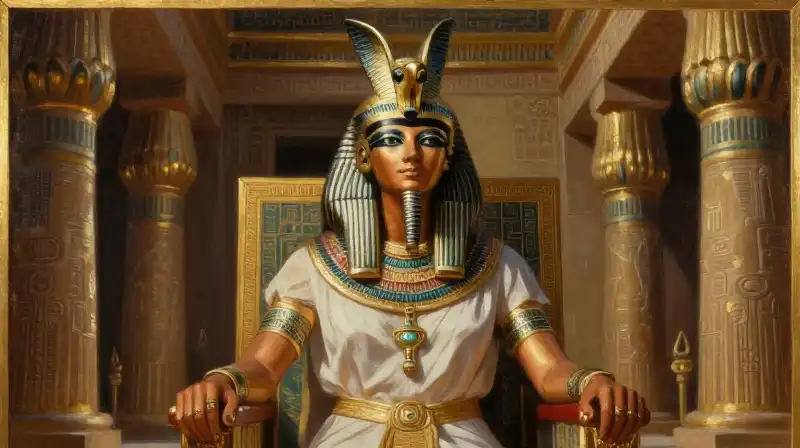
Cleopatra’s most profound political move was the intentional transformation of her persona into the figure of Isis. Isis was arguably the most vital mother deity in the Egyptian pantheon, revered as a figure of fertility and a supreme maternal power 1. By positioning herself alongside this potent archetype, Cleopatra transcended the status of a mere Hellenistic queen, who might otherwise be viewed as a distant, exotic outsider. She adopted the *Nea Isis*, or “New Isis,” title, which formalized this adoption of the goddess’s ceremonial regalia 1. This included the adoption of the tripartite wig and the iconic vulture headdress, symbols that immediately broadcast a profound connection to Egyptian royalty. The performance of divinity was formalized during critical moments of her reign. After the birth of her son, Caesarion, Cleopatra consciously adopted iconography that mirrored the traditional depiction of Isis—a powerful mother goddess cradling her suckling Horus 1. This visual narrative was not purely devotional; it was a calculated political statement. By mirroring the maternal power of Isis, she positioned herself as the life-giving source of the new dynastic line, blending the East and West to present a vision of unified power 1.
The Living Image: Iconography and the Horus Connection
The evidence of this divine claim lives most visibly in the material culture of her reign. Her coinage was a prime tool in this mythological performance. These coins featured Cleopatra wearing the sacred Isis diadem alongside the image of her son, Caesarion 1. This pairing was a masterful piece of political messaging: Caesarion was presented not just as a political heir, but as the living Horus—the falcon deity and son of Osiris. This narrative allowed Cleopatra to perform a uniquely ancient Egyptian role in a Greco-Roman environment. In this cultural context, a female queen wielding power through inherent, goddess-like authority was a legitimate—albeit powerful—tradition 1. By making this claim, she successfully linked the legitimacy of the powerful pharaonic lineage to the political capital she held in the Hellenistic world, providing a narrative foundation for a form of world unification 1.
Was Cleopatra Egyptian, or the Ptolemaic Queen?
This question touches on the complex interplay of race, culture, and political representation in ancient times. Cleopatra was, by blood, a Ptolemaic. However, her political identity was deeply rooted in the Egyptian cultural sphere. While not a native Egyptian by birth, her masterful adoption of the religious and cultural symbols of Egypt—specifically the personification of Isis—allowed her to be interpreted through the lens of Egyptian divinity by her people and her opponents alike. Her successful navigation of the two cultures, and her fluency in the language of the land, ensured her identity was far more complex than the simple dichotomy of “Greek” versus “Egyptian.”
The Persistence of the Myth and Scholarly Nuance
While the cultural weight of her divine identification is unmistakable in her iconography, it is important to distinguish between “divinity” as a political title and “devotion” as a religious practice. Scholars maintain that while her use of grand “liturgical pageantry” was culturally rooted in tradition, the true intent—whether it was purely spiritual devotion, a purely political performance, or a strategic fusion of both—remains subject to academic debate 1. Furthermore, as the political landscape shifted and Roman influence grew, the Western perception of her began to mutate. Roman sources frequently observed her through a critical or allegorical lens, which subsequently shaped her public image in the Medieval and Renaissance periods, often portraying her not as a complex divine bridge, but through a narrower, often adversarial, cultural lens 1. In essence, the tradition of Cleopatra as the embodiment of Isis serves as a powerful reminder that power is often constructed as much through narrative and cultural symbols as through military might. Her legacy illustrates how a ruler can transform a deeply ingrained spiritual belief into a potent political tool, leaving behind a myth that continues to challenge our understanding of history, culture, and the intersection of the divine and the temporal.
References
Footnotes
Frequently Asked Questions
Was Cleopatra an Egyptian goddess?
Cleopatra strategically transformed her persona and adopted the title of Isis to utilize the cultural imagery of Egyptian divinity and validate her rule. While her political maneuvering involved mimicking the divine nature of a goddess, scholars debate whether her actions were purely spiritual or a calculated political performance.
How old was Caesar when he slept with Cleopatra?
The article does not provide any information regarding the age of Caesar when he was with Cleopatra.
Related Articles