Demeter: Exploring the Greek Goddess of the Harvest and Divine Law

Introduction
In the ancient world, the welfare of a community was inextricably tied to the health of the land. For the Greeks, this profound connection between human sustenance and divine order was embodied in Demeter, the Olympian goddess revered not merely as the patron of grains and harvest, but as the guarantor of life’s most fundamental cycles—birth, marriage, fertility, and death. Demeter’s role was foundational; she represented the very “Mother-Earth,” a figure whose happiness and the upholding of her divine laws directly correlated with the thriving or failing of the agricultural season 1. She was more than a deity of the field; she was a pillar of the social and cosmic order 1. The cultural significance of Demeter extends deeply into ancient religious practices, most notably through her relationship with her daughter, Persephone. This relationship served as a primary mechanism through which ancient Greeks understood the cyclical nature of time. The story of Persephone’s journey into the Underworld, presided over by Hades, is not simply a tragic romance; it is a cosmological narrative used to explain the transition between the productive abundance of spring and the stark famine of winter (1, 2).
The Cycle of Sorrow and Sustenance
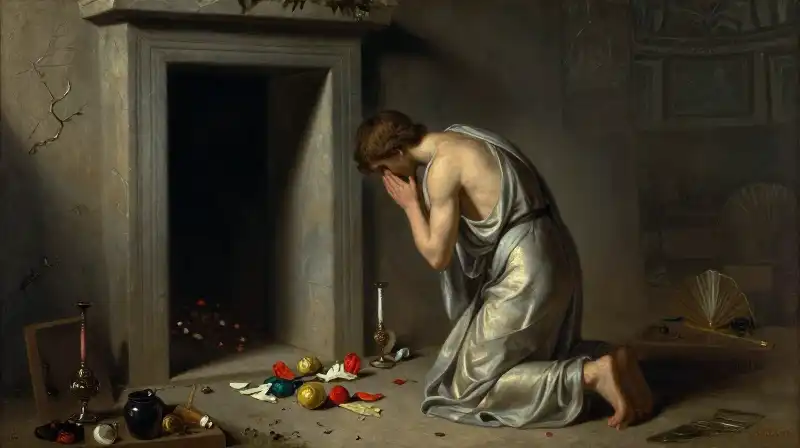
The central narrative surrounding Demeter and Persephone is the foundational myth of the seasons, a narrative that gives the tradition its deep psychological and cultural weight. When Persephone is taken, Demeter’s profound grief causes her to halt the natural cycles, resulting in a desolate earth and widespread famine (1, 2). However, this is not a story of eternal loss, but of a cyclical tension. Demeter’s sorrow and the subsequent return of Persephone to the surface of the earth allow for the renewal of the cycle. The “living culture” embedded in this myth is the understanding that life depends on periods of dormancy and rest. The seasonal rhythm—the transition from Demeter’s mourning to her celebration of spring—is seen as the external manifestation of the divine order 1. Demeter’s presence is what ensures the crops flourish; her joy is the harvest, and her sorrow is the winter dormancy 1.
Divine Law and Social Peace: The Thesmophoria
While most often referenced in the context of the harvest, Demeter’s function in ancient society was also deeply tied to law and social structure. Through the epithet *Thesmophoros*, she was invoked as a “bringess of law.” This concept highlights her importance beyond mere sustenance. The most direct expression of this legal and communal aspect of her worship is the Thesmophoria, a secretive, female-only festival dedicated to her 1. These gatherings underscore her role as a guardian of peace and the regulator of social conditions dependent on agricultural success 1. By maintaining the balance within the community and within the natural world, Demeter was seen as upholding a necessary divine equilibrium.
Expanding the Scope: Gaia and Global Connections
To truly understand Demeter’s cultural power, it is essential to see her not as an isolated deity, but as a component of a vast pantheon of earth and life. Scholarly analysis suggests that Demeter was conceptually tied to Gaia, the personification of the agricultural earth, implying an early cultural link between the chthonic forces of the Underworld and the fertile soil 1. Her influence spread through the Mediterranean, illustrating how universal human concerns about agriculture are encoded in regional myths. Demeter has been linked to several powerful figures in other cultures, such as the Anatolian goddess Cybele and the Roman goddess Ceres 1. This syncretism shows the common thread running through the tradition: the powerful feminine figure who governs the essential relationship between life and the soil 1.
Regional Echoes: Where Demeter Lives
The myth of Demeter and Persephone is not monolithic; its narrative details and localized traditions vary depending on the community that honors her. These regional variations enrich the tradition, allowing for different local interpretations of her power. A notable departure from the core narrative occurs in Arcadia, where she is known as “Black Demeter.” In this unique depiction, she is portrayed with a horse’s head—a mythological transformation rooted in a local tale involving her escape from her younger brother, Poseidon 1. Additionally, localized traditions regarding the abduction of Persephone place the event in various locales, including Enna in Sicily, Eleusis, Attica, Crete, and Asia Minor 1, showing how the powerful central narrative adapted to local geography and myth-making.
Symbolism and Iconography
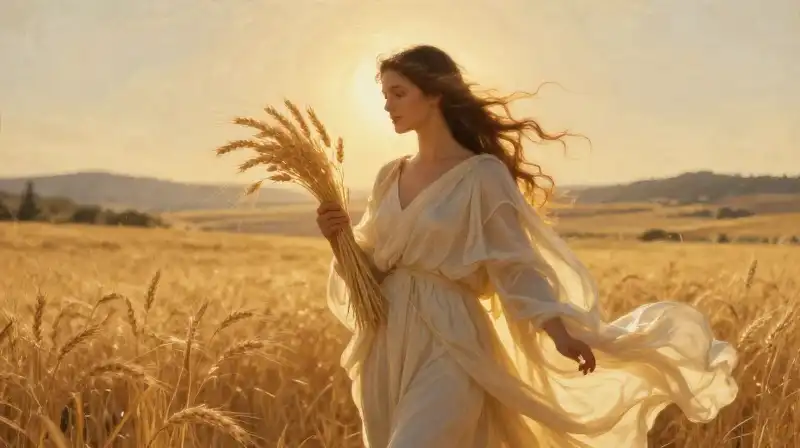
In the visual culture of ancient Greece, Demeter is frequently identified by symbols that immediately communicate her function as the goddess of abundance. She is often depicted carrying a cornucopia (a horn of plenty) or sheaves of wheat 1. These images emphasize her original role, which was rooted in the practical duties of threshing and grain cultivation within early agrarian communities 1. Her imagery speaks not just to the end result of the harvest, but to the continuous, life-giving flow of matter from the earth.
Beyond the Myth: The Tradition Today
Demeter’s story serves as a timeless reflection on the balance between creation and entropy, and between prosperity and deprivation. The tradition is a sophisticated meditation on dependency; it teaches that while the harvest provides life, it is also conditional on maintaining the right balance—the right respect for the earth, the right observance of natural and social laws, and the acceptance of inevitable cycles, even the “sorrow” of winter. By exploring her through the lens of regional variations and divine law, the tradition remains a living cultural mirror reflecting humanity’s enduring need to understand its place within the vast rhythm of the natural and social world.
References
Footnotes
Related Articles