The Medusa Myth: Ancient Greece and the Gorgoneion

Introduction
The image of the Gorgoneion—the terrifying head of the Gorgon Medusa—is one of the most potent and enduring motifs of classical antiquity. More than a mere depiction of monstrous wrath, this powerful symbol functioned as a cornerstone of ancient Greek cultural life. For the Hellenic people, the Gorgoneion was primarily an apotropaic figure, a powerful image used to actively ward off ill fortune and negative forces, much like the concept of the modern “evil eye” 1. To truly understand the Medusa myth is not simply to recount a monster story; it is to trace a profound journey—one that spans millennia, shifting from a practical architectural defense against the chaos of the world to a complex, deeply layered cultural symbol that challenges notions of beauty, power, and victimhood.
The Gorgoneion in Architecture and Art
The initial prominence of Medusa’s head was functional. During the Archaic period (roughly 700–480 B.C.), the Gorgoneion was integrated into public architecture, most visibly decorating temple pediments and other monumental structures, such as the examples found at Temple C in Selinunte, Sicily 1. Its ubiquity in material culture suggests that the fear and power it represented were intrinsically linked to the protective boundaries of the community. The motif was not confined to the colossal; it adorned smaller, everyday objects, appearing on armor, jewelry, and the decorative handles of bronze vessels used by soldiers and athletes 1. This pervasive presence highlights its status as a common cultural guarantor of safety.
Over time, the artistic representation of Medusa evolved. As the image transitioned from the Archaic into the Classical and Hellenistic eras, her depiction subtly changed. She was no longer exclusively presented as a monstrous figure characterized by sharp teeth and a dense beard, but shifted toward a more complex, feminine, and often human-like form, even while retaining her confrontational, paralyzing power 1. This artistic evolution mirrored the way the cultural understanding of the figure itself was beginning to broaden.
The Shifting Myths: Narratives of Transformation and Terror
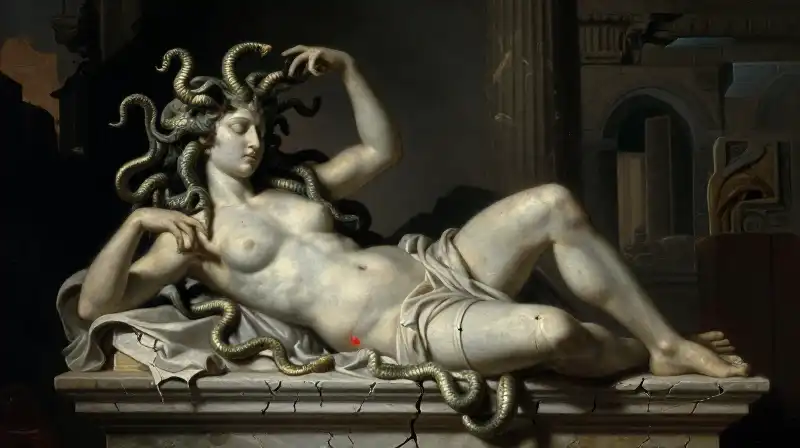
The mythology surrounding Medusa lacks a single, universally agreed-upon version. The stories themselves are a cultural mosaic, varying drastically between canonical classical texts and later retellings. Traditional narratives present Medusa as one of three mortal Gorgons, alongside the immortal Euryale and Stheno. Their most defining, and frightening, characteristic was the ability to instantly petrify any living being that dared meet their gaze (1, 2). The most famous and foundational narrative involves the Greek hero Perseus. Utilizing divine aid—such as the reflective shield provided by Athena and the swift, winged sandals of Hermes—Perseus successfully decapitated Medusa and subsequently employed her deadly head as a weapon (1, 2).
However, another crucial narrative perspective, drawn from the Roman poet Ovid, radically alters Medusa’s role. In this version, she is not born a monster but is a beautiful maiden. Her transformation into the terrifying Gorgon was the result of a desecration: she was victimized in Athena’s temple by Poseidon (Neptune) (1, 3). This contrast between the “monster born” narrative and the “beautiful maiden transformed” narrative offers a powerful window into how cultural communities negotiate concepts of divine punishment, victimization, and the power of the feminine.
Cultural Depth: From Fiction to Sociological Insight
For the ancient Greeks, these myths were not treated as mere entertainment or fiction; they were understood as an essential, shared record of their cultural and heroic history 1. This understanding elevates the Medusa story beyond a simple bedtime tale and positions it as a living part of their cultural landscape.
Modern academic study has provided further layers of meaning. Some scholars have interpreted the Perseus-Medusa myth in a quasi-historical manner, suggesting the legend might represent a form of “sociological trauma” or a sublimated memory relating to historical conflicts between the Hellenic people and the divine realm 1. Even more expansive is the psychoanalytic approach, where figures like Freud have linked the Medusa narrative to themes of forbidden maternal figures and castration terror 1. These modern interpretations reinforce the idea that Medusa is not static. She functions as a dynamic cultural construct, evolving from a primordial, elemental monster into a complex figure who can be simultaneously perceived as a powerful aggressor and a tragic, victimized figure (1, 2).
Understanding the Tradition’s Persistence
The enduring significance of Medusa lies in this duality. She embodies the paradox of power—power that is both destructive (petrification) and victimized (the desecration described by Ovid). The shift of the Gorgoneion from a defensive tool in temple architecture to a subject of profound literary and philosophical debate demonstrates how a culture can assimilate a frightening archetype. Rather than being feared solely for her power, the Medusa myth ultimately offers a complex allegory for confronting the unknown, understanding the intersection of divine power and human vulnerability, and acknowledging the multifaceted nature of identity itself.
When engaging with this tradition, one must recognize that Medusa’s meaning is contingent upon the context. In its ancient form, she provided a powerful, protective boundary. In its later narrative forms, she explores the tragedy of transformation and the resilience of the feminine. She remains a powerful cultural touchstone, symbolizing the eternal tension between the uncontrollable chaos of nature and the attempts of human society to order and define it.
References
Footnotes
Related Articles