Aiolos vs Aeolus: Exploring the Myth of the Keeper of Greek Winds

Introduction
The figure known as Aeolus, or his variant Aiolos, occupies a unique space in Greek mythology. He is not merely a god of the weather, but the divine architect of travel, fate, and the relationship between humanity and the vast, unpredictable forces of nature. For a culture steeped in the maritime life and the constant threat of the sea, Aeolus represents the tenuous thread of control—the ability to manage, restrain, and guide the wild winds. Understanding his myth is to understand a sophisticated ancient attempt to categorize the sublime chaos of nature.
The Keeper of the Gales: Myth and Domain
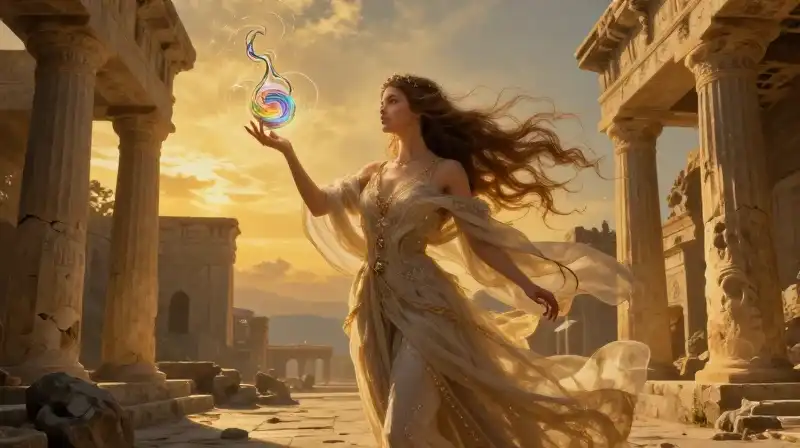
Aiolos is primarily known as the sovereign guardian of the winds, holding dominion over the tumultuous air currents of the Aegean. His mythical seat of power is the floating island of Aiolia, or Aeolia (1, 2). In the foundational narratives of Homer’s *Odyssey*, Aeolus functions as the master of this idyllic realm. His most famous act is the provision of a bag containing the storm winds, a gesture designed to ensure the safe passage of the hero Odysseus (1, 2). This portrayal establishes him initially as a benevolently powerful figure, capable of bringing order to a dangerous journey, provided the winds are contained and managed.
From Mythical Bag to Mountain Cabin: A Changing Narrative
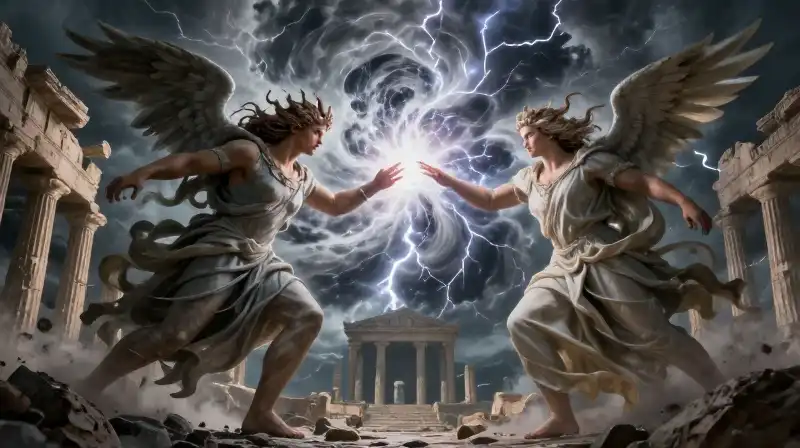
As mythological traditions evolved across centuries, the depiction of Aeolus and his power shifted, reflecting changing literary styles and philosophical concerns. In later epic works, such as Virgil’s *Aeneid*, the focus moves from the magical containment of the winds in a simple bag to a more structured, monumental display of authority 1. Virgil depicts Aeolus as a sovereign who has confined the powerful winds within a fortified cabin nestled high in a mountain, restraining their rage through his “sceptred hand” 1. This elevation of his physical domain reflects a move toward the idea of a regulated, disciplined power. Furthermore, Aeolus’s presence enters more complex dramatic scenarios, such as the *Aeneid*, where Juno seeks his assistance to unleash destructive winds upon Aeneas. Aeolus’s ultimate refusal to comply—a power later challenged by Neptune—solidifies his role not just as a manager of nature, but as a force capable of wielding significant moral and cosmic leverage 1.
The Web of Lineage: Addressing Aiolos vs. Aeolus
One of the most common points of confusion for readers encountering this tradition is the variation in the name itself: Is it Aiolos or Aeolus? These variations point to a complex history of transcription and scholarly amalgamation. 3 notes the presence of three distinct characters named Aeolus in ancient writings, whose genealogical connections are often ambiguous and whose unique identities have been merged over time by historians such as Diodorus Siculus. Diodorus Siculus attempted to provide a cohesive rationale for the divine status of the wind keeper, suggesting that the winds themselves were a physical reflection of Aeolus’s own great piety and his keen ability to predict local wind patterns through careful observation of the fire 1. The lineage offered in the tradition is equally intricate. Homer portrays Aeolus as the son of Hippotes, maintaining a significant household that included six sons and six daughters 1. Diodorus Siculus expands this tradition further, listing Aeolus’s mother as Melanippe and cataloging sons such as Astyochus and Androcles (1, 2). From an ancestral perspective, another line of myth establishes Aeolus as the son of Hellen, thereby identifying him as the eponym of the Aeolians, one of the four major Ancient Greek tribes 1.
Order from Chaos: The Cosmological Meaning
The titles and roles assigned to Aeolus underscore the cultural understanding of control and order within the universe. He was known by the title *Hippotades*, a name derived from the Greek words *hippos* (horse) and *tadên* (reiner), which translates to “the reiner of horses” 1. This title points to the idea that the winds were not random storms, but spirited entities, perhaps even horse-shaped spirits, whose wild energy he could master. This mastery positions him within a broader cosmological framework. Cultural parallels have been drawn between Aiolos and other primordial forces, such as Ouranos and Astraios. This connection links his specific function—the control of the transient wind—to the grander mythological themes concerning the sky, the heavens, and the cyclical patterns of the stars 1. By controlling the wind, Aeolus is effectively controlling the medium through which the world and the divine exchange energy.
The Living Legacy of the Winds
The tradition of Aeolus is more than a collection of names and stories; it embodies a deep cultural need to understand and respect the immense power of the natural world. The shift in the narrative—from the benign guide who places the winds in a bag (Homer) to the powerful sovereign who locks them in a mountain stronghold (Virgil)—mirrors a societal shift in understanding nature: from a mysterious force to a force that can be, and must be, regulated. Whether traveling across the sea or simply observing the sky, the figure of Aiolos/Aeolus reminds communities that even the most pervasive elements—the winds—are governed by a powerful, though often inscrutable, will. The enduring myths of the wind keeper serve as a testament to the human drive to categorize chaos, creating a cultural framework that honors both the danger and the indispensable necessity of the forces that shape our lives.
References
Footnotes
Frequently Asked Questions
Is it Aiolos or Aeolus?
Both Aiolos and Aeolus are considered variants of the same figure in Greek mythology. The variation between the names stems from a complex history of transcription and scholarly amalgamation over time.
Related Articles