Irish Moon Goddess: Defining Lunar Deities in Celtic Traditions

Introduction
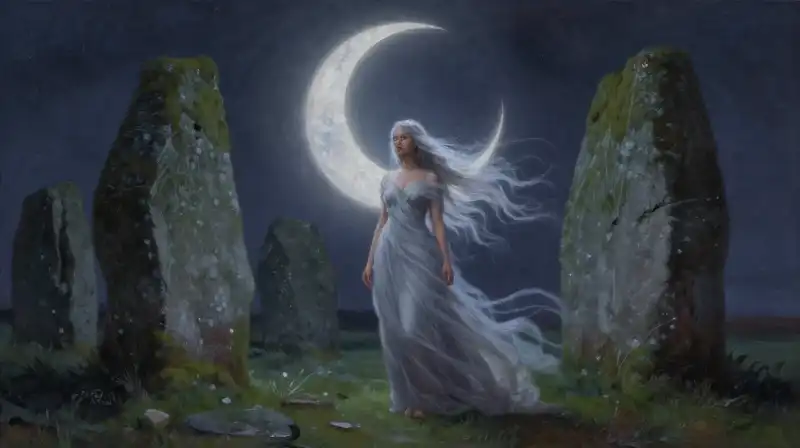
The search for a singular, definitive “Irish Moon Goddess” is a journey often rooted in the desire to find a clear, monolithic figure in traditional folklore. However, exploring the landscape of Celtic spirituality reveals a much more intricate and decentralized view of the divine. According to scholarly analysis, the concept of one specific, unified lunar deity in Irish traditions is a false premise 1. Instead of focusing on a single entity, the tradition speaks to lunar wisdom as a multifaceted force, woven into the various aspects of ancient goddesses and through the actions of both male and female figures. Understanding the Irish relationship with the moon requires moving past the search for a name and embracing the regional specificity and symbolic complexity that defines these ancient belief systems.
The Nuance of the “Celtic” Label
The difficulty in pinning down an Irish lunar figure is not merely a matter of folklore obscurity; it involves the fundamental problematization of the term “Celtic” itself. Tradition within Irish heritage places heavy emphasis on regional specificity, arguing that generalizing the term obscures the unique characteristics of local deities and narratives 1. Furthermore, Irish traditions do not define the moon as a gendered entity, which renders establishing direct, immutable connections between lunar cycles and any specific goddess tenuous and often cryptic 1. The lunar influence, therefore, is less about a single, dedicated moon goddess, and more about the way natural rhythms and cyclical change are expressed across the entire pantheon.
In practice, this means that the lunar energy is absorbed and expressed through several different ancient figures, making the tradition profoundly complex and layered. Rather than looking for a definitive lunar deity, practitioners and scholars look for the “lunar wisdom” embedded within the broader mythological cycles of these powerful figures.
Lunar Influence in Myth and Practice
When examining specific figures often brought into this discourse, the associations are diverse and highly contextual. For instance, the Dagda, a prominent male deity, is cited as being heavily associated with the moon. This link is rooted in a foundational myth involving the acquisition of his staff, a feat that required his mastery over the movement of both the Sun and the Moon 1. This demonstrates that celestial powers are not solely the domain of feminine deities, but are interwoven across the entire cosmic order.
Similarly, the figure of Aine presents a complex case. While some contemporary theories suggest she may hold connections to the lunar cycles, other accounts specifically identify her as a powerful solar deity 1. This ambiguity is emblematic of the broader cultural understanding: ancient goddesses possess many different faces and aspects. This allows for a much broader interpretation of their relationships with natural cycles, including the shifting phases of the moon, rather than forcing a singular definition 1.
Contextualizing the Lunar Search
For those seeking to understand the modern interpretations, it is important to distinguish between scholarly research and lived practice. Some sources assert that no single deity in Irish Paganism is explicitly associated with the moon 1. However, this does not diminish the power of the practice itself. The religious understanding of these subtle connections is highly subjective. Practitioners are encouraged to honor whichever deity or aspect “feels right” to them while engaging in moonwork 1. This subjective approach underscores the living nature of the tradition, where personal experience and intuition guide one’s spiritual practice more than rigid dogma.
Differentiating Local Lore: Irish vs. Regional Traditions
To properly contextualize Irish belief, it is helpful to compare it with other regional traditions. In contrast, other Celtic or neighboring traditions, such as those found in Breton or Angle mythology, may feature figures like the goddess Mona, who is specifically associated with the moon 1. This comparison highlights how the Irish tradition differs by not having such a singular, clearly defined lunar counterpoint in the same way other traditions do. The emphasis remains on the broad, encompassing nature of natural cycles across multiple divine figures rather than a concentrated lunar focus.
Clarifying the Scope of Power
A common question among those studying these traditions is who the “Irish version of Gaia” might be—the figure representing the earth and life cycle. Given the decentralized nature of divine power in the Irish tradition, there isn’t one sole answer. Instead, the concept of a unified, elemental Gaia figure is distributed across goddesses and ancestral spirits who embody the fertility of the land, the abundance of the harvest, and the persistence of life itself. The moon, in this context, is a cyclical regulator, often influencing these earthly cycles rather than being the primary embodiment of them.
Ultimately, the quest for a single “Irish Moon Goddess” leads to a richer understanding of Celtic spirituality. It reveals a tradition that values complexity, regional nuance, and the interconnectedness of all natural forces—sun, moon, and earth—represented through a tapestry of powerful, multifaceted deities, rather than a single, simplified symbol.
References
Footnotes
Frequently Asked Questions
Who is the moon goddess in Irish mythology?
There is no singular, definitive Irish Moon Goddess because the concept of a unified lunar deity is considered a false premise in Irish traditions. Instead, lunar wisdom is seen as a multifaceted force woven into the various aspects of ancient figures and the broader mythological cycles.
Who is the Irish version of Gaia?
There is no single answer to who the Irish version of Gaia is, as the concept is distributed due to the decentralized nature of divine power. Instead, it is embodied by goddesses and ancestral spirits who represent the fertility of the land, the abundance of the harvest, and the persistence of life.
Related Articles