Anubis and Ra: The Relationship Between Life, Death, and Cosmic Order

Introduction
In the ancient landscape of Egyptian cosmology, life and death were not viewed as opposing forces, but as interconnected stages of a vast, cyclical journey. At the heart of this intricate system of order and transition stood the mighty solar creator, Ra, and the focused guide of souls, Anubis. While many modern perspectives separate these figures into domains of ‘life’ and ‘death,’ the tradition in Egyptian mythology viewed them as complementary pillars supporting a unified cosmic order. This article explores how the authority of the sun and the solemn duty of the jackal god collaborate to shape the understanding of heritage and the passage of the soul. Their relationship is not one of conflict, but one of operational harmony, where Ra’s infinite power validates the precise, critical work of Anubis.
Ra: The Sovereign of Eternal Cycles
Ra is fundamentally the solar creator god and the undisputed sovereign of the daytime cosmos 1. His role is the embodiment of cyclical renewal. Just as the sun rises every morning, bringing light and life to the world, Ra’s existence represents continuous creation and kingship. He is the force that underwrites the material world and the perpetual rebirth of existence 1. Crucially, Ra’s authority extends far beyond the bright world; as mythological narratives recount, Ra himself undertakes a nightly journey through the Duat, the underworld. It is this nightly transit that links his solar power to the realm of the dead, establishing the ultimate framework for judgment 1.
Anubis: The Guide Through Transition
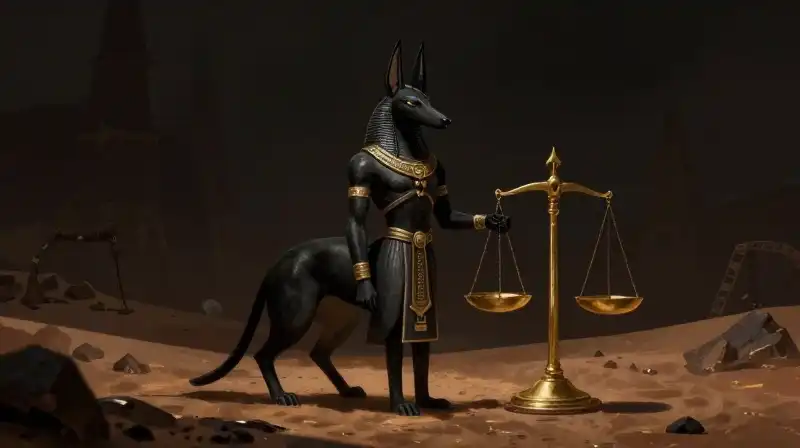
In contrast to Ra’s sprawling cosmic domain, Anubis operates with highly specialized focus. He is the quintessential psychopomp—the guide of souls—and the protector of graves (2, 3). His sacred duty centers on the crucial, delicate transition from earthly life to the eternal realm of the dead (2, 3). The cultural iconography of Anubis is profoundly grounded in ancient Egyptian practice. His association with the jackal form was not arbitrary; jackals were scavengers strongly linked to cemeteries. In early burial rites, choosing this form was a deliberate cultural act, intended to harness the wild natural power of the jackals to safeguard the deceased 1. Furthermore, Anubis was frequently depicted in the color black. This pigment carried multiple layers of meaning, symbolizing regeneration, the life-giving, fertile soil of the Nile, and the natural discoloration associated with the meticulous process of embalming 1.
The Weight of Judgment: How Ra and Anubis Interact
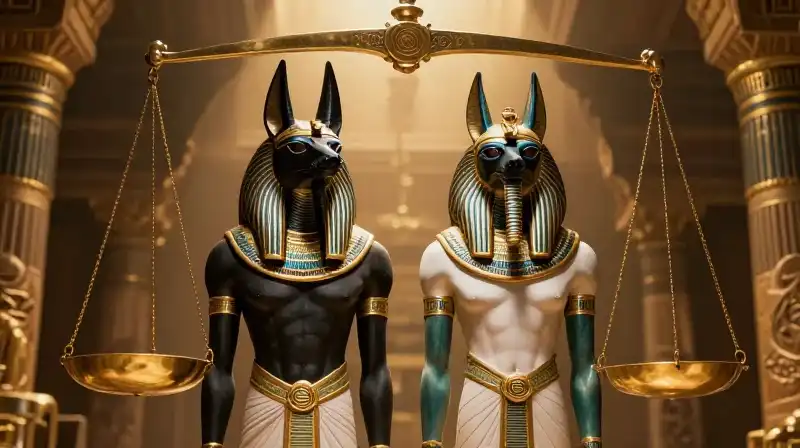
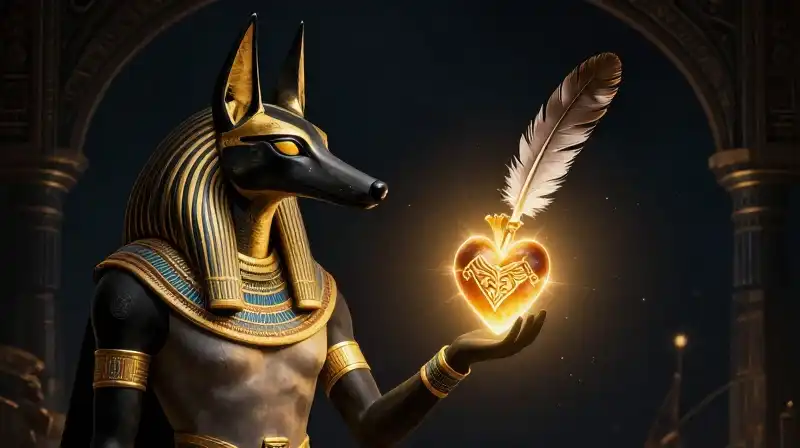
The most critical point of interaction between these two deities occurs during the judgment of the deceased. Anubis is the figure who oversees the meticulous preparation and execution of the “Weighing of the Heart” ceremony (2, 3). In this sacred event, Anubis acts as the impartial overseer, guiding the soul through the judgment to determine if that soul is worthy of joining the afterlife 1. The nature of this judgment, however, is not a subjective whim; it is sanctioned by the highest cosmic power. Ra’s cosmic authority underwrites the entire process, validating the cosmic order and thus legitimizing the deceased’s passage or rejection 1. Anubis, by performing his funerary rites and protecting the soul, allows the deceased to participate in the solar-regeneration cycle represented by Ra (2, 3). Thus, Anubis’s work as an embalmer and protector is the necessary, grounded action that enables Ra’s ultimate principle of cyclical life to be maintained. Their relationship is therefore a partnership: Ra provides the ultimate, unchanging order, and Anubis executes that order at the moment of deepest transition.
Cultural Adaptation and Specialized Role
While Anubis was a central and revered figure in scenes of judgment, scholars note that few major narratives are solely dedicated to him. This reflects his highly specialized and critical role within the broader, vast Egyptian pantheon 1. His function was essential, but it was one that supported the overarching narratives of creation and cosmic cycle led by figures like Ra. Over time, this tradition demonstrates the capacity for cultural syncretism. For instance, during the Ptolemaic era, Anubis merged with the Greek god Hermes to form Hermanubis, an adaptation that accommodated the Hellenistic populations and allowed the core traditions to persist across changing cultural landscapes (3, 2).
Navigating the Nuance: Answering the Cultural Questions
When interpreting this tradition, it is easy to oversimplify the roles of Ra and Anubis, but the reality is far more nuanced. The notion of Ra’s “greatest enemy,” for example, typically points to chaos and forces that seek to halt the cosmic renewal, not a specific rival deity designed solely for confrontation. Similarly, the question of whether Ra *created* Anubis depends heavily on the specific source and regional tradition being examined; mythology shows that Anubis’s parentage varies widely, being identified variously as the son of Ra, Osiris, Isis, or Nephthys (2, 3). This fluidity underscores the dynamic and evolving nature of the tradition, where beliefs were continuously adapted rather than rigidly fixed.
A Synthesis of Meaning
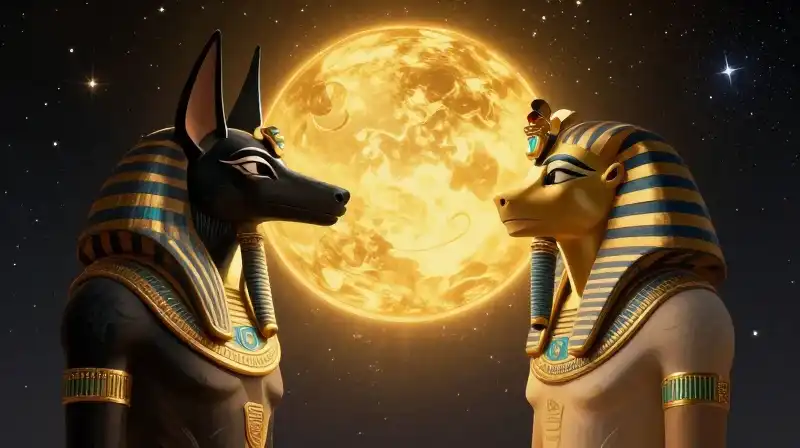
The relationship between Anubis and Ra teaches a profound lesson about heritage and the continuum of existence. They represent the balance between the infinite (Ra’s timeless, cyclical power) and the specific, critical moment (Anubis’s guardianship of the transition). For the people who hold this tradition, it serves as a powerful reminder that death is not a final ending, but a highly regulated and sacred component of eternal renewal. Anubis is the necessary conduit that allows the individual soul to rejoin the cosmic narrative woven by the sun. Understanding this relationship allows the modern reader to appreciate Egyptian tradition not as a static set of myths, but as a sophisticated framework for understanding life’s most profound transitions.
References
Footnotes
Frequently Asked Questions
Who is Ra's greatest enemy?
Ras greatest enemy typically points to chaos and the forces that seek to halt the cosmic renewal, rather than a specific rival deity designed for confrontation.
Did Ra create Anubis?
The article states that the question of whether Ra created Anubis depends on the specific source and regional tradition, as Anubiss parentage varies widely in mythology. Anubis is identified as the son of Ra, Osiris, Isis, or Nephthys.
How to under the Judgment of the Deceased
Initiate the Weighing of the Heart
Anubis oversees the meticulous preparation and execution of the "Weighing of the Heart" ceremony.
Navigate the Judgment
Anubis acts as the impartial overseer, guiding the soul through the judgment to determine its worth.
Achieve Cosmic Approval
Ra's cosmic authority underwrites the entire process, validating the deceased's passage or rejection and allowing the soul to participate in the solar-regeneration cycle.
Related Articles