Anubis and Horus: Roles, Myths, and Family in the Afterlife

Introduction
The ancient Egyptian worldview was not a mere collection of stories about the dead; it was a highly functional cultural framework designed to manage the transition from earthly life to eternal existence. Central to this complex system were powerful figures like Anubis and Horus. While both are deeply woven into the fabric of the afterlife, they represent different, necessary stages of this transition—Anubis as the meticulous guide and judge of the moment, and Horus as the ultimate embodiment of renewed cosmic order and rightful sovereignty. To understand these gods is to understand the profound reverence the Egyptians held for the delicate balance between death and rebirth.
The Gatekeeper: Anubis and the Ritual of Transition
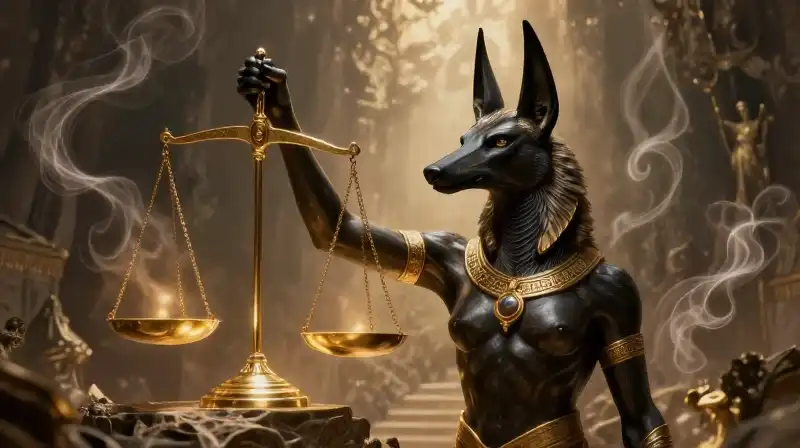
Anubis, often depicted with a regal canine head, was the ultimate orchestrator of the sacred transition. His role was far more than simply presiding over cemeteries; he was the primary guide and protector in the crucial journey from the physical realm into the underworld 1. Culturally, Anubis was inextricable from the rites of mummification. He acted as the god who prescribed the exact ritual handling of the deceased, ensuring the spiritual integrity of the body during the embalming process 1. This responsibility culminated in his pivotal role in the “Weighing of the Heart.” In this profound judgment, Anubis oversaw the delicate balance: determining if a soul’s earthly deeds warranted passage into the eternal realm 1. His name itself holds a layer of cultural specificity, with roots suggesting “a royal child” or “He Who is in the Place of Embalming,” reflecting the highly specific, sacred duties assigned to him within the Egyptian pantheon 1. It is important to note that the use of jackal imagery for Anubis was not merely aesthetic; it was rooted in the practical reality of the era, as wild jackals were scavengers often found near cemeteries and prone to disturbing burials 1.
The Divine Lineage: Anubis, Horus, and the Family Tree
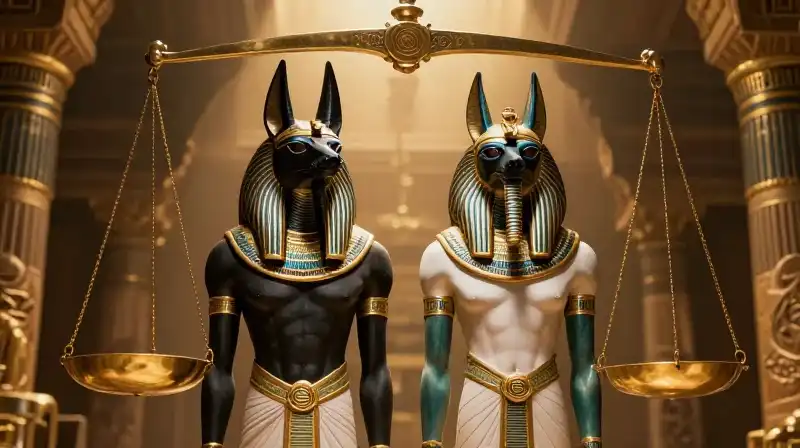
The relationship between Anubis and Horus is one of the most complex in the Egyptian pantheon, defying simple categorization. While their roles in the afterlife are intertwined, the specific nature of their family ties is the subject of significant scholarly disagreement (1, 2). Some traditions present Anubis as the son of Ra, Osiris, and Isis, while others reference him as being born from a cow goddess named Hesat (1, 2). Despite these varying mythological lineages, Anubis cemented his status as the protector of the dead by attending the embalming of Osiris following his death, an act that solidified his connection to the divine process of rebirth 1. Within certain funerary traditions, Anubis is grouped with other figures, such as Duamutef, who belongs to the quartet of the Four Sons of Horus 1. While the idea that Anubis and Horus are direct brothers has been explored 1, their relationship is often best understood through the broader context of the Osirian pantheon, where they both represent vital components of the cyclical nature of life, death, and subsequent restoration.
Navigating the Hierarchy: Understanding Authority in the Afterlife
A common question regarding Anubis is to determine who holds a higher status in the divine hierarchy. Within the context of Egyptian belief, Anubis is not the absolute highest authority; rather, he is the critical process-manager. The judgment he oversees—the Weighing of the Heart—is performed *on behalf of* the divine authority of Osiris. Osiris, as the ruler of the dead and the ultimate arbiter of the afterlife, is the entity that ultimately dictates whether a soul is worthy or not 1. Anubis serves the judicial process, acting as the highly specialized guide and ritual expert. He performs the preparation and presentation of the soul for the final verdict, making him indispensable, but Osiris remains the transcendent sovereign who receives the outcome.
Cultural Endurance: Syncretism and the Living Tradition
The influence of Anubis did not remain confined to ancient Egyptian temples. As cultural boundaries shifted, the tradition proved remarkably adaptable. During the Hellenistic Ptolemaic Period, the syncretic merging of religious practices became common. Anubis began to blend with the Greek deity Hermes, evolving into the figure known as Hermanubis 1. Furthermore, during the Ptolemaic era, some cultural descriptions merged Anubis with Serapis—a powerful figure created to bridge the Egyptian religious experience with the burgeoning Greek population 1. These syncretic forms demonstrate the tradition’s ability to adapt and survive. Even when later Roman or Greek contexts sometimes viewed Egyptian animal-headed gods as primitive, Anubis retained cultural significance; he was even referenced by Plato as a powerful arbiter of truth in the underworld 1.
Synthesis: The Meaning of the Jackal God
Ultimately, the reverence for Anubis lies in his profound connection to the cyclical nature of existence. He grounds the abstract concept of the soul in tangible ritual, from the preservation of the body to the weighing of its moral balance. Whether one considers the philosophical complexities of his parentage or his practical association with funerary rites, Anubis functions as the necessary link between the mundane reality of death and the eternal promises of the afterlife. He is the guardian who ensures the spiritual path is traversed correctly, allowing for the eventual rebirth represented by figures like Horus, who embody the established order returning after the chaos of death. This duality—the careful, meticulous process of Anubis leading to the ultimate victory of life represented by Horus—defines the enduring cultural value of these powerful figures.
References
Footnotes
Frequently Asked Questions
Who is higher than Anubis?
Osiris holds a higher status than Anubis as the ruler of the dead and the ultimate arbiter of the afterlife. While Anubis manages the judicial process, Osiris is the transcendent sovereign who ultimately dictates a souls worth.
Related Articles