Anubis: The Egyptian God Who Guided Souls Through the Afterlife

Introduction
In the vast tapestry of ancient Egyptian belief, few figures embody the complex relationship between life, death, and the pursuit of truth as fundamentally as Anubis. He is not merely a deity associated with the dead; he is the architect of the transition, the meticulous guide who oversees the passage of the soul into the eternal realm. The tradition of Anubis centers on one of the most vital cultural practices in Ancient Egypt: ensuring that the deceased successfully navigated the journey to the afterlife. This practice reflected a profound Egyptian reverence for transformation, viewing death not as a cessation, but as a critical metamorphosis, overseen by a specific set of divine guardians. To understand Anubis is to understand the core cultural anxiety and hope of a civilization dedicated to order and permanence.
The Cultural Roots: From Necessity to Divinity
The origins of Anubis’s powerful association with the jackal are deeply practical, rooted in the observable ecology of the ancient Nile valley. Initially, the reverence may have stemmed from the harsh realities of the burial process. In the Predynastic period, jackals were naturally found in cemeteries where they would consume human remains 1. More specifically, the Egyptians developed a protective measure against “wild dogs” which often disturbed burials after they were covered. This “common problem” prompted the cultural development of Anubis as a symbolic protector of the dead, a manifestation of the cultural principle of “fighting like with like” 1. This initial, functional link between the jackal’s role as scavenger and its protective qualities as a guardian of the grave eventually elevated the jackal form into a sacred emblem, transitioning from a simple observation to a sophisticated theological framework.
The Mechanics of the Afterlife: Mummification and Judgment
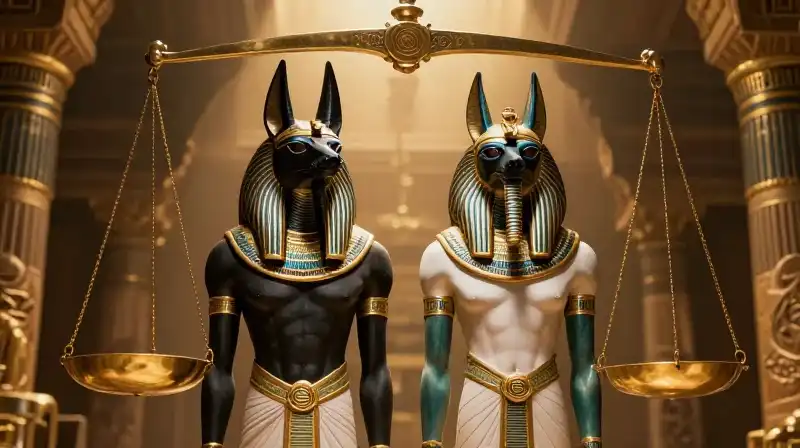
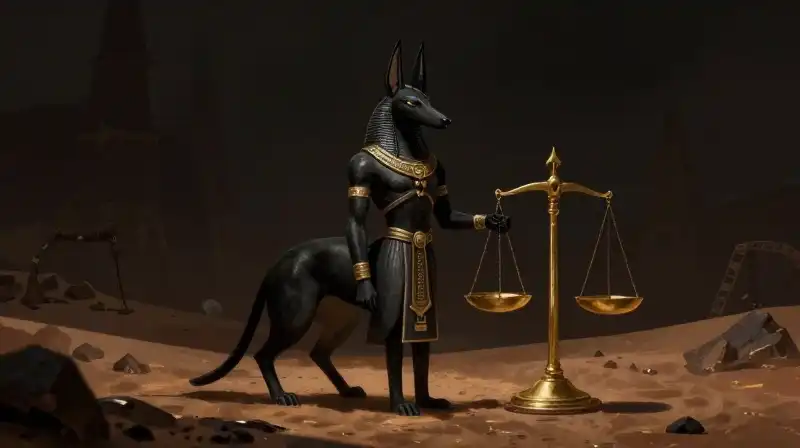
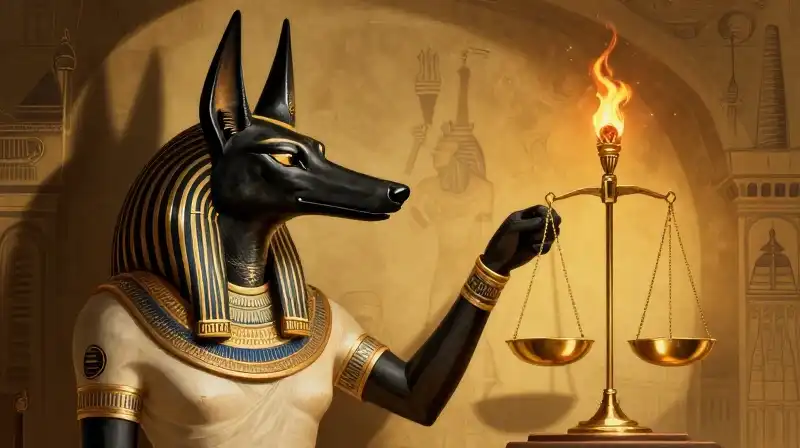
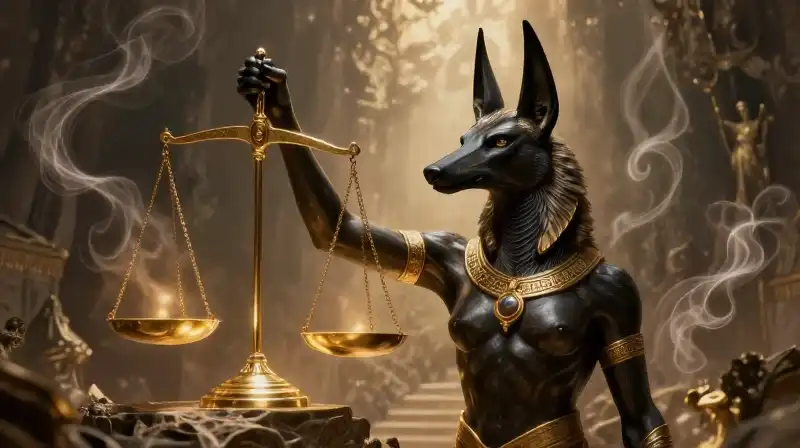
Anubis’s role in the Egyptian cosmogony was bifurcated between his practical responsibilities and his cosmic duties. On a hands-on level, he was known as “He who is in the place of embalming” and served as the patron of those who performed the rites. His presence was essential during the complex mummification process, a culturally specific act that prepared the physical body for eternal life 1. Beyond the physical preparation, Anubis presided over the metaphysical judgment of the soul. This culminated in the “Weighing of the Heart” ceremony. This critical cultural rite was the moment when a soul’s heart was weighed against the feather of truth. Anubis acted as the guide to this divine chamber, directing the deceased toward a verdict on whether they had lived a life worthy of eternal existence in the underworld 1. His involvement ensured that the journey to the afterlife was not merely passive, but one subject to divine arbitration and divine guidance.
The Language of Form: The Symbolism of Black and the Jackal Head
The physical depiction of Anubis—a figure with a jackal’s head—is more than decorative; it is intensely symbolic. The canine head represented an enduring cultural strength in the context of protection and the wild, untamed aspects of the desert. However, the color Anubis was often portrayed in held profound cultural meaning. His characteristic black coloration was not just a stylistic choice but a symbol of life, regeneration, and the deep, rich soil of the Nile River 1. Furthermore, the black hue directly reflected the discoloration that occurred naturally on a body after the intricate process of embalming. This color tied the deity directly to the process of transformation and the mysteries of the transition from the physical realm to the spiritual one.
A Tradition in Flux: Shifting Roles and Global Adaptation
The story of Anubis is one of powerful tradition meeting inevitable evolution. His status was not static; historians observe distinct shifts in his cultural weight. During the Old Kingdom, Anubis reigned as the preeminent god of the dead, holding a crucial role. However, his importance began to recede as the cultural landscape changed, with his role eventually being integrated and superseded by the powerful Osirian pantheon during the Middle Kingdom 1. This tradition also demonstrates its remarkable ability to adapt when encountering global cultures. As Egyptian civilization interacted with the Hellenistic Greeks and Romans, Anubis was blended into the surrounding pantheons. He merged with the figure of Hermes, becoming known as “Hermanubis,” an act that allowed this powerful local deity to be integrated into wider, more expansive traditions 1. Despite initial skepticism from Greek practitioners toward Egyptian animal-headed gods, Anubis maintained his conceptual weight, notably being referenced later by the philosopher Plato as an arbiter of truth within the underworld 1.
Beyond the Canine: Variations and Nomenclature
While the jackal form is most closely tied to Anubis, the concept of canine guardians was part of a broader lineage of divine protectors. Scholars recognize other “Death Dogs” like Wepwawet (portrayed with a dog’s head) and Duamutef, who collectively functioned as companions in the perilous journey to the next world 1. The relationship between these deities suggests that Anubis was part of a larger cultural mechanism for safeguarding the deceased. Regarding his name, while some aspects are debated by scholars, it is confirmed that “Anubis” was derived from a royal title meaning “a royal child,” further cementing his integration into the Egyptian ruling structure 1.
The Lasting Significance of the Jackal-Headed God
Anubis remains a vital example of how human anxieties and necessities can crystallize into profound spiritual tradition. By observing the natural world, the Egyptians created a god who did not merely exist apart from death, but was intrinsically linked to its meticulous process. He embodied the principle that transformation is ordered, judged, and protected. Anubis tells the story of Egyptian culture: a people who honored life so deeply that they constructed an entire divine infrastructure dedicated to perfecting the transition beyond its end, ensuring that even in death, cosmic order and truth would prevail.
References
Footnotes
Frequently Asked Questions
Which Egyptian god represented with the head of a jackal?
The Egyptian god Anubis is depicted as a figure with a jackal’s head. While other canine guardians like Wepwawet and Duamutef were also known, the jackal form is most closely tied to Anubis.
The Ancient Egyptian Journey to the Afterlife
Physical Preparation (Mummification)
Under the supervision and patronage of Anubis ("He who is in the place of embalming"), the deceased undergoes a complex mummification process to prepare the physical body for eternal life.
Guidance to the Divine Chamber
Anubis, acting as a meticulous guide, leads the soul through the cosmic journey to the chamber where the final judgment will take place.
The Weighing of the Heart Ceremony
The soul's heart is presented and weighed against the feather of truth, a critical test of the deceased's moral worth and actions during life.
Receiving the Final Verdict
Anubis ensures the divine arbitration determines whether the soul lived a life worthy of eternal existence in the underworld.
Related Articles