Understanding Helios: The Greek Sun God and His Relation to Apollo

Introduction
The sun has always been the undisputed heartbeat of ancient Greek culture. For a people deeply connected to the agricultural cycle, maritime travel, and the relentless movement of the heavens, the sun was not merely a celestial body—it was a powerful, personified entity. At the center of this tradition stands Helios, the magnificent god who embodies the literal fire of the day. While modern understanding often seeks a single, uniform deity for the sun, the complex tapestry of Greek mythology reveals a rich and evolving tradition. Understanding Helios is not just about identifying a god, but about recognizing a core cultural narrative concerning order, cosmic law, and the relentless passage of time that defined early Greek life.
The Daily Odyssey: Helios as the Eye of Heaven
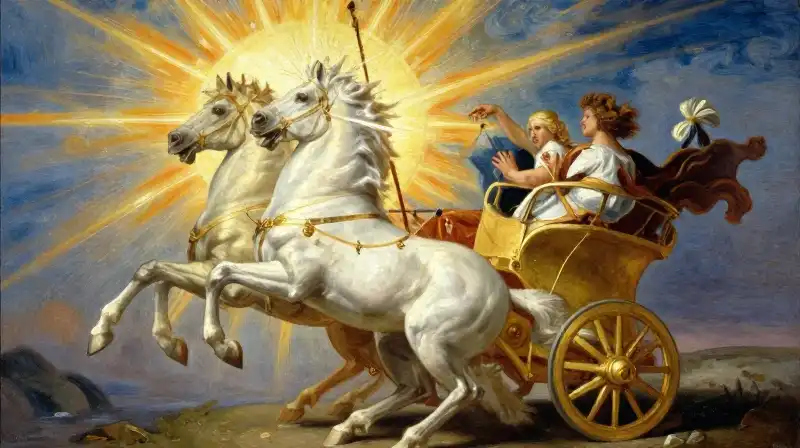
The most foundational elements of the Helios tradition center on his powerful and constant movement across the sky. Traditionally depicted as a handsome, beardless youth, Helios was the divine charioteer who drove his wagon pulled by four winged horses across the heavens each day (1, 2). His journey is a constant, predictable arc—from the eastern horizon, across the vibrant blue, and descending into the west. This daily ritual of rising and setting was intrinsically tied to the Greek worldview. Furthermore, as the god’s journey concluded, he was understood to be returning through the watery realm under the domain of Oceanus via a golden boat 1. This cyclical transit made Helios an all-seeing witness to the entire world. Because of this omnipresent role, Helios became known as the “Eye of Heaven” (1, 2). This immense observational power gave him significant cultural authority; he was frequently invoked in sacred oaths and ancient spells. His divine presence was a guarantee of witnessing events both on earth and in the celestial spheres, making him an indispensable figure in the moral framework of the culture.
Narratives of Cosmic Order and Divine Disruption
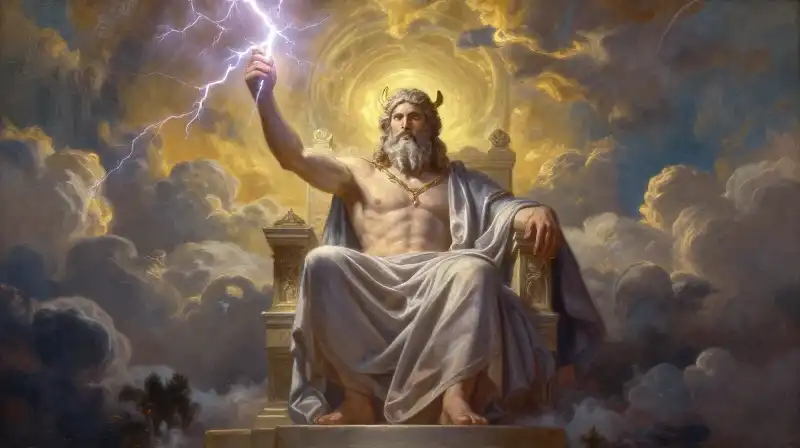
While Helios symbolized divine order, his myth cycles also explore the inherent volatility of the cosmos. One of the most dramatic narratives involving the Sun God is the story of his son, Phaethon. Phaethon, in his arrogance and youth, attempted to pilot the sun chariot himself. His reckless failure caused immense cosmic chaos, threatening to burn the world and the natural order. This hubris led to his tragic death at the hands of Zeus’s thunderbolt (1, 2). The emotional aftermath of this disaster also left a profound mark on the tradition. According to mythology, the sorrow of Phaethon’s sisters, the Heliades, upon witnessing his demise was so profound that their tears crystallized into amber. Their lament was so great that they were transformed into trees, specifically poplars 1. This single myth encapsulates the dual nature of the tradition: the power of the solar order, and the tragic, chaotic consequences of defying that divine mandate.
Regional Cult of the Sun and Divine Authority
The worship of Helios was significant across the ancient world, but it manifested with regional intensity in specific locales. One of the most prominent areas of his worship was the island of Rhodes, which held a colossal statue of him, indicating the deep reverence and monumental scale of his local significance 1. Culturally, Helios represented more than just physical heat; he represented a specific lineage of power. His divine ancestry linked him to the ancient Titans Hyperion and Theia, positioning him within the older generations of the gods, despite his intense prominence in the cultural narrative (1, 2). His power was occasionally tested and displayed through his interactions with other figures. In *The Odyssey*, Helios’s divine temper was demonstrated when he, upon having his sacred cattle consumed, called for Zeus to strike the ship carrying Odysseus with a thunderbolt, showcasing his position as a formidable, often volatile, deity (1, 2).
The Evolution of Light: Understanding Helios and Apollo
A primary point of cultural confusion for observers is why there appear to be two significant sun gods: Helios and Apollo. This distinction is central to understanding the evolution of Greek cultural thought regarding the solar domain. Both gods were deeply related to light and the sun, but they represented different aspects of it. Helios functioned as the primary personification of the *physical* sun—the blazing, undeniable body traversing the sky (3, 2). Conversely, Apollo, particularly starting in the Hellenistic period, was increasingly associated with the *spiritual* manifestation of the solar domain (3, 2). Where Helios embodied the brute, physical power of the light source, Apollo often represented the light itself, the clarity, and the intellectual or creative energy derived from that sun. This differentiation allowed the tradition to expand its scope; Helios managed the cosmic journey, while Apollo handled the intellectual, prophetic, and creative aspects of the “light of truth.”
Synthesis: The Enduring Significance of the Tradition
The story of Helios transcends simple mythology; it serves as a profound cultural mechanism for structuring reality. Whether viewed through his role as the relentless charioteer charting the day, the ultimate “Eye of Heaven” witnessing our deeds, or the figure whose tragedy defines cosmic consequence, Helios embodies the fundamental Greek concept of *Aletheia*—the light of truth and observable reality. The tradition of Helios reminds the culture that order, though powerful, is fragile and subject to the immense forces of divine power and human error. By tracing this lineage from the mighty charioteer Helios to the nuanced light of Apollo, we see how a culture adapts its foundational myths to reflect evolving philosophical and religious ideas, maintaining the sun’s centrality while expanding the meanings attached to its glorious, fiery presence.
References
Footnotes
Frequently Asked Questions
Why are there two Greek gods of the sun?
Helios functioned as the primary personification of the physical sun, embodying the blazing body that traversed the sky. In contrast, Apollo was increasingly associated with the spiritual manifestation of the solar domain, representing the light itself, clarity, and intellectual or creative energy.
Related Articles