Achilles: Exploring the Myth of the Greatest Greek Warrior

Introduction
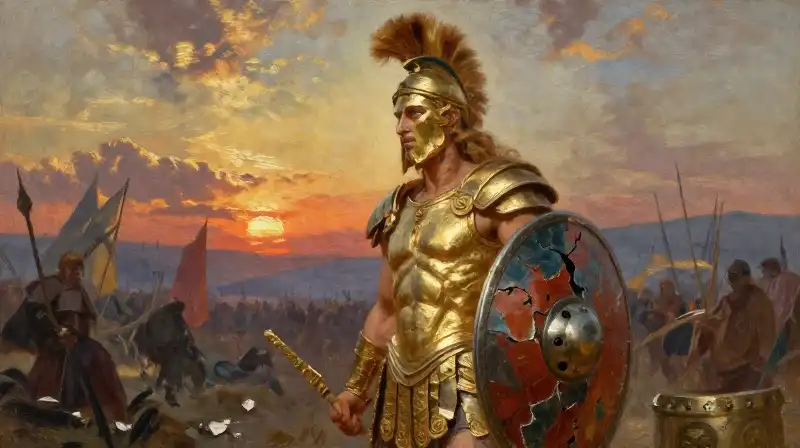
In the vast tapestry of ancient storytelling, few figures possess the singular impact of Achilles. He is the quintessential Greek hero, the center of Homer’s *Iliad*, and for centuries, his narrative has served as the ultimate examination of honor, mortality, and the burden of destiny. Achilles is not merely a powerful warrior; he is a cultural archetype who embodies the tension between human frailty and divine potential. His life, as recorded in epic traditions, is a study in the pursuit of *kléos*—immortal glory—often at the cost of his own peace. To understand Achilles is to explore the deep roots of Western conceptions of tragedy, suffering, and the enduring nature of legend itself.
The Weight of Lineage and Fate
The story of Achilles begins with a prophecy that set his path before it began. Born from the union of Peleus, king of Phthia, and the Nereid Thetis, his existence was not random; it was dictated by fate (1, 2). The prophecy stated that Thetis would bear a son who would surpass his father in martial prowess, a promise that framed his very identity from the moment of conception. This dual lineage—mortal king and ethereal sea nymph—already positioned him at the intersection of two worlds. His name, while often understood through its epic usage, has scholarly interpretations that add a layer of cultural depth. Some analysts suggest the name combines the Old Greek words *akhos* (signifying distress, pain, or sorrow) and *laós* (referring to the people or soldiers). This linguistic interpretation implies a profound thematic connection between his existence and the suffering inherent in war and the collective fate of the warriors 1.
The Immortality of the Mortal Wound
The legend of the River Styx provides the definitive marker of Achilles’ status, separating him from lesser warriors. According to the foundational accounts, his mother, Thetis, dipped him into the sacred waters of the Styx as an infant. This ritual granted him near-invulnerability, allowing him to be immune to the sharpest blades and most powerful weapons. However, this divine protection came with a poignant, singular vulnerability. The Styx failed to touch his heel, leaving it exposed (1, 2). This myth is the cultural progenitor of the term “Achilles’ heel.” In its most basic form, it denotes a point of catastrophic weakness. But in the context of Greek tradition, it represents a fundamental human truth: even the god-like hero is bound by mortal limits. The myth elevates the single point of vulnerability from a simple weakness to a profound philosophical statement about the necessary condition of human existence within a heroic, divinely sanctioned framework (1, 2).
Complex Traditions: From Training to Transformation
The narrative surrounding Achilles is rich with regional and scholarly variation, proving that a myth is a living body of stories rather than a static definition. While the *Iliad* focuses on his unparalleled martial skill and his pivotal role in the slaying of the Trojan prince Hector—a high-stakes moment of military drama (1, 2)—other traditions expand on his early life. Some accounts place his education under the tutelage of Chiron, the wise and compassionate centaur who resided on Mount Pelion, highlighting the blending of raw heroic power with profound wisdom (1, 2). Furthermore, in some narrative variations, such as those mentioned by Statius in his incomplete epic *Achilleid*, his birth was marked by extreme rites, including the belief that he was burned to remove the parts of him that would anchor him to mortality (1, 2). These different traditions, whether the hiding of a disguised infant among the daughters of Lycomedes or his years with Chiron, do more than vary the plot; they enrich the cultural understanding of the hero’s origins as being as complex and multifaceted as the society that tells the stories.
The Paradox of Glory and Grief
Achilles exists in a powerful, inherent contradiction. In the heroic culture of the ancient Greeks, the ultimate goal of a great man was to achieve *kléos*, or enduring glory, which was the only true path to immortality. Yet, his very name suggests a connection to sorrow or distress (*akhos*) 1. This paradox is central to the enduring appeal of the Achilles myth. He represents the tragedy of the warrior: the person who strives for the highest peak of glory must, by the rules of the tradition, often endure or inflict the greatest sorrow. The story of Achilles is not simply about the greatest warrior, but about the inevitable confluence of extreme human capability and inescapable human suffering. The tradition forces the audience to wrestle with the idea that ultimate greatness often entails profound loss.
The Legacy of the Archetype
Understanding Achilles means acknowledging the tradition he has preserved and molded across millennia. Whether the reader is searching for the original Greek mythology story or examining the modern concept of the “Achilles’ heel,” the figure remains a symbol of the tension between our best capabilities and our fundamental limits. In contemporary culture, the archetype reminds us that even in moments of apparent invulnerability—be it personal, structural, or technological—there exists a crucial, singular point of vulnerability. Achilles stands as a reminder that the human story is defined not just by the grand achievements of glory, but by the fragile moments where human destiny collides with the boundaries of fate.
References
Footnotes
Related Articles