Anubis: The Egyptian God of the Dead and the Underworlds Guide

Introduction
In the rich tapestry of ancient Egyptian spirituality, Anubis serves as a profoundly significant figure—not merely as a deity, but as a vital ritual intermediary between the living world and the eternal expanse of the afterlife. He is primarily understood as the god of funerary rites and the vigilant protector of graves, acting as a guide through the treacherous underworld (Source 1, Source 3). Far from being a simple ‘dog god,’ Anubis embodies the complex responsibilities of transition, ensuring that the deceased are properly prepared for their journey into eternity. His presence at the threshold of the tomb and the judgment hall of the gods speaks to his role as the ultimate arbiter of the transition from mortal life to the next.
The Architect of Passage: The Weighing of the Heart
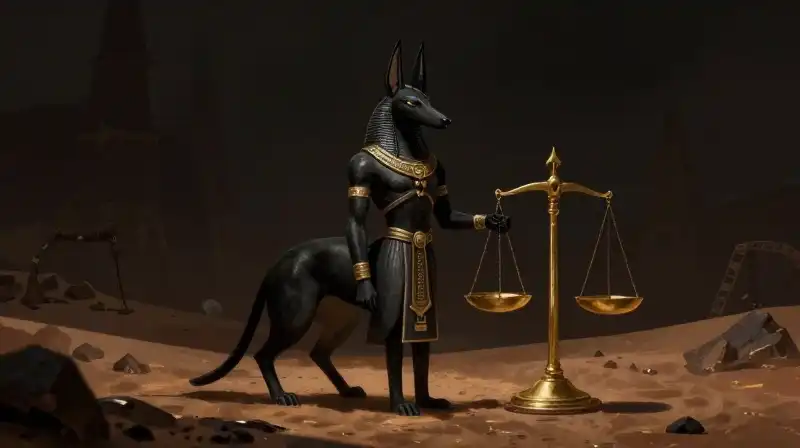
Anubis’s central and most enduring function revolved around overseeing the ultimate judgment: the “Weighing of the Heart” (Source 1, Source 3). This pivotal ceremony was the moment the soul of the departed was measured to determine its worthiness to enter the afterlife. According to the tradition, his sacred duties involved placing the heart of the deceased upon one scale and juxtaposing it against the feather of Maat—the symbolic representation of truth, justice, and cosmic order (Source 1, Source 3). This duty cemented his position as the impartial Lord of the Dead, a figure who maintained the integrity of the divine legal system. While he was often referred to in less formal terms as the “Egyptian dog god” (Source 3), his power was institutional, rooted in his management of the rites that followed death. This responsibility meant that even in his most fearsome depictions, Anubis functioned as a facilitator of truth, rather than a god of death itself; he was the guide ensuring the proper protocol of the spiritual transition was followed (Source 1, Source 3).
Symbolism and the Enigma of Form
The iconographic depictions of Anubis are immediately striking, often portraying a sleek black canine or a man bearing a head of a dog or jackal (Source 1, Source 3). However, the meaning behind this appearance is heavily layered with cultural symbolism, rather than mere physical reality. The consistent use of the color black in his imagery carried profound spiritual significance (Source 1, Source 3). It did not represent the physical fur of a creature but rather embodied concepts of regeneration and perpetual life, mirroring the dark, fertile soil of the Nile River and the natural process of transformation that occurs within a preserved body (Source 1, Source 3). Furthermore, there remains significant scholarly debate surrounding the exact species Anubis represented. While the traditional understanding often points toward a dog, Egyptologists have proposed several candidates, suggesting he might have been based on the wild jackal, an African golden wolf, or a sturdy desert hound (Source 2, Source 3). This ambiguity indicates that his form was less a biological portrait and more a fluid representation of the boundary between life and the wilderness—the untamed forces he had to command in the funerary process (Source 2, Source 3).
From Funerary Ritual to Cosmic Deity: The Evolution of Anubis
Anubis’s influence and titles expanded dramatically over the millennia, reflecting the changing religious landscape of ancient Egypt. Initially, his primary function was localized to the rites surrounding death and burial, earning him the epithets such as “The Dog who Swallows Millions” (Source 1, Source 3). His role as “Lord of the embalmers” was vital; he was intimately involved in the mummification process, famously assisting in the reassembly of Osiris’s remains after they had been desecrated by the god Set (Source 1, Source 3). As the civilization matured, his specific duties often intersected with others. Over time, as the cult of the dead grew more formalized, his functions began to merge with those of other important deities. Specifically, during the Middle Kingdom, his authoritative role as the Lord of the Underworld was gradually adopted and integrated into the broader authority of Osiris (Source 1). Later, during the Ptolemaic period, his influence spread through syncretism, blending his ancient identity with Hellenic gods—most notably becoming merged with the Greek god Hermes to form Hermanubis (Source 1).
Beyond Ancient Egypt: The Modern Echoes of Anubis
Today, Anubis continues to exert a powerful hold on cultural imagination, persisting in modern art, iconography, and popular media. Modern depictions frequently feature the powerful silhouette of a watchful, sleek black canine, an artistic nod directly back to the ancient tomb walls and the foundational iconography (Source 2). Though his specific roles have adapted across eras and cultures, the core meaning of Anubis remains relevant: he represents the management of transition. His story is not merely one of death, but of the profound passage and necessary judgment that occurs when one journey into the unknown.
Understanding the Ritual Context
To truly grasp Anubis, one must view him through the lens of his function as a guide rather than a god of darkness. His existence speaks to the belief that life and death were a continuous, necessary cycle. The various traditions and interpretations regarding the specific species he represented, or the evolution of his role into figures like Hermes, remind us that religious traditions are living things—they shift, they incorporate new ideas, and they are subject to intense scholarly debate. Anubis thus stands as a symbol of the enduring Egyptian commitment to order (Maat) even in the most sacred moments of human vulnerability.
How to determine worthiness during the Weighing of the Heart
Prepare the Scales
Position the sacred scales central to the Judgment Ceremony.
Place the Heart
Place the heart of the deceased upon one side of the scale.
Juxtapose Against the Feather of Maat
Place the feather of Maat (symbolizing truth, justice, and cosmic order) upon the opposing scale.
Determine Worthiness
Observe the measurement of the scales to determine if the soul is worthy to enter the afterlife.
Related Articles