Horus: The Ancient Egyptian God of the Sun and Sky

Introduction
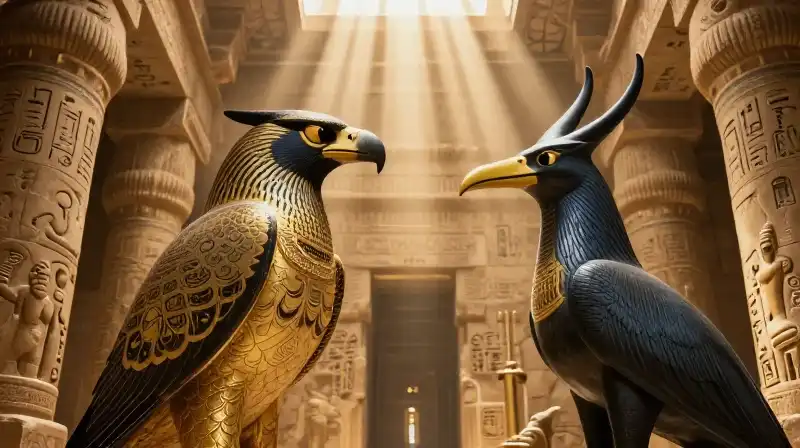
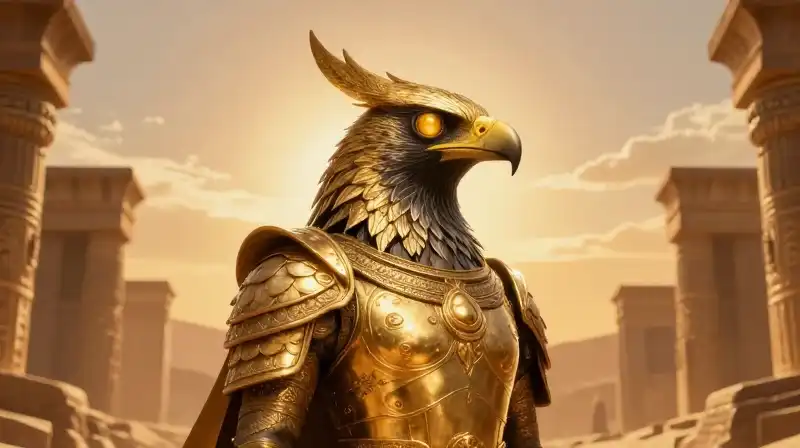
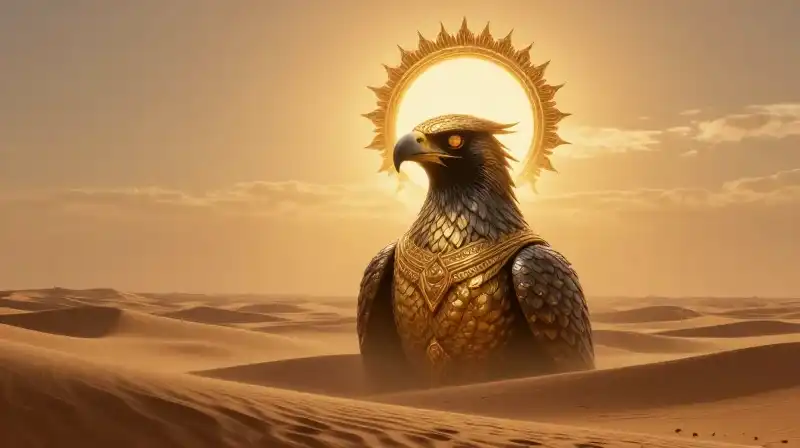
In the landscape of ancient Egyptian mythology, very few figures hold as much weight as Horus. He was not simply a god of conflict or a harbinger of the future; he was a profound cosmological concept personified. Horus functioned as the principal deity of the sky and the sun 1. To understand Horus is to understand the Egyptian relationship with celestial order—the movement of the sun, the vastness of the heavens, and the divine legitimacy of the pharaoh. His narrative is one that traces the journey of the sun across the horizon, making him the ultimate embodiment of cosmic power rendered in divine form.
The Dual Nature of the Sky God
The nature of Horus is inherently dual, reflecting the cyclical and balanced worldview of ancient Egyptian cosmology. As a deity that traversed the heavens in the form of a falcon, he was conceptually understood to contain both the brilliant Sun and the subtle Moon (1, 2, 3). This synthesis allowed the Egyptians to reconcile seemingly opposite forces—light and shadow, heat and healing—within a single, powerful celestial figure. This duality is most clearly seen in his symbolic representation. The Sun, representing the essence of power and life, was often equated with the Horus’s right eye. Conversely, the left eye served as the representation of the Moon or the power of healing (1, 3). This merging of the diurnal and nocturnal cycles into one entity underscored the Egyptian belief that life and order (Ma’at) required the harmonious balance of all cosmic forces.
Titles and Transitions: Horus in the Horizon
The cultural significance of Horus is further illuminated by the multitude of epithets assigned to him, each reflecting a specific moment in his celestial journey or a focused aspect of his power 1. The epithet Horakhti, for instance, was used specifically to personify the Sun exactly as it traversed the horizon 1. Other titles like Harakhte are closely tied to the mighty sun god Re, illustrating how the concept of solar power could be attributed to Horus depending on the specific cultural emphasis of the era 1. The phrase Harmakhis (“Horus in the Horizon”) neatly captures this focus on the transition and the cyclical journey inherent in his mythology 1. This transition between names reflects a dynamic and living tradition; Horus was not a static figure but a multifaceted manifestation of divine power, capable of being seen as the blazing sun, the protective night, or the active king.
The Wedjat: The Symbol of Protection and Kingship
Perhaps the most enduring artifact derived from the concept of Horus is the Eye of Horus, or the Wedjat. This powerful symbol emerged directly from the solar deity’s complex iconography (1, 3). More than just an image, the Wedjat represents the wholeness and ultimate protection granted by the gods. It became an indispensable symbol associated with royal authority and the potent protective power derived from the divine sky (1, 3). The adoption of the Wedjat as a symbol of royal power was integral to the political theology of Egypt. The reigning pharaoh was perceived as a direct manifestation of Horus. This understanding established a direct link between the earthly rule of the king and the vast, unassailable celestial power of the sky god 1. Thus, the symbol of protection was intrinsically linked to the guarantee of divine rule, making the Wedjat not merely an amulet, but a statement of theological and political legitimacy.
Celestial Reflection and Global Echoes
The narrative of Horus, particularly his powerful status and connection to the divine mandate of rule, illustrates the deep cultural currents of the ancient Near East. Cultural historians have noted the presence of *interpretatio romana*, a phenomenon wherein Egyptian beliefs and deities were often aligned with Greek gods in the Hellenistic period (1, 3). In this cultural exchange, the might and authority embodied by Horus were sometimes associated with the Greek god Apollo, demonstrating how similar archetypes of solar, protective power transcended regional boundaries and were adopted into broader Mediterranean cultural narratives (1, 3).
Understanding the Meaning of Horus
To grasp the full scope of the Horus tradition is to look beyond the falcon and the crown. It is a tradition rooted in cosmic balance. Horus provides the cultural framework for how ancient Egyptians understood the relationship between the predictable, cyclical movement of the heavens and the required order on Earth. His duality—the Sun and the Moon—is a continuous visual reminder that even in conflict, even in the cycles of death and rebirth, there is an inherent cosmic equilibrium that ensures survival and prosperity. For a modern reader, contemplating Horus offers a deep dive into the ancient Egyptian belief that life itself is a dynamic, balanced, and divinely protected journey, mirroring the solar path across the eternal sky. This tradition remains a testament to the power of synthesizing vast cosmic forces into a relatable, guiding narrative.
References
Footnotes
Related Articles