Ancient Egyptian Religion: The Gods, Cosmology, and Evolution of Faith

Introduction
To approach the ancient Egyptian religious landscape is not to encounter a singular, monolithic creed, but rather a vibrant, deeply layered ecosystem of beliefs. Far from a unified doctrine, the religious life of ancient Egypt was a “complicated hodgepodge of cult[s] and sect[s]” 1. It was a tradition built on a staggering capacity for syncretism and regional variation, reflecting the diverse needs and geographical identities of the people who lived along the Nile. For the modern reader, understanding this tradition means appreciating its dynamic nature—its gods were not static figures in a dusty mythology, but active, complex forces that responded to the shifting politics of the Pharaoh, the demands of the afterlife, and the specific cultural concerns of local communities.
A Tapestry of Regional Devotion
The strength of Egyptian faith lay in its adaptability. What was sacred in one city might hold a different meaning in another, allowing the tradition to flourish across diverse communities. The creation myths themselves exemplify this regional nuance. While major central figures connected the entire civilization, specific regions championed unique foundational stories. In Heliopolis, the cosmological narrative followed the Ennead, while in Memphis, the city focused its reverence on Ptah as the ultimate, singular creator 1. Elsewhere, the traditions shifted entirely, with communities in Elephantine emphasizing Khnum, the sculptor, creating humans from clay 1. This decentralized devotion allowed different populations—from those living in Thebes to those in Nubia—to see their own local deity as the source of their world.
The religious currents flowed geographically, connecting the heart of the kingdom to its farthest edges. For instance, the spiritual power of Amun’s cult didn’t stop at Thebes; its influence radiated outward across the deserts into neighboring regions like Ethiopia and Nubia 1. These regional variations show that the tradition was fundamentally a living practice, one that adapted to the soil and the specific needs of the local populace.
The Cosmos and the Divine Drama
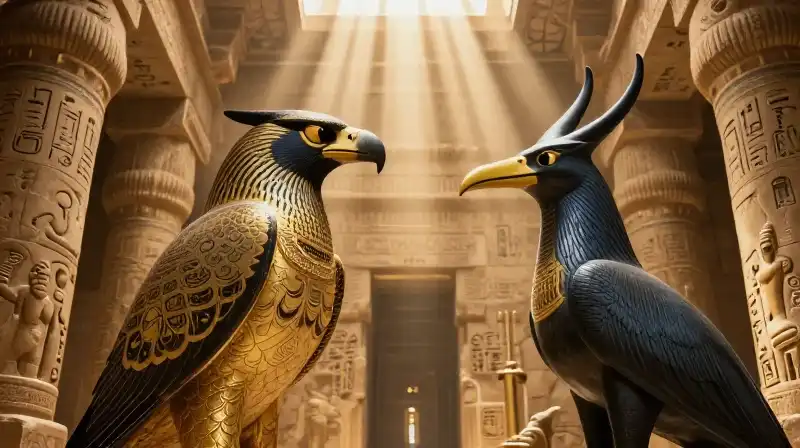
The Egyptians perceived the world as a magnificent, highly dramatized conflict between order (Ma’at) and chaos. Their cosmology was vividly represented in the divine forms. The celestial realm was personified by figures such as Nut, who represented the sky and held the divine role of “mother” by swallowing the setting sun (Ra) each night to give birth to it the following morning 1. The visual representation of the gods frequently merged human and animal anatomy, a practice often used to express a god’s intense emotional state; a deity might be depicted as a ferocious lioness when their temper flared 1.
Among the divine pantheon, the central conflicts defined the moral and spiritual universe. Seth embodied the wild, chaotic, and malevolent forces of the world, his actions dramatically underscored by the tragedy of murdering his brother, Osiris 1. This act, however, set the stage for the enduring spiritual struggle between life and destruction, which was later championed by Horus and defended by Isis 1. These great cosmic forces—the order-givers and the chaos-bringers—shaped the entire moral framework of their society.
The Rise of Supreme Power: Syncretism and Transformation
One of the most profound elements of Egyptian religion was its tendency toward monumental syncretism—the act of merging divine powers to create a new, greater entity. This process wasn’t a dilution of belief, but an expansion of power. As the city of Thebes rose to prominence, the god Amun gained political and spiritual dominance. He was elevated into a supreme creator deity, noted by the fact that he possessed a secretive, often concealed nature, even from other gods 1. The peak of this evolution occurred when the powerful sun god Re gained such widespread popularity that it led to major syncretisms. Amun and Ra were combined into potent new forms, such as Atum-Re and Amun-Re, collectively known as the King of the Gods (2, 3). This continuous process of blending deities shows that their religion was always evolving, absorbing power from the successful gods of the past.
Guardians, Devourers, and the Journey into the Afterlife
Beyond the towering cosmic figures, the religious structure also provided specialized roles and guardians necessary for everyday life. Figures like Hathor, the patron of beauty, music, and love, had a multifaceted nature, including complex narratives about a dark side where her unrest was only halted through specific rituals 1. Conversely, minor deities like Bes fulfilled crucial, localized roles, acting as a guardian of childbirth and prosperity, contrasting with the vast, sweeping power of the creator deities 1. However, the most dangerous forces were often represented by composites, such as Apepi, the cosmic snake, and Ammut, the Devourer of the Dead, figures representing the immense, supernatural threats that humanity and the gods struggled to contain 1.
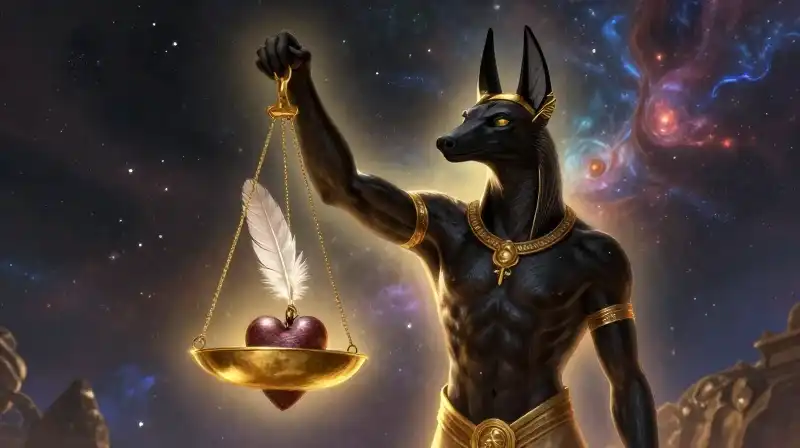
The final, crucial stage of the tradition was the journey of the soul. The cult of Anubis was centrally involved in this process; depicted as a jackal-headed figure, he was responsible for guiding the deceased through the treacherous journey of the afterlife and overseeing the critical process of their judgment 1. This journey was the culmination of the religious belief—the ultimate testing of one’s moral standing in the cosmic drama.
Understanding the Nuances of Egyptian Gods and Goddesses
A common misconception when learning about Egyptian gods is that they are simple moral archetypes. In reality, they are richly layered personalities that embody complex forces. For example, the god Amun, while becoming the King of the Gods, was inherently secretive and complex 1. The animals incorporated into the deities were not merely decorative; they served as a visual shorthand for the deity’s specific moods and elemental connections 1. To genuinely understand this tradition, one must move past a simple definition and grasp that every god, from the grand solar figures to the specialized guardian of birth, occupied a distinct and necessary place in maintaining the delicate balance of the cosmos and the lives of its people.
Synthesis: The Living Significance of Ancient Egypt’s Faith
Ancient Egyptian religion stands as a powerful testament to humanity’s ability to build meaning from chaos. It was not a closed system but a dynamic, breathing tradition that continually absorbed and transformed external influences and internal political shifts. It is a history of powerful syncretism, where the divine was understood not as a static decree, but as a living, negotiating force.
For those who seek to understand this heritage, the key takeaway is the importance of context. The regional variations, the evolution of supreme deities like Amun-Ra, and the meticulous details of the afterlife journey are not merely historical footnotes; they are the elements that define the vibrant, resilient cultural life of the ancient Egyptians, proving that even in their most complex cosmology, the deepest concerns of the community—order, survival, and eternal life—always held precedence.
References
Footnotes
Related Articles