Celtic Gods and Goddesses: Uncovering Ancient Irish and British Myths

Introduction
The spiritual and mythical landscape of the Celts was not defined by a single, monolithic god or a singular, unified religion, but rather by a rich tapestry of localized, dynamic forces that shaped the traditions and folklore of communities across Europe. For a reader seeking to understand the heart of Celtic heritage, it is helpful to approach this belief system not as a dusty catalog of ancient figures, but as a living tradition—a set of cultural narratives that reflect how people related to their land, understood the cycle of life and death, and celebrated community.
The diversity of these beliefs is central to their identity. While there were general deities sought for healing or protection 1, many were profoundly tied to the physical landscape itself, such as specific rivers, ancient forests, or mountain peaks 1. The Celts revered the interconnectedness of nature and the supernatural. When exploring the legends of the Celts, one is essentially tracing the deep cultural conversation about what it means to belong to a place and to the rhythms of the natural world.
The Foundational Pillars of Celtic Cosmology
To grasp the scale of these traditions, it is useful to examine the figures who hold the most central position in certain narratives, particularly within Irish mythology. The *Tuatha Dé Danann* represent a foundational group of god-like beings (1, 2). Their existence and their elaborate cycles of myth are the very framework for much of the ancient Irish storytelling. These divine figures are often linked to a realm known as Tír na nÓg, which symbolizes the eternal or the otherworldly home (1, 2).
At the core of this cosmic structure are the great maternal and paternal figures. Danu is a powerful supreme mother figure 1, strongly associated with nature, regeneration, and wisdom. She is often credited as the source of the *Tuatha Dé Danann* themselves. Complementary to her is the figure of Dagda, who holds significant cultural weight as a father figure and leader of the *Tuatha Dé Danann* 1. The Dagda embodies the strength of the earth and the promise of fertility, connecting the divine to the agricultural life of the community.
The concept of divinity was also defined by domains of cultural significance, rather than just abstract power. For example, Brigid exemplifies this multifaceted divinity 1, governing essential aspects of human life: fire, healing, agriculture, and poetry. This complexity underscores the holistic nature of the Celtic worldview, where the spiritual realm mirrored the practical concerns of daily life.
Regional Echoes: Ireland, Britain, and the Spectrum of Deities
It is a critical point for the reader to understand that the “Celtic gods” are not a single entity; they are a family of related, yet distinct, traditions. Scholars distinguish clearly between the specific mythological traditions of the Gaels in Ireland and the figures found in Western Britain, known as the Brythonic tradition 1.
In the Brythonic tradition, for instance, the great narratives preserved in *The Mabinogion* feature figures like Cerridwen, a goddess associated with the acquisition of inspiration and knowledge, and Arianrod, the goddess of fate 1. Likewise, the Welsh tradition includes Lleu as a prominent figure, mirroring the role of the Irish deity Lugh (2, 1), illustrating the shared cultural structures that flowed across these regional borders.
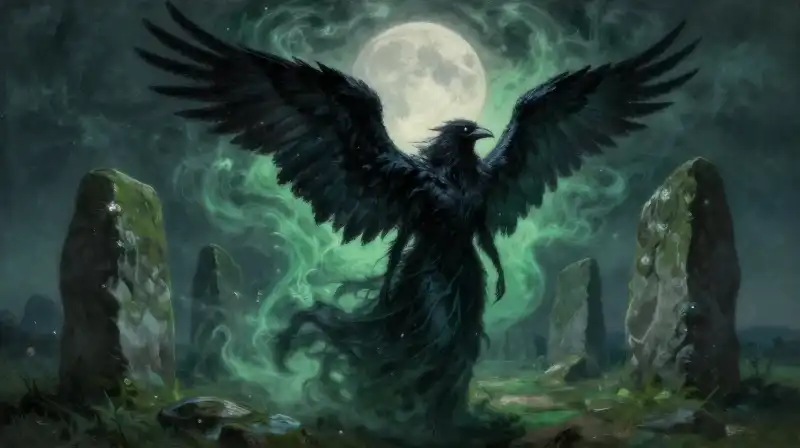
Beyond these specific, literate traditions, the history of the region speaks to a wider array of widespread figures. Cernunnos, the Horned One, is a widespread figure among the people (2, 1), often recognized as the “lord of wild things.” Alongside him, deities such as Morrigan and Macha showcase the capacity for gender fluidity and thematic complexity. Morrigan is famously associated with war and fate, and she is sometimes portrayed as a trio of sisters 1. Macha further symbolizes the complex cycle of life, war, and death, linking maternal and agrarian elements together 1.
Historical Ambiguity and the Search for the Lost Gods
When studying these ancient spiritual traditions, it is vital to maintain a respectful awareness of the historical context in which they were recorded. The historical record is not a neutral archive; it reflects cultural perspectives. Christian writings frequently sought to “euhemerize” pre-Christian gods 1. This practice meant interpreting the *Tuatha Dé Danann* not as divine entities, but as fallen celestial beings, or perhaps as historical human leaders from antiquity 1.
Furthermore, due to the focus of historical study on the Iron Age, many localized Celtic gods have been lost to the historical record. However, this does not diminish their importance; rather, it highlights the vastness of the tradition. What remains are the major narrative cycles and the persistent archetypes—like the Cernunnos or the elemental forces embodied by Danu and Brigid—which suggest a profound, widespread spiritual landscape that existed long before modern documentation.
The Living Significance of Celtic Mythology in Community
The cultural meaning of these traditions lies not in the literal belief in mythical battles, but in the societal values and cosmologies they describe. The narratives—such as the *Book of Invasions* describing the arrival and subsequent defeat of the supernatural beings by the Milesians 1—serve to explain the origins of the modern Irish people and their relationship to the land. They are narratives of emergence and settlement.
These stories, whether recounted in Irish Gaelic communities or through modern pagan practices in Western Britain, help define community identity. They provide a shared language for addressing complex themes like fate versus free will (as seen with figures like Arianrod), the importance of the land (the influence of Danu), and the balance between destruction and rebirth (the role of Morrigan and Macha).
Navigating the Tradition: A Guide for the Curious Reader
For those seeking to understand the primary spiritual landscape before the arrival of Christianity in Ireland, the core belief system centered on the highly localized, deeply rooted relationship with the land and cyclical time, rather than a structured religion defined by a single main god 1. The concept of a “main god” is an oversimplification that misses the complexity of the various regional pantheons.
If your interest lies in tracing the names and meanings of these deities, remember to differentiate between the high, centralized mythic cycles (like those featuring the *Tuatha Dé Danann*) and the myriad smaller, regional spirits that were integral to the daily life of the common person. The power of the tradition remains in its multifaceted nature: the ability to embody war, wisdom, harvest, and wildness, often in a single figure.
Ultimately, the Celtic heritage offers a window into a culture that was fundamentally rooted in the earth. By studying the gods and goddesses, one is studying the community’s way of understanding the natural world, where the divine and the mundane were perpetually intertwined.
References
Footnotes
Frequently Asked Questions
Who is the main god of the Celts?
The Celts were not defined by a single, monolithic god or a singular, unified religion. Instead, their spiritual landscape consisted of a rich tapestry of localized, dynamic forces and regional pantheons, featuring figures such as Danu and Dagda.
What religion did Ireland have before Christianity?
Before Christianity, Ireland’s spiritual landscape was not a unified religion defined by a single main god, but rather a rich tapestry of localized, dynamic forces. The core belief system centered on a deeply rooted relationship with the land and cyclical time, rather than a structured theology.
How to Navigate Celtic Mythology
Understand Localized Belief
Begin by focusing on the core principle that Celtic spiritual traditions were centered on localized, deeply rooted relationships with the land and cyclical time, rather than a structured religion centered on a single main god.
Differentiate Mythic Scales
Distinguish between high, centralized mythic cycles (such as the Tuatha Dé Danann) and the myriad of smaller, regional spirits that were integral to the daily life of common people.
Analyze Multifaceted Figures
Identify the power of the tradition through figures that embody multiple domains—such as a single figure representing war, wisdom, harvest, and wildness.
Interpret Cultural Meaning
Remember that studying the gods and goddesses provides a window into the community's societal values and their unique way of understanding the natural world, where the divine and the mundane were perpetually intertwined.
Related Articles