The Sea King and the Earth Shaker: Defining the Powers of Poseidon

Introduction
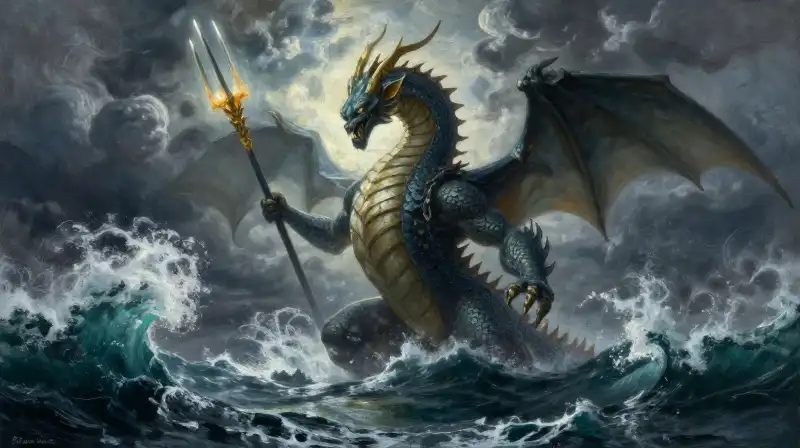
The ancient Greek worldview understood the sea not as a predictable expanse of blue, but as a powerful, shifting entity—a source of both life and existential danger. At the heart of this powerful, ambivalent nature stood Poseidon, the sea king. He was far more than a mythological figure presiding over vast oceans; he was a multifaceted deity whose domain encompassed the deepest mysteries of the earth and sky. To understand Poseidon is to understand the complex relationship between ancient Greek civilization and the untamed forces of the natural world. He was simultaneously the master of maritime travel, the shaper of tremors, and the embodiment of untamable, capricious power, a god whose influence shaped not only the lives of sailors but the civic and cultural identities of entire city-states.
The Amphibious Power: Master of Seas and Seismic Shifts
One of the most profound elements of Poseidon’s mythology is his lack of singular focus. While he is widely recognized as the deity of the sea and oceans, his power extended deep into the terrestrial and equine realms. Scholars have noted that he presided not only over the waves but also over earthquakes and horses (1, 2). This broad, often surprising scope suggests that his domain was not merely nautical, but truly elemental. This connection to terrestrial forces is highlighted by his frequent title, the “Earth-Shaker.” This designation, particularly in regional ancient worship, underscores a specific local cultural understanding of his relationship with seismic activity, linking the depths of the ocean to the tremors felt on land 3. Furthermore, his symbolic representation reflects this blended power; he was often depicted riding in chariots pulled by beings that were half-horse and half-fish, visually embodying the blurred, powerful lines between the marine world and the volatile forces of the earth and air 3.
The Dual Nature of the Deep: Provider vs. Hazard
In the lived experience of ancient Greek communities, the sea represented an ultimate duality. Poseidon was not simply a figure of catastrophic storms; he was also a primary provider of life. This duality is richly reflected in his consort, Amphitrite. She held significant cultural standing, being credited with bringing the sea’s rich bounty—including fish, shellfish, dolphins, and whales—to humanity 3. The ocean’s benevolent side is represented by the Nereids, a band of fifty nymph goddesses who acted as both guardians of the sea’s bounty and protectors of sailors 3. However, for every Nereid who offered protection, there were devastating forces of chaos. Cultural depictions of the sea’s danger were intrinsically linked to Poseidon’s divine power, as he was viewed as commanding massive, destructive waves and powerful storms that threatened both ship and coastline (3, 2). This contrast between the nourishing presence of figures like the Nereids and the terror invoked by monstrous sea Daemons, such as Ceto and Echidna, shows that the Greek understanding of the ocean was never monolithic. It was a realm of awe, where life depended on balancing respect for its generative power against its potential for sudden, overwhelming destruction 3.
Regional Echoes and Symbolic Significance
The tradition of Poseidon’s worship and representation varied significantly across the Greek world, illustrating the way mythology was woven into specific regional histories and civic rivalries. For instance, in some ancient Mycenaean cult practices at Pylos, Poseidon was revered under the title “Wanax.” This term suggests a powerful, chief deity, often with chthonic aspects 3. His influence also shaped grand mythological narratives that defined cultural identity. The legend of Atlantis, placed within Poseidon’s domain, speaks to the power of the sea to conceal civilizations and symbolize immense, hidden wealth or forgotten power 3. Additionally, in the context of Athenian civic life, Poseidon’s legendary contest with Athena for patronage served as a critical reflection of the competing religious and cultural identities of different city-states, illustrating how these deities were used to ground local political and social priorities 3.
The Legacy of the Sea King
Poseidon, as the “Earth-Shaker” and the master of both the vast oceans and the powerful forces of the earth, represents the quintessential ancient Greek struggle to comprehend and coexist with immense, often terrifying nature. Through his varied figures—from the protective Nereids to the destructive Daemons—he serves as a powerful symbol of nature’s inherent duality. He embodies the necessary tension between the gift of sustenance and the threat of chaos, a complex cultural understanding that remains foundational to the study of the Mediterranean world.
References
Footnotes
Related Articles