Mythical Feline Creatures: Legends of Cat Sìth, Bakeneko, and More

Introduction
Few animals possess the enigmatic qualities of the feline. Whether depicted as a sleek, domesticated companion or a terrifying supernatural entity, the cat has occupied a unique space in human cultural consciousness. Across continents and epochs, mythical feline creatures—from the legendary Cat Sìth to the supernatural Bakeneko—are far more than mere monsters; they are symbolic reflections of cultural anxieties, spiritual beliefs, and social instructions. These traditions demonstrate how communities worldwide use the image of the cat to process concepts as complex as duality, protection, death, and social order. They are living stories of how humans perceive the mysterious boundary between the domestic and the wild.
Guardians, Fertility, and the Divine Cat
In many cultures, the cat embodies protection and powerful, sometimes untamed, domestic forces. This benevolent archetype often serves to link the mundane aspects of life—like home and fertility—with the sacred. The ancient Egyptian reverence for Bastet is a prime example; she was a highly revered goddess associated with domestic life, fertility, and a fierce protection against evil (1, 2). Bastet represents the domestic side of divine power, contrasting with the fierce destructive power of her counterpart, Sekhmet (1, 2).
This theme of divine or agricultural protection is echoed in Scandinavian tradition. Frayja’s cats, in Norse tradition, were symbolic figures that pulled her chariot, representing both fertility and domesticity. The significance of these creatures was so profound that farmers were traditionally expected to offer them specific offerings 1. Similarly, the Dawon, a fierce tigress in Hindu mythology, serves a powerful protective role, acting as a battle companion for the goddess Durga, whose weapons and claws she employs in combat 1.
The Dual Nature of Myth: From Boon to Burden
Perhaps the most culturally rich aspect of mythical cats is their tendency toward duality—they can bring both wealth and catastrophic danger. This suggests a deep-seated cultural understanding that power, especially animal power, is not inherently good or bad, but dependent on how it is handled. The Matagots of southern France are a vivid illustration of this duality; they are viewed as spirits that possess potentially evil qualities, yet certain communities believe they can bring wealth if properly cared for 1. This idea of the cat being a walking paradox is also seen in various regional American legends.
In the Cherokee myths, the Wampus Cat is framed as a cursed female shapeshifter, embodying tragic transformation and danger. Meanwhile, the Southwest features the Cactus Cat, described as a bobcat-like creature with thorny fur 1. On the darker side of this regional variation, medieval Europe subjected black cats to intense persecution, labeling them “Devil’s Little Minions” and associating them with witchcraft and dark magic 1. The juxtaposition of the protector, the bringer of wealth, and the agent of doom reveals a culture grappling with the unpredictable nature of the forces outside human control.
The Power of Transformation and the Supernatural
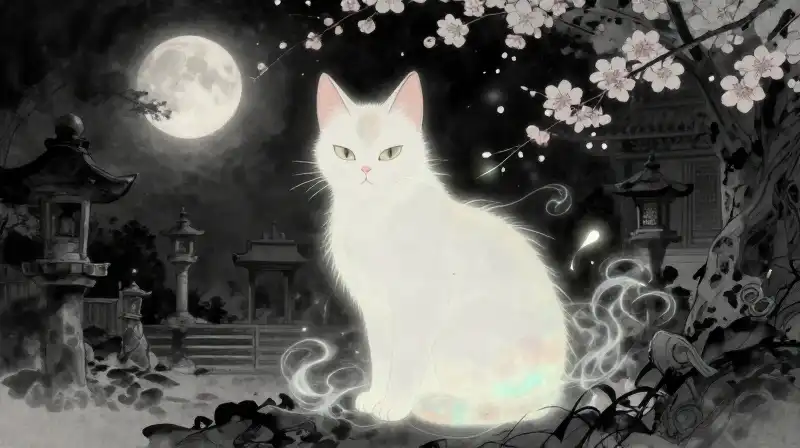
Many of the most compelling myths revolve around the ability of the feline creature to transform or possess supernatural abilities, bridging the gap between human and animal life. In Japan, the concepts of Bakeneko and Nekomata illustrate supernatural transformation and life cycles. Bakenekos gain power and increase in size as they age, while Nekomata are specifically defined by the feature of having two tails (1, 2). These figures represent the harnessing and accumulation of magical power.
Transformation also serves as a powerful moral or social lesson. Greek mythology offers the example of Lyncus, a human king who was literally transformed into a Lynx as a punishment 1. In contrast, Cha Kla, a legend from Thailand, illustrates transformation through fear; this mystical cat is believed to bring death to those who see or touch it, despite its use by sorcerers for warfare 1. This shows how transformation can be used either as a supernatural curse or as a tool of cultural warning.
Instruction, Anxiety, and the Living Practice
Some mythical cats do not merely exist for fear or reverence; they are used as agents of social or practical instruction. The legendary Yule Cat (Jólakötturinn) in Icelandic folklore serves a striking social purpose. Its terrifying presence motivates citizens to prepare new clothing before the Christmas season, effectively blending cultural terror with mandatory preparation 1. This narrative structure turns a mythological beast into a cultural deadline.
The mythical cat can also embody hybrid danger. In Argentine folklore, the Hombre Gato exists as a hybrid creature with traits of both human and cat, believed to be a nocturnal predator 1. This kind of hybrid serves to explore the unsettling territory of human-animal boundaries and the dangers of liminal spaces. Furthermore, while historical legends like the Cat-siths (a large black feline that can transform into human-like forms when humans are away) 1 or the Cat-siths of Scotland (distinct by a white chest spot and believed to steal souls before burial) 1 highlight danger, others, like the Matagots, suggest that the same creature can be seen differently depending on the perspective.
Synthesizing the Myths: Addressing Common Questions
The diversity of these legends often leads readers to ask specific questions about their origins and nature. To clarify the boundaries between different types of mythical cats:
- Transformation: While many cats are depicted as supernatural, the most direct examples of feline transformation include the Norse Frayja’s cats (symbolic partners to her power), the Japanese Bakeneko (growing with age), and the Celtic Cat-siths (shifting based on human absence) (1, 2).
- Yokai and Similar Entities: Within the context of Japanese folklore, entities like the Nekomata fit the criteria of a supernatural feline or *yokai*. They represent powerful, often complex, spiritual forces that exist in the world’s shadows (1, 2).
- Regional Variations: The perception of a cat changes drastically by location. What is a cursed, lethal entity in Thailand (Cha Kla) is compared to a domestic divine protector in Egypt (Bastet), illustrating how specific cultural needs shape mythological attributes.
Beyond the Feline: The Endurance of the Myth
The longevity and persistence of these mythical feline creatures are a testament to the powerful cultural need for narrative anchors. These stories are not arbitrary; they offer a framework for understanding nature, morality, and the unknown. Whether they are benevolent figures used to inspire productivity (the Yule Cat), powerful spiritual entities representing fertility (Bastet, Frayja’s cats), or terrifying agents of moral decay (Wampus Cat, Cat-siths), these myths allow communities to communicate profound ideas through the lens of the cat. They remind us that the stories we tell about the things we fear or revere are often the deepest reflections of our own cultural selves.
References
Footnotes
Frequently Asked Questions
What mythical creature can turn into a cat?
In Cherokee myths, the Wampus Cat is described as a cursed female shapeshifter who embodies tragic transformation and danger. It is also noted that the Cat-siths are a large black feline that can transform into human-like forms.
What are the Norse mythical cats?
In Norse tradition, Frayja’s cats were symbolic figures that pulled her chariot, representing both fertility and domesticity. These mythical creatures are part of Scandinavian tradition and were considered profound figures.
Are there any cat yokai?
Within the context of Japanese folklore, entities like the Nekomata fit the criteria of a supernatural feline or yokai. They are described as powerful, complex spiritual forces existing in the shadows.
Related Articles