
Dragon Witches: The Philosophy of Dragons as Spiritual Entities

Introduction
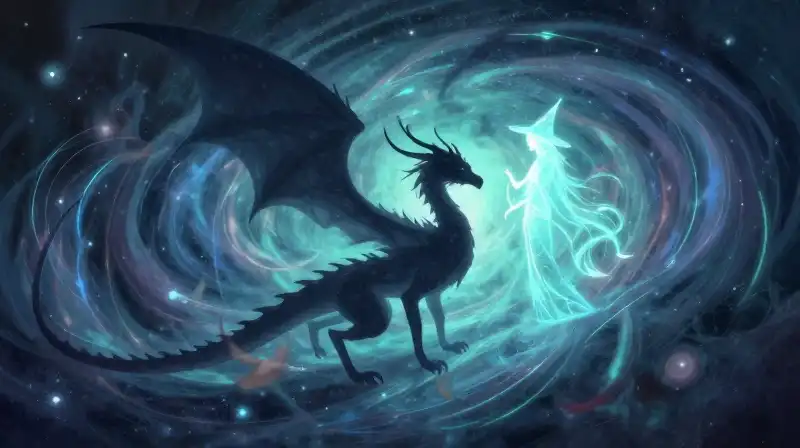
>The figure of the “dragon witch” is not a static figure found in standard folklore, but rather an emerging, dynamic concept within modern Pagan and spiritual communities. Rather than being a costume or a simple mythical character, this concept describes a profound spiritual lens through which certain practitioners view the human relationship with deep, ancient power. It is an exploration of how vast, elemental forces—symbolized by the dragon—can intersect with personal spiritual practice. > >At its core, the term speaks to a modern realization: that the dragons found in ancient myths like those of Wales are not merely creatures of fantasy, but potential manifestations of deep “soul memory” or collective archetypes. These practitioners view the dragon not as a physical beast, but as a potent spiritual entity or a “current”—a living energy that bridges the gap between the physical world and a more elemental, creative past 1. This is a practice grounded in the belief that dragons embody the raw, untamed, and creative “living potential” of the universe.
The Philosophy of Dragon Memory and the “Current”
>For those engaging in dragon-centric spirituality, the focus quickly moves away from the idea of a dragon hoarding gold. Instead, dragons are understood to be guardians of “living potential”—the raw energy and creative power needed for evolution. According to 2, this power is not meant to be seized or possessed in isolation; it is meant to be circulated and shared. > >This spiritual framework is underpinned by the idea of “dragon memory.” Practitioners believe that humans are not a separate invention but might have been “dream[ed] into being” by these powerful, ancient entities to expand their influence in the material realm 1. This suggests a non-linear relationship where the distinction between human and dragon was once blurred. The “dragon current” is seen as a form of deep ancestral memory, a dormant part of the self that links the practitioner to a version of their being where the dragon and human were one.
The Dragon Witch: Bridging Fire and Flesh
>The “dragon witch” role, therefore, is fundamentally a quest for reclamation. It involves a spiritual journey to reconnect with parts of the self that have been suppressed by contemporary human rationalism and “left-brain dominance” 1. The philosophy demands a “bridge between fire and flesh, dream and deed” 1. > >This is why the practice emphasizes tangible, embodied actions. Spiritual work is not seen as purely intellectual; it requires immersion in creative processes, healing, and active protection 1. The dragon spirit serves as the archetype for this “fire”—the transformative heat of intuition, power, and creation—which the practitioner must integrate with their physical “flesh.” The goal is not to become a monster, but to become a more integrated, powerful version of oneself by reclaiming this elemental part of the soul.
Regional Roots and Mythological Variation
>While the term “dragon witch” is a modern label, the concept draws heavily on deep regional mythologies. One significant example cited in the community is *Y Draig Goch*, the Welsh red dragon. Some individuals apply this powerful regional entity as a focal point for their worship within a modern Pagan framework 1. > >The way a practitioner relates to a dragon can vary widely. Some draw on very specific regional deities, like the Welsh dragon, while others focus on the broader archetype. This lack of uniformity is reflected in the online discussions 1. Some individuals report direct spiritual interactions with a personal entity—calling it a “dragon on their spirit team”—which occurs through spiritual means, suggesting a highly individualized, non-literal relationship with the creature 1.
Exploring the Nature of Spiritual Connection
>For a reader who might be asking, “how do I know if I’m connected to a dragon but I’m human?” the spiritual tradition suggests that the connection is felt rather than proven. This is often manifested as intense, vivid spiritual imagery. Practitioners may report experiencing powerful dreams featuring sleek red dragons or more abstract, less benevolent black dragons 1. > >The “knowledge” of the connection is rooted in the experience of the power within. If a personal spiritual entity or vision consistently interacts with you through subtle spiritual channels, the community views this as proof of an alignment with that ancient current 1. This personal, experiential knowledge differs significantly from simply reading about dragon myths.
The Ethical and Intellectual Limits of the Practice
>As this practice evolves in contemporary digital spaces, questions arise concerning its commodification. There is a stated concern among some proponents that the “ancient, vast, and sovereign nature of the dragon current” could be restricted or “trademark-ed” by modern intellectual property 1. The community stresses that the dragon current is a living force, not a marketable IP. > >Furthermore, there is an ongoing philosophical debate regarding the source of this inspiration. Some believe the practices are rooted in broader, overarching witch-centric traditions, while others firmly anchor the tradition in specific, ancient dragon deities 1. Understanding this nuance is crucial for approaching the philosophy with respect—it is not a single doctrine, but a constellation of interconnected spiritual meanings.
Living with the Dragon Current
>Ultimately, the philosophy of the dragon witch is one of integration. It is an invitation to seek out the creative, expansive, and often untamed parts of the self—the parts that remember the elemental world before civilization. Whether connecting to a specific myth like the *Y Draig Goch* or embracing the abstract concept of the “dragon memory,” the practice is a call to embodied action. It encourages practitioners to use the symbolic power of the dragon not for selfish hoarding, but for the collective circulation of living potential.
References
Footnotes
Related Articles