
The Aten: Explaining Ancient Egypt’s Revolutionary Sun Worship

Introduction
The religious life of ancient Egypt was fundamentally altered during the Amarna Period, a time characterized by an unprecedented and radical cultural experiment. At the heart of this shift was the Aten, a celestial entity that transformed from one aspect of the traditional sun god, Ra, into a singular, supreme creator deity. This revolution, driven by the Pharaoh Akhenaten, involved more than just a change in name; it was a total restructuring of Egyptian spiritual life, art, and architecture (1, 2). For readers seeking to understand the depth of this tradition, the Aten offers a fascinating lens into how a culture can radically redefine its connection to the divine, placing the sun not merely as a powerful force, but as a benevolent, all-seeing presence watching over all living things 1.
The Symbol and Theology of the Aten
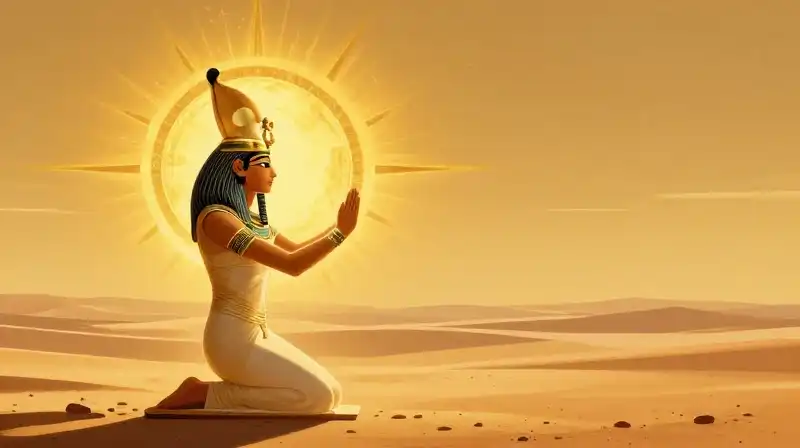
To understand the Aten, one must first understand its primary visual manifestation. Rather than being a sprawling, bearded figure like some traditional gods, the Aten was depicted as a radiant solar disc. Emanating from this disc were rays that did not simply vanish into the sky but terminated in human hands. This unique visual form served as a powerful symbol, representing the Aten’s active power and its dominion over the mortal realm (1, 2). The core theology of Atenism posited the Aten as the ultimate source of life, a nurturing spirit responsible for the entire world’s existence. The faith held that the Aten did not just provide light; it actively sustained life by providing rain to the land and overseeing all creation 1. This depiction stands in contrast to the traditional pantheon where gods often had complex, often localized roles; the Aten was conceived as the unified, singular creator who breathed life into everything.
The Cultural Reimagining of Worship
The adoption of Atenism demanded a complete overhaul of the ancient religious infrastructure and ritual practices. Traditional Egyptian temple worship, which relied heavily on the purification and anointment of carved divine images, was radically altered (1, 2). The Aten, according to the new doctrine, was too absolute and radiant to be represented by physical statues, which were viewed as idolatrous. This philosophical shift dictated the architecture of the new cult centers at the capital city of Akhetaten (Amarna). Unlike traditional, enclosed sanctuaries, Aten’s temples were intentionally designed as open-air structures. They featured unroofed design, allowing the sun’s rays to flood the interior, providing the worshipper with a direct and unimpeded connection to the divine source of light and life (1, 2). Ritual practices themselves were redefined; the offering of foodstuffs, meats, fruits, and incense took place on these open-air altars, replacing the older, formalized rituals involving divine images 1.
The Role of Royalty and the Divine Triad
The Aten did not merely change the god; it changed the way people interacted with the state religion. Akhenaten positioned himself as the singular intermediary between the divine Aten and the general populace, creating a unique cultural hierarchy. This established a direct, emphasized link between the king, the sun god, and the people 1. Furthermore, the Aten cult afforded a unique and powerful prominence to royal women. Nefertiti, in particular, became a significant figure, being portrayed within a divine triad and serving as a powerful tool to legitimize the new state religion within the Egyptian culture 1. The hymns dedicated to the Aten, however, also provided a humane dimension to the theology, depicting the god as compassionate and actively involved in watching over and serving all living things 1.
Debate: Monotheism or Evolution?
Scholarly discussion surrounding the Aten remains one of the most significant debates in Egyptian history. While Atenism is often viewed as a precursor to monotheism, historians debate whether it represents a complete break from tradition or a profound evolution of existing solar divinity (1, 2). The key distinction lies in how the Aten was perceived: was it truly the sole, abstract creator, or was it the most perfected expression of the traditional, established cult of Ra? It is important to note that even as the Aten was the official state worship, evidence from archaeology suggests a complex cultural reality outside the royal capital. Many historians believe that household worship of the traditional pantheon likely persisted among the general populace, suggesting that the revolution was top-down and did not necessarily extinguish deeply rooted beliefs throughout the wider Egyptian community (1, 2).
Clarifying Related Belief and Concepts
The Aten’s unique nature often leads to questions about its relation to other deities. It is crucial to understand that the Aten was fundamentally linked to Ra, evolving from an aspect of him to a singular entity. However, the Aten itself is not merely a name for a solar god; it is a specific, radical religious doctrine. Regarding the concept of Atenism, there are often misconceptions about its reach. For instance, historical records do not support the claim that Moses was an Atenist; the religion of ancient Egypt, while profoundly influential, existed independently of the biblical narrative concerning the Hebrews (1, 2). Similarly, while the Aten is an ancient Egyptian god, his name and appearance are specific to the Amarna Period and are not synonymous with all solar deities found in other cultures.
Synthesis: The Cultural Legacy
The Aten, then, was not just a religious concept; it was a cultural watershed—a period of dramatic and unprecedented creative upheaval. It forced the Egyptian community to reassess their relationship with the sacred, the state, and the individual. While the era itself was temporary and ultimately failed to replace the ancient religious infrastructure, the Aten left a profound mark, forever challenging the established norms of power and faith. Understanding the Aten is not merely learning about a defunct deity; it is recognizing a powerful moment where a culture experimented with the very definition of divine connection, laying the groundwork for later religious shifts in the Near East.
References
Footnotes
Frequently Asked Questions
Was Moses an Atenist?
Historical records do not support the claim that Moses was an Atenist. The religion of ancient Egypt existed independently of the biblical narrative concerning the Hebrews.
Related Articles