Taranis God: The Pan-Celtic Thunder Deity of Gaul and Beyond

Introduction
The name Taranis evokes the raw, sudden power of the storm. He stands as a powerful and often terrifying figure in the tapestry of ancient Celtic polytheism, recognized as a Pan-Celtic thunder god. Unlike a deity of gentle pastoral life, Taranis was the embodiment of untamable forces—the storms that brought both necessary life-giving rain and devastating destruction (1, 2). To truly understand Taranis is to understand a tradition where nature and divinity were inseparable, and where the great forces of thunder and lightning commanded the reverence, and often the fear, of ancient communities across Gaul and beyond.
The Authority of the Storm and Celestial Power
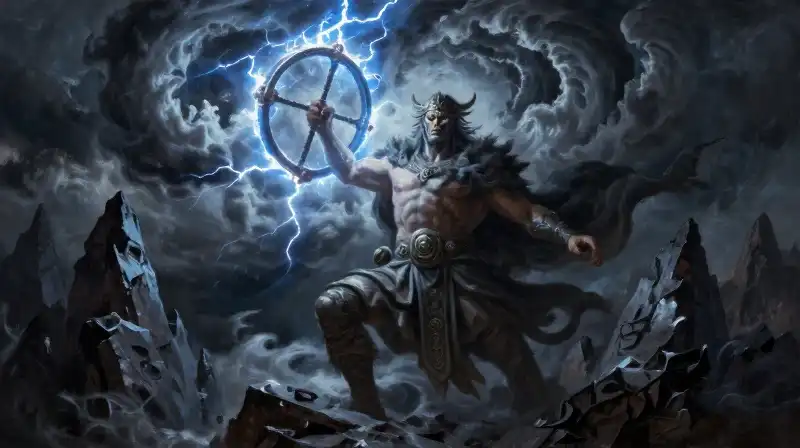
At the core of Taranis’s divinity was his absolute command over the atmospheric fury. He was a formidable deity whose primary weapon was a mighty thunderbolt, often depicted functioning as a spear. This powerful implement underscored his role not just as a natural force, but as a potent leader and protector within the complex Celtic pantheon 2. The very name, derived from the Proto-Celtic *torano-, resonates with words for thunder found in disparate languages, including Old Irish and Gascon French, suggesting a linguistic and cultural unity across diverse tribal groups 2. His role was foundational to the life of the community; the unpredictable nature of his power meant he was both deeply revered for his ability to control the weather and profoundly feared for the sudden, uncontrollable violence of the storms he commanded (2, 1).
The Symbolism of the Sacred Wheel
In depictions of Taranis, a notable feature is his association with the wheel. This iconography has led scholars to label him as a “wheel god.” This symbol carried multiple layers of meaning for ancient Celts, tying his immense power to cosmic cycles and physical motion (1, 2). Interpretations of the sacred wheel vary significantly among scholars. Some suggest that Taranis’s usage of the wheel represented the sun and the immutable cycle of life—a solar connection to his celestial domain 2. However, others argue that viewing it through this lens might be an anachronism, potentially imposing later symbolic structures onto the primal worship 2. Regardless of the exact meaning, the wheel connects Taranis to concepts of mobility and the erratic, unstoppable passage of time, much like a sudden storm.
Ritual Practice and Historical Evidence
The presence of Taranis in ancient communities is confirmed through both art and literature. Epigraphic evidence—inscriptions and artifacts—of his worship has been discovered in locations such as Orgon, France, dating between the 4th century BCE and the 3rd century CE 2. Taranis’s prominence is dramatically recorded in Roman literature, most notably in Lucan’s epic *Pharsalia*. This text depicts scenes in ancient Gaul where Taranis, alongside other major deities like Teutates and Esus, demanded massive human sacrifices (2, 1). Analysis of these classical texts suggests that the victims were often subjected to a ritual practice involving being burned within a hollow wooden container, a practice documented across other classical sources (2, 1). It is important to note that while these accounts depict high-stakes ritual, scholarly debate persists regarding the overall religious importance of Taranis, complicated by the limited and often selective nature of the surviving epigraphic and literary record 2.
Connecting Taranis to Other Celestial Forces
The study of Celtic mythology requires looking at the relationships between deities. Taranis often shares functional similarities with other powerful gods. Some modern analyses suggest potential connections between Taranis and other powerful sky deities, such as Sucellus and the Irish Dagda, suggesting they may have collectively functioned as both sky and fertility gods within their respective regional spheres 2. Furthermore, the transmission of Gaulish mythology was filtered through extensive Roman influence. This has led researchers to look for deeper origins in common Indo-European concepts, drawing parallels to deities like Perkwunos, helping to trace the shared mythological heritage 2. While he has no direct, confirmed analogue in the Roman pantheon, scholars have explored the connection, suggesting he might have been equated with Jupiter, the Roman weather god, or even Dis Pater, the god of the underworld 2.
Taranis and the Modern Inquiry into Celtic Deities
Because of Taranis’s prominence and power, he is often compared to figures from other traditions, such as the Norse god Thor. However, the nuances of the pantheons are distinct. The specific cultural focus of Taranis lies within the continental Celtic world, whereas Thor represents the Norse traditions (addressing the query: Is Taranis the same as Thor?). The traditions themselves are geographically and linguistically divergent. Regarding his regional counterparts, scholars identify related figures, such as the Irish Dagda, who fulfilled similar roles in their own cultural contexts (addressing the query: Who is the Irish equivalent of Taranis?). These figures highlight the widespread cultural concepts regarding powerful sky and earth deities that existed across the Celtic world (addressing the query: Who is the Irish equivalent of Taranis?). Taranis’s powers were fundamentally linked to mastery over severe weather, encompassing leadership, protection, and the volatile forces of nature.
The Lasting Impact of Primal Belief
Taranis is not merely a figure of ancient texts; he represents the enduring cultural relationship between humans and the unpredictable forces of the natural world. Whether seen through the lens of a sacred wheel, a terrifying thunderbolt, or a dramatic sacrificial narrative in Lucan, the tradition surrounding him speaks to a worldview where the divine was immediate, powerful, and fundamentally linked to the storms that governed life and death. The journey of Taranis—from a linguistic concept to a terrifying presence in Roman epics, to a symbol of cosmic cycles—reveals the tremendous capacity of ancient human culture to interpret, re-contextualize, and venerate the overwhelming power of the heavens. He remains a testament to the living power of tradition, even as its origins are still debated and its regional manifestations continue to be explored by modern scholars.
References
Footnotes
Frequently Asked Questions
Is Taranis the same as Thor?
Taranis and Thor are not the same, as Taraniss cultural focus lies within the continental Celtic world while Thor represents the Norse traditions. The article notes that these two traditions are distinct and geographically and linguistically divergent.
Who is the Irish equivalent of Taranis?
Scholars identify the Irish Dagda as a related figure who fulfilled similar roles in their own cultural contexts. This deity is suggested to have collectively functioned as a powerful sky and fertility god alongside Taranis.
What are the powers of Taranis?
Taranis, a Pan-Celtic thunder god, held absolute command over atmospheric fury, representing the embodiment of untamable forces like storms. His powers included being a potent leader and protector, with mastery over severe weather encompassing both life-giving rain and devastating destruction.
Related Articles