Cernunnos: Understanding the Origins of the Celtic Horned God

Introduction
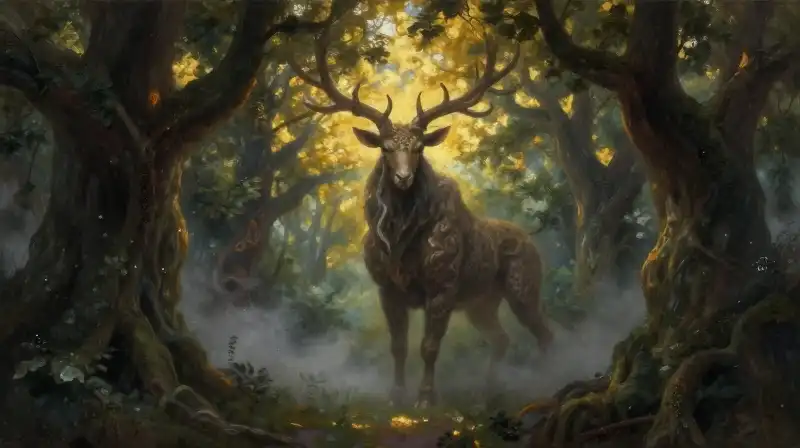
When exploring the rich tapestry of ancient Europe, figures like Cernunnos stand at the intersection of wildlife, mysticism, and social change. Often categorized simply as the “Celtic deer god,” this figure represents much more than a mythological creature; he is a symbol of the wild, powerful cycles of nature, and the complex ways ancient communities viewed the relationship between the human and natural worlds. Cernunnos is traditionally depicted as an aged, bearded man with antlers—often resembling a stag or ram—and typically adorned with torcs and a prominent association with wild beasts such as deer, serpents, and rams 1. The true depth of understanding Cernunnos requires looking beyond mere definitions. He is a figure whose origins are debated, whose geography is widespread yet inconsistent, and who may represent a critical societal shift in ancient Gaul, the region where his imagery is most concentrated. To understand Cernunnos is to engage with the perennial human impulse to personify the untamed forces of the wilderness.
The Iconography of the Wild
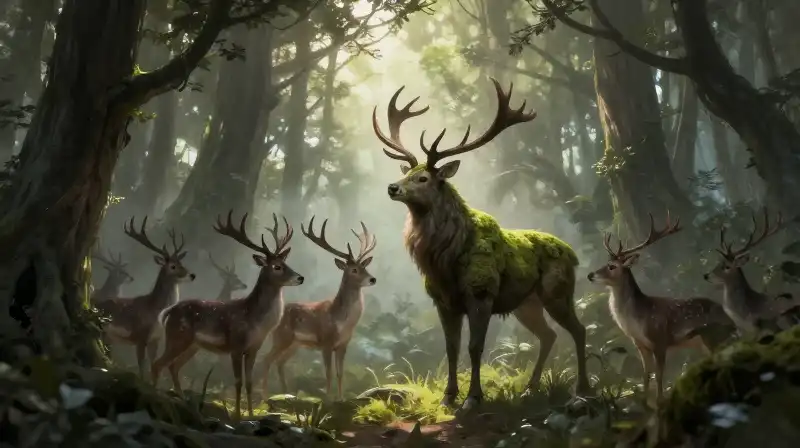
Cernunnos’s physical appearance is rarely just decoration; it is a deliberate piece of cultural narrative. The visual elements of the tradition—the antlers, the aged appearance, the torcs—serve to communicate his primal connection to the forest and the cyclical nature of life and death. The most defining characteristic is the deer-like anatomy. Antlers, in particular, are not merely headwear; they signify a life tied to the woods, representing growth, shedding, and rebirth. He is often portrayed in crossed legs, a posture that lends a sense of contemplative power and rooted stillness. This focus on the wild is further underscored by his consistent association with powerful animals like the deer, the ram-horned serpent, and other symbols of fertility, suggesting he holds a position as a potent guardian of both life and death in nature 1.
The Evolution of a God: From Goddess to Patriarch
One of the most compelling aspects of scholarly research into Cernunnos involves his likely development over time. It is hypothesized that the male horned god iconography may be the result of a cultural or societal transition within ancient Gaul. According to 2, some scholars suggest that Cernunnos’s development could signify a move away from an earlier, dominant cult focused on an ancient feminine deer-goddess originating in the Scottish Highlands. This transition raises fundamental questions about the power structures of ancient Celtic society. The shift from a feminine, perhaps more nurturing or generative deity, toward a strong, antlered male figure may be interpreted by some as a manifestation of changing political, social, or religious tides, illustrating the ongoing process of cultural interpretation across millennia 1.
Regional Echoes: Comparing Gaul and Ireland
While Cernunnos remains most closely tied to the archaeological record of Gaul—the heartland of the tradition—the fascination with the “horned” deity is not limited to that region. The concept of a powerful, nature-aligned deity is a recurring theme in Celtic mythology, though the specific attributes and names vary significantly, and the term “Celtic” is a complex academic construct that does not imply interchangeable beliefs across all regions 1. The geographical distribution of Cernunnos-type images is largely concentrated in Gaul. However, exceptional sightings appear elsewhere, such as the rock carvings in Val Camonica, Italy, and the decoration found on the Gundestrup cauldron in Denmark, illustrating the far-reaching influence of these motifs 1. Further comparison can be made to Irish lore. There, the figure of the Dagda is recognized as a “great or ample father.” His full name, *Fir Benn*, is translated as “man of the peak” or “horned man,” indicating a parallel cultural preoccupation with figures who embody the raw power of the wilderness. While the Fenian Cycle and Irish mythology include characters interacting with nature, such figures are typically mortal servants rather than the central divine deity described in the Gaulish tradition 1.
Navigating the Archaeological Record
Understanding Cernunnos also requires an appreciation for the limits of historical knowledge. Despite the common use of his name in archaeological records, serious scholarly discourse maintains a necessary level of caution. Researchers question whether the attributes and iconography of Cernunnos truly stem from a single, unified cluster of ideas, or if the image has been pieced together from various localized traditions across different geographical regions 1. Furthermore, the linguistic origins of the name itself are debated. Theories range from a direct root meaning “horn, hoof” to a derivation from the proto-Celtic *kerno*, which suggests “the one who has the top of his head like a deer” 1. This linguistic ambiguity suggests that the figure, in his early forms, might have been a more localized interpretation of a shared natural phenomenon—the striking presence of deer in the sacred landscape—rather than a single, monolithic divine entity.
The Cultural Meaning of the Horned God
Ultimately, Cernunnos serves as a living cultural touchstone for contemporary readers and enthusiasts. In the modern context, he represents the enduring spirit of the sacred wild. He symbolizes a reverence for the cyclical nature of life—the growth, the death, and the renewal tied to the forest. He stands as a powerful reminder that ancient societies viewed the wilderness not as something to be conquered, but as a powerful, sentient force that shaped their spiritual and social lives. By studying Cernunnos, we gain insight into the sophisticated relationship ancient people had with their environment, exploring how they integrated the untamed power of nature into their art, their rituals, and their belief systems, long before the term “Celtic deity” became a modern academic construct.
References
Footnotes
Frequently Asked Questions
Who is the Celtic god associated with deer?
Cernunnos is often categorized as the Celtic deer god, representing a figure with a prominent association with wild beasts such as deer, serpents, and rams. This association is a defining characteristic of his iconography, symbolizing his primal connection to the forest and the cyclical nature of life.
Related Articles