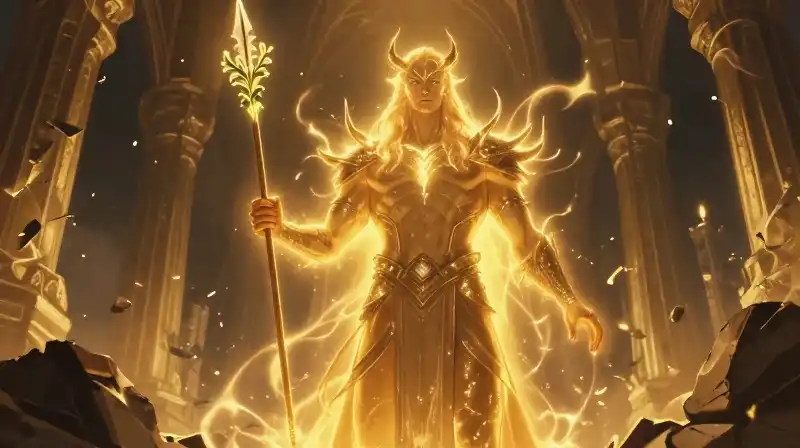
Sága in Norse Mythology: Goddess of Tales and Wisdom


Introduction
In the sweeping tapestry of Norse mythology, figures often serve as reflections of core societal values—roles like the warrior, the jötunn, and the guardian. Sága, however, stands at the heart of something different: the preservation of history, the weight of oral tradition, and the quiet power of wisdom. She is not merely a goddess; she represents the collective memory of a culture, embodying the role of the “guardian of ancient tales” 1. To understand Sága is to understand the immense cultural importance the Vikings placed on narrative and lineage. She is the keeper of the *saga*, a term that refers both to epic stories and the sacred act of recording or transmitting history, linking the gods directly to the human need to remember.
Her existence is a testament to the belief that knowledge and wisdom are living things—entities that reside in specific places and possess divine attributes. This tradition explores how narratives shaped identity, how specific landscapes became sacred centers for revelation, and how these ancient roots continue to inform contemporary interpretations of the old ways.
Sága: The Embodiment of the Seeress
The essence of Sága is tied to her function as a visionary. Her name itself likely draws from the Old Norse word sjá, meaning “to see,” or the verb sjá, suggesting a deep connection to a seeress 1. This capability extends beyond mere prophecy; it encompasses the ability to perceive the patterns of history and the lives of ancestors. She holds the wisdom that bridges the mortal and divine realms, ensuring that the lessons of the past are never lost.
For the Viking communities, where history was primarily preserved through recitation and storytelling, a deity like Sága was an essential conceptual anchor. Her role parallels the significance of the oral tradition, serving as a vital link to the ancestors. This divine embodiment of memory reflects the cultural value placed on those who hold and share the wisdom of the community 1.
The Sacred Hearth of Sökkvabekkr
The mythological home associated with Sága, Sökkvabekkr, provides a vivid location for understanding her significance. Described in the Poetic Eddas, Sökkvabekkr is not a distant, inaccessible realm, but a place of profound natural serenity. It is generally understood to be a place characterized by serene, flowing waters, or in Old Norse, a submerged stream or brook (*bekkr*) 1. It is a landscape of quiet, persistent flow—a fitting symbol for the continuous stream of history and stories.
The relationship between Sága and Sökkvabekkr is made even more resonant through her association with Odin. In narratives like those found in the Poetic Eddas, Odin and Sága are seen joyfully drinking from golden cups at this location 1. This shared scene suggests a bond of mutual respect and camaraderie. Whether one interprets Sökkvabekkr as a tranquil creek or more abstractly as a “sunken bank” or “treasure bank,” its function remains consistent: a sacred space where the highest forms of knowledge and wisdom are exchanged (1, 2).
The Sage vs. The Goddess: Nuances and Debates
Like many traditions, the history of Sága is not settled by a single definition. Scholarly and popular interpretations reveal a fascinating intellectual debate regarding her precise identity. Due to the clear resonance between her name, the site of Sökkvabekkr, and the intimate association with Odin, many scholars suggest that Sága may be an alternative name for the more famous goddess Frigg 1. These theories posit that Sága belongs to a group of lesser-defined protective female goddesses, or *Asyniur*, who managed the nuances of the private and domestic sphere 1.
However, other interpretations maintain Sága’s distinct and independent importance. She is seen as the one specifically tied to epic tales and the concept of *saga* itself 1. In the cultural records of the Poetic and Prose Eddas, Snorri Sturluson noted her dwelling as one of the major residences after Frigg’s own Fensalir (1, 3). This suggests a tradition that accommodates multiple facets of wisdom, recognizing that the preservation of history requires both the immense power of the Great Goddess and the focused guidance of a specific seeress.
Beyond the Myth: The Embodied Concept of Wisdom
At a deeper cultural level, Sága transcends her literal depictions in the Eddas; she is often theorized to represent the concept of the “sage” or “mære.” This suggests that Sága is not just a character, but an embodied idea—a deified form of wisdom found perpetually at springs, wells, or near streams 1. To engage with Sága is therefore to engage with a tradition of intellectual inquiry that elevates the power of memory and careful listening.
For those who engage with these traditions today, the ambiguity of Sága is itself a feature. Some modern pagan practices highlight this uncertainty, honoring her unique role through the distinct association with epic tales, while others view her through the lens of Frigg 1. This living ambiguity reflects a cultural practice of honoring complexity—understanding that power in tradition can be multifaceted, residing simultaneously in the powerful and the specialized.
Sagas and the Modern Reader: Meaning and Continuity
For a reader interested in Norse mythology, the figure of Sága provides a clear understanding of the profound value the ancient cultures placed on “story.” In the context of this tradition, a ‘saga’ is more than fiction; it is a curated record. Whether exploring related searches like ‘Norse god saga names’ or ‘Saga norse mythology deer,’ the common thread is the reverence for the narrative structure that holds a culture together.
Sága, in all her forms, offers a bridge between the cosmological grandeur of the gods and the terrestrial experience of human history. She reminds practitioners and students that wisdom is not only found in monumental deeds but also in the quiet, continuous flow of memory. The preservation of her myths reflects a deep, enduring cultural interest in the importance of lineage, narrative, and the lineage of gods who observe and record life from a place of profound serenity.
References
Footnotes
Frequently Asked Questions
What are sagas in Norse mythology?
A saga refers to both epic stories and the sacred act of recording or transmitting history. The goddess Sága embodies this role, representing the collective memory of a culture and serving as the guardian of ancient tales.
What did the Vikings call Jesus?
The provided article does not contain any information about what the Vikings called Jesus.
Related Articles