Baldur in Norse Mythology: Light, Tragedy, and Ragnarök

Introduction
In the vast cosmology of Norse mythology, where the eternal dance between chaos and order is constant, Baldur occupies a unique and profound space. He is not merely a figure of light, but a personification of the fragile, often deceptive nature of perfection itself. As a central figure among the Æsir—the gods governing Midgard and beyond—Baldur’s story serves as a powerful exploration of fate, purity, and the looming shadows of Ragnarök. He is defined by his splendor and grace, yet his narrative is fundamentally one of tragic inevitability, positioning him as a harbinger whose death signals the beginning of a cosmic twilight.
The Nature of Divine Light
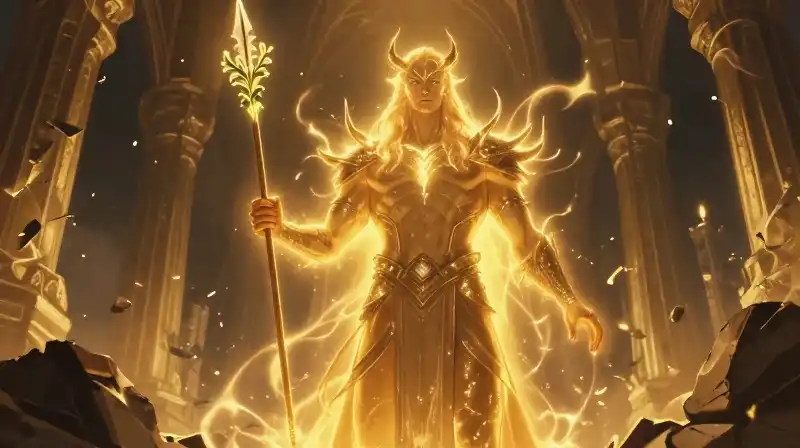
Baldur, son of Odin and Frigg, was widely known among the Æsir for his captivating presence and inherent goodness. According to academic and cultural documentation, he is consistently described as handsome, gracious, and radiant 1. His character was often viewed as a pure, luminous quality that emanated light, making him a beacon of virtue in a world of gods and giants fraught with internal strife. His very name is a subject of scholarly curiosity, offering hints at the cultural concepts surrounding him. Some interpretations link his name to ideas of “white” or “shining,” reinforcing his association with brilliant light and clarity (2, 3). This divine radiance represented the ideal state of peace and order within the divine realm. However, the complexity of his character is made even more pronounced by the possibility of contradictory etymologies. Some suggest an alternate root that could imply a “warlike” character, suggesting that the Norse perception of him was not always monolithic (2, 3).
The Fractured Narratives of His Death
The core of the Baldur tradition lies in the tragic events surrounding his demise, a narrative meticulously preserved across various ancient texts like the *Poetic Edda* and the *Prose Eddas* 1. These sources blend poetic myth and detailed chronicle, resulting in distinct, yet interwoven, versions of his fate. The *Prose Edda* details a dramatic attempt by the gods to protect him. Despite the efforts of his mother, Frigg, who sought oaths from every element—from the mountains to the oceans—to keep him safe, Baldur met his end. This was orchestrated by Loki, who manipulated the blind god Hodr into casting a spear made of mistletoe, the only thing capable of harming the seemingly invincible god 1. This version introduces a key condition: Baldur’s death requires that the world mourn for him in order for him to be retrieved and restored 1. The narrative gains a layer of irony and complexity when the giantess Þökk (often interpreted as a manifestation of Loki’s malice) refuses this act of communal grief. In sharp contrast, the *Poetic Edda* presents his fate through the lens of a *Völva* (a seer), where his death and subsequent return are viewed more as symbolic moments of transition 1. Rather than dwelling on the treachery of Loki, the Poetic Eddas frame his journey as signifying a shift toward a “new age of peace” 1.
The Weight of Inevitable Fate
For those studying Norse tradition, the story of Baldur is not just a recounting of a tragic murder; it is a powerful meditation on fate itself. His loss is widely regarded as a pivotal moment, a critical precursor to the ultimate reckoning of Ragnarök 1. Baldur’s death embodies the Norse understanding that even the purest forms of life and order are subject to the relentless power of chaos and time. The narratives surrounding him are layered with complex interpretations that defy simple definitions. While the traditional accounts emphasize his innocence and luminous purity, modern cultural reinterpretations and certain kennings have begun linking him to themes of “gates” or a powerful, protective disposition (1, 3). This reflects a broader cultural conversation about how these ancient figures have been repurposed and understood through different eras. Furthermore, the concept of “invulnerability” often associated with Baldur is central to the drama. His death, achieved by the most obscure and least powerful of weapons (mistletoe), serves as a profound commentary on how even the greatest strengths and defenses can be undone by unexpected or unseen forces.
Navigating Personal and Cultural Variations
When seeking to understand Baldur’s role, one must be careful not to collapse his multifaceted nature into a single archetype. While the foundational texts define his celestial beauty and radiant goodness, the living tradition allows for subtle shifts in understanding:
- The Archetypal Baldur: Represents idealized goodness and the light of existence 1.
- The Mythological Conflict: Embodies the tension between divine grace and the creeping influence of primordial chaos (Loki) 1.
- Modern Reinterpretations: In contemporary discourse, he is sometimes viewed through the lens of protective elements or as a figure embodying the necessary cycles of destruction and rebirth (1, 3).
Understanding these variations is key to appreciating the depth of the tradition. Whether viewed as a symbol of pristine virtue or a tragic victim of cosmic forces, Baldur remains a pivotal cultural touchstone, reminding the community of the precariousness of existence.
The Enduring Significance of the Baldur Myth
To understand Baldur is to grasp a facet of the Norse worldview where no state of being is permanent. The stories surrounding his death are not intended to provide a simple moral lesson, but to illuminate the complex machinery of the universe—a place where the most perfect beings are often the most vulnerable, and where peace is always held in a fragile balance against the possibility of upheaval. Baldur’s journey through light, tragedy, and eventual transition remains a profoundly resonant cultural narrative. It speaks to the enduring human struggle with the dual forces of hope and loss, ensuring that even centuries after the original oral traditions faded into the written record, his figure continues to hold a meaningful, vibrant place in the tapestry of world heritage.
References
Footnotes
Related Articles