Dual Forces in Slavic Creation Myths: The Earth-Diver and Rod

Introduction
In the tapestry of Slavic folklore, the creation of the world is rarely a singular act of effortless power. Instead, the origins of the cosmos are understood through a powerful, cyclical rhythm of opposition. The narratives preserved across different communities—from the lands of Ukraine to those of Poland and Russia—are not merely historical tales but structural maps of the universe. Central to these myths is the motif of dualism: the idea that order, light, and life can only emerge through the interaction, cooperation, or struggle between seemingly contradictory forces, such as divine order and primordial chaos. This intricate worldview suggests that the Slavic understanding of existence is inherently a dance of opposites.
The Dance of Opposites: Dualism as Cosmic Law
To understand the Slavic creation myth is to appreciate the deep philosophical weight given to balance. The gods, or supernatural entities, in these stories rarely operate in isolation. Instead, creation demands the participation of opposing archetypes—a motif that extends from the concept of a benevolent creator to figures often translated as “the devil.” This pairing suggests that existence is not merely a linear progression but a constant negotiation between inherent forces. 1 notes that these narratives frequently require the cooperation of antagonistic entities to bring the world into being. This dualism operates on several levels, including the eternal struggle between light and darkness, which informs the structural layout of the cosmos itself. This principle is vital for understanding the complexity of the myths beyond a simple, monolithic description of a single god.
The Earth-Diver Narrative: Reaching the Surface of the World
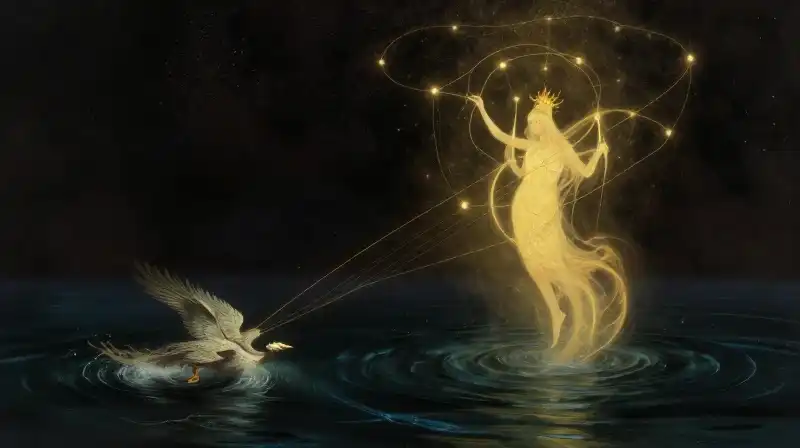
One of the most globally resonant variants of Slavic mythology is the earth-diver myth. This narrative typically begins with a vast, undifferentiated primordial ocean where no land exists. According to documented versions, a figure possessing divine authority—sometimes referred to simply as a “god” (Bog or Boh)—commands a powerful entity, often a devil-like figure, to descend into these deep waters and retrieve a handful of primordial earth to begin the formation of the land (1, 2). The resultant land, however, is often not a passive gift. Instead, many regional accounts, particularly those preserved in Russian and Ukrainian folklore, imbue the process with struggle. The devil may find the expanding earth so overwhelming that he struggles to contain its growth, occasionally leading to dramatic moments where his movements are marked by strikes of thunder and lightning as mountains and hills rise from his labor 1. This version highlights that the creation of the physical world is a difficult, ongoing process of forcing order onto a chaotic element.
Rod and the Golden Egg: The Order from Chaos
Contrasting with the aquatic earth-diver myth is the powerful tradition known as the Rod myth. This narrative offers a different starting point for the cosmic drama: not the sea, but primordial darkness and chaos. In this tradition, the world originates from a golden egg, a potent symbol of nascent life and potential (3, 2). At the core of this chaos resides Rod, the forefather, who eventually gives rise to the established order. A significant part of the Rod myth involves the creation of the goddess Lada, the deity associated with love and harmony. Her emergence is interpreted as a necessary act to reconcile the initial, volatile imbalance between the opposing forces of light and darkness 1. Furthermore, Rod forms six sons and three daughters—primeval gods who take control of the fundamental elements of nature, including fire, water, soil, and air. These elemental powers are the initial rulers of the nascent universe 1.
Structuring Reality: The Three Realms
The comprehensive worldview offered by the Rod myth provides a framework for the entire cosmos. In this Slavic cosmological structure, the created universe is typically categorized into three distinct realms: PRAV, the divine realm where the great entities reside; JAV, the tangible world of daily human reality; and NAV, the realm of lower existence or the underworld 1. This division reflects the inherent Slavic preoccupation with hierarchy and the connection between spiritual and physical life. The myth suggests that completeness is achieved through this integrated system, a recognition that there can be no complete beginning without a final end, nor light without its source in the darkness.
Beyond the Narrative: Origins, Variants, and Modern Context
The body of knowledge concerning pre-Christian Slavic mythology is scattered and complex. A key caveat from scholarly records is that the record of original Slavic mythology is sparse, leading some researchers to suggest that names and specific details may be distorted or be the result of reconstructed oral traditions 1. This has resulted in a mosaic of variants: narratives found in the specific Polish recordings of Sieradz Land differ from those found in Bulgarian or Slovenian folklore 1. Additionally, while some narratives exist rooted in a primordial egg or fire, there is no single, unified narrative shared across all Slavic groups 1. It is also important to note that even as these myths were preserved and studied, they often underwent Christianization. For instance, some narratives describe a depiction of God attempting to consecrate or bless the earth using the symbol of a cross. However, scholars point out that this motif of divine consecration is not unique to Slavic culture, having parallels in other global mythologies, such as those of the Maidu or Huicholas 1.
Addressing the Human Element: How Were Humans Created?
While the myths are rich with the creation of deities and the physical world, the creation of humanity itself is often addressed through variations of the central theme: the mingling of elemental forces. Though specific details vary regionally, human creation is often tied to the transition from the purely elemental to the culturally aware. In the broader scope of Slavic folklore, humanity emerges as a blend of the elemental and the divine, embodying the struggle and cooperation established during the earth’s formation. While humans are not always created in isolation, their existence is fundamentally tied to the structure of the PRAV/JAV/NAV system and the natural order established by Rod’s divine children.
Living Culture: Synthesis and Understanding
The collective stories of Slavic creation transcend a mere historical curiosity. They function as a vital framework for understanding the community’s view of reality. Dualism, whether expressed through the Earth-Diver or Rod narratives, is not a call for endless conflict, but a recognition of complementary forces. The tradition insists that life, beauty (represented by Lada), and order can only be sustained through the recognition and balance of opposing powers. For the contemporary reader seeking to genuinely understand this heritage, the significance lies in the cyclical nature of these beliefs: the continuous, delicate process of transforming primordial chaos into a manageable, complex, and beautiful world. It is a story of continuous emergence, where every element, good or seemingly “evil,” holds a place in the structure of being.
References
Footnotes
Frequently Asked Questions
How were humans created in Slavic mythology?
Human creation is often addressed through variations on the central theme of the mingling of elemental forces, signifying the transition from the purely elemental to the culturally aware. In Slavic folklore, humanity emerges as a blend of the elemental and the divine, embodying the cooperation established during the earths formation.
What is the mythology of the Slavs?
Slavic mythology is centered on the powerful motif of dualism, which holds that order and life emerge through the interaction or struggle between seemingly contradictory forces like divine order and primordial chaos. These narratives, which include the Earth-Diver and Rod myths, structure the cosmos into three distinct realms: PRAV, JAV, and NAV.
What is the myth of the Slavic earth-diver creation?
The earth-diver myth begins in a vast, primordial ocean where no land exists, and a divine figure commands a powerful entity, often a devil-like figure, to retrieve a handful of primordial earth. In many regional accounts, the creation process is a difficult struggle, with the devil attempting to contain the expanding earth as mountains and hills rise from his labor.
Related Articles