Nut: The Ancient Egyptian Goddess of the Sky and Cosmos

Introduction
In the vast and intricate tapestry of ancient Egyptian cosmology, certain figures serve as the essential framework through which existence is understood. Nut, the goddess of the sky, is not merely a deity representing the heavens; she is the personification of the curving, celestial vault—a monumental presence that actively shapes and protects the world below. Within the traditions of the Heliopolis, Nut is the dynamic canvas upon which the dramas of creation, rebirth, and the journey of the sun unfold. To understand Nut is to understand the Egyptian perspective of time, death, and the infinite cycle of being.
The Celestial Canopy and the Separation from Earth
The imagery of Nut is profoundly architectural. She is typically depicted arching over the Earth, a powerful visual metaphor that defines her function: to cover and encompass the world beneath her. Her posture—with her feet positioned in the East and her head turned toward the West—emphasizes her role as a perpetual enclosure. Nut is not a distant, detached entity; she is the immediate, encompassing reality of the atmosphere and the heavens [1, 2, 3].
Her origin narrative, rooted in the Heliopolis cosmogony, establishes her as the daughter of Shu (Air) and Tefnut (Heat), and the sister to Geb, the god of Earth [2, 3]. Early myths describe a relationship of immense tension between the sky and the ground. A major theme in these narratives is the separation of Nut from Geb. This separation was facilitated by Shu (Air), who intervened and raised Nut into the realm of the celestial sphere, pulling her away from the terrestrial realm of Geb [3]. This dynamic is significant, as it establishes a cosmic tension—the necessary distance between the volatile, material world of the earth and the eternal, celestial expanse above [1].
The Mechanism of Rebirth: Ra’s Journey Through Nut
One of the most profound functions of Nut in Egyptian belief is her connection to the solar cycle and the concept of eternal rebirth. In these myths, the sun god Ra must navigate the expanse of the night sky. Ra travels through the body of Nut during the night, a journey that culminates in her swallowing him and giving birth to him again each morning. This act of cyclical birth and renewal perfectly symbolizes the Egyptian understanding of life, death, and the perpetual resurrection of the sun [2, 3].
This continuous journey through the celestial body of Nut also intertwines with the human measurement of time. Narratives explain that while the official calendar year was based on 360 days, Nut gave birth to five children despite the Sun God Ra’s prohibition during that period, receiving assistance from Thoth [2]. This suggests that Nut represented not just a fixed space, but a dynamic, generative force that transcended rigid, human-imposed measurement.
The Generative and Protective Power
The generative power of Nut is evident in her divine lineage. According to the Heliopolis narrative, Nut and Geb eventually mated, bearing four prominent children: Osiris, Set, Isis, and Nephthys. While some later accounts, such as those recorded by Plutarch, mention variations that include a fifth son, this family established the core divine structure of Egyptian life and death [1, 3].
Beyond her generative role, Nut is heavily associated with the protection of the dead. Her function as the “Cover of the Sky” extended into the funerary realm. Ancient cultural narratives frequently portray her on coffins and sarcophagi, reflecting her protective role over the departed as they transitioned into the afterlife [1, 2]. In this capacity, she is frequently interpreted through titles such as “She Who Protects” and “Mistress of All,” emphasizing her ability to shield the soul in the vastness of the cosmos [1].
Interpretations and Cross-Cultural Parallels
The influence of the Nut goddess extended far beyond the geographical boundaries of ancient Egypt, showing how powerful archetypes travel and transform across cultures. Scholars have noted that ancient Greek sources, such as Plutarch, identified parallels between Nut and certain Greek deities, suggesting a deep level of syncretism or shared mythological themes between the civilizations [1].
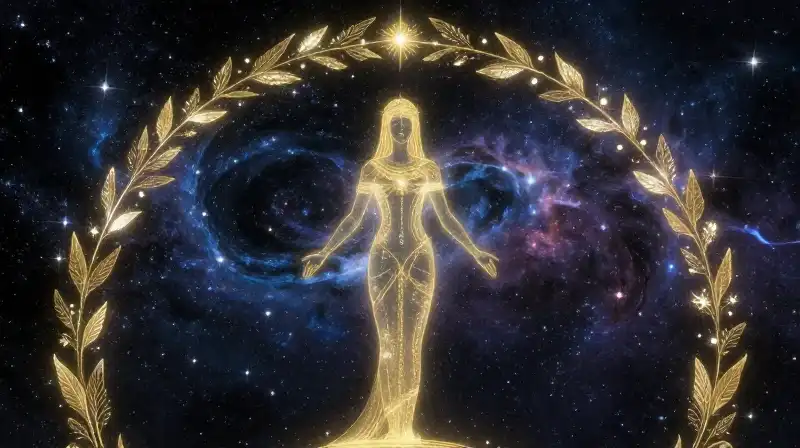
Furthermore, the concept of a dark, enveloping celestial feminine deity can be traced into non-Egyptian mystical traditions. For example, some cultural texts highlight an interpretation of Nut appearing as a dark Sky Goddess above the “Golden Sphere of Hadit” in a Kabbalistic Tarot deck, showing how the archetype of the cosmic void—the necessary backdrop for existence—continues to resonate in modern mystical practices [3]. These variations underscore the enduring appeal of Nut as a symbol of powerful, encompassing, and generative cosmic energy.
Understanding Nut’s Living Legacy
Nut, as the embodiment of the starry sky, represents the intersection of the infinite and the immediate. She is the space where the material world (Geb) meets the divine cycle (Ra). She provides the framework for the Egyptian understanding of continuity—the fact that though a form may die (Ra’s passage into Nut), the energy is never lost; it is merely transformed and reborn every dawn.
For the modern reader engaging with this tradition, the significance of Nut lies not simply in the identification of a deity, but in appreciating the sophisticated cosmological metaphor she represents. She teaches the lesson that protection, creation, and the cycle of decay are all unified components of a grand, eternal whole. Nut is the living history of a culture that viewed the sky not as a backdrop, but as a profound, protective, and constantly regenerating presence.
References
Footnotes
Frequently Asked Questions
Who is called the goddess of the sky?
Nut is called the goddess of the sky, as she is described as the personification of the curving, celestial vault in ancient Egyptian cosmology.
Who is the African goddess Nut?
Nut is the goddess of the sky, serving as the personification of the curving, celestial vault in ancient Egyptian cosmology. She is depicted arching over the Earth to cover and encompass the world beneath her, and is known for her role in the dynamic processes of creation, rebirth, and protection.
Are there myths about Nut goddesses?
Yes, the article describes numerous myths concerning Nut, including her origin as the daughter of Shu and Tefnut, the narrative of her separation from Geb, and the story of Ra traveling through her body nightly to be reborn. These cultural narratives also detail her generative power and her function as a protective figure for the deceased.
Related Articles