Wadjet: The Mighty Cobra Goddess of Ancient Egypt

Introduction
Wadjet is one of the most enduring and formidable protective deities of the ancient world. In the cultural landscape of Egypt, she was known locally as the ‘Green One’ (wꜣḏyt), a formidable goddess intrinsically tied to the regional identity of Lower Egypt. Far from being a mere symbol of danger, Wadjet was a powerful, fierce, and protective matron whose very essence was interwoven with the defense and prosperity of her people [1, 2]. She embodies the powerful dynamic of guardianship, transforming the primal venom of a common desert snake into a divine force that protected both the common populace and the pharaonic lineage. Understanding Wadjet is to understand the localized roots of Egyptian identity, which eventually grew to encompass the entire kingdom.
The Iconography of Divine Protection
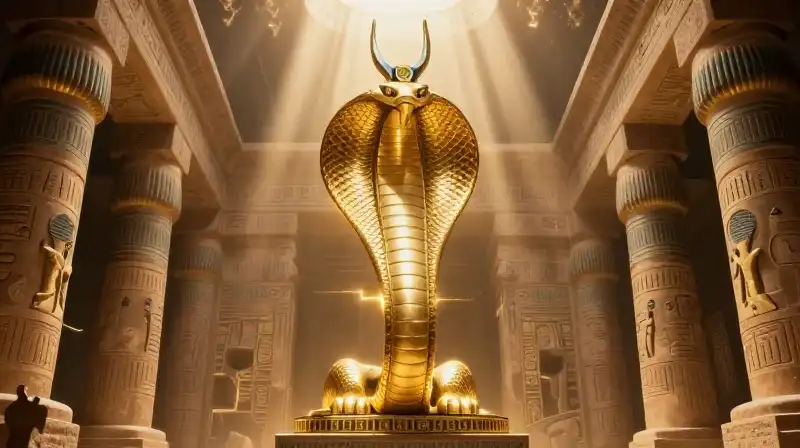
The visual representation of Wadjet speaks volumes about her power. Her signature form was that of an Egyptian cobra, a highly venomous snake native to the region. This serpent was not depicted as harmless; instead, she was shown striking and biting enemies, harnessing the natural, potent power of the desert’s most dangerous creatures [1]. This inherent danger was transformed into divine defense. As she evolved, artistic depictions emphasized this power through striking colors: vibrant green and blue, colors commonly associated with her, or in more intense periods, the deep red and gold used to signify potent danger or the divine flesh itself [1]. The most politically and religiously significant symbol associated with Wadjet is the uraeus—the cobra coiled upon the head. This emblem was the defining feature of the crown of Lower Egypt, serving as a stark, eternal reminder of the King’s protection [1, 2]. When this cobra was placed on a diadem or crown, it was not merely an adornment; it was Wadjet’s living manifestation, signifying that the king’s reign was divinely sanctioned and guarded by her fierce vigilance [2]. This powerful visual vocabulary established her as more than just a local spirit; she became a symbol of supreme sovereign protection.
The Shift from Regional Deity to National Guardian
Wadjet’s spiritual journey is one of profound regional growth. Initially, she was viewed as a local deity tied to the heart of Lower Egypt, documented as early as the Predynastic era, with early symbolic traces including a snake entwined around a papyrus stem [1]. This local significance was deeply rooted in community life and the specific needs of the northern lands. However, her cultural weight expanded dramatically following the unification of Upper and Lower Egypt. In her role as a protective entity, Wadjet eventually transitioned into the mantle of the matriarch and guardian of the entire country [1]. This unification saw her spiritual domain widen to encompass the whole of the Nile valley. Her role became most fully realized through her symbiotic relationship with her sister, Nekhbet, the powerful Goddess of Upper Egypt. Together, Wadjet and Nekhbet were elevated to joint protectors over the unified land, a relationship immortalized by their joint depiction on the king’s diadem, symbolizing dominion over both regions [1, 2].
Myth, Symbol, and Divine Ambiguity
Like many powerful ancient deities, Wadjet’s mythology contains layers of interpretation and debate. Some narratives portray her as the daughter of the sun god Ra and his seeing eye. In these accounts, she plays a foundational role in creation, being responsible for discovering the gods Shu and Tefnut before she turned her protective gaze toward enemies to defend her father [1]. While some texts tentatively suggest she served in a nursing role for the infant god Horus, the primary, consistent description of Wadjet remains one of relentless protection and striking power [1]. A notable nuance regarding her tradition is the ambiguity surrounding her gender. While her name’s ending is often used to signify a feminine presence, there is historical discussion about whether Wadjet was originally conceived of as male or female, reflecting a common pattern in ancient pantheons where attributes and forms could shift over time [1]. This fluidity itself reflects a broader cultural tendency to define deities by their function and power rather than a rigid biological classification. Furthermore, Wadjet’s iconography sometimes blended her protective aspects with other symbols of royal might, such as being portrayed as a lioness crowned with a rearing cobra, illustrating the blending of human, serpentine, and animal power within her divine identity [1].
Wadjet’s Connection to Other Traditions and Concepts
While Wadjet remains uniquely Egyptian, the connections between her and other ancient pantheons highlight the cultural exchange occurring across the ancient Mediterranean. For instance, her mythological counterpart—a deity known as Uto or Buto—suggested potential cultural links between the Egyptian and Greek religious traditions [2]. This relationship is particularly telling because it suggests that Egyptian protective ideals, embodied by the cobra goddess, held a resonant significance that transcended the geographic boundaries of the Nile. In terms of spiritual power, Wadjet was associated with the powerful symbolic eyes of Horus and Ra, both emblems of potent defense and foresight. Though scholarly consensus has yet to pinpoint exactly which eye is singularly tied to her, her protective function naturally aligned her with these concepts of divinely vigilant observation [1].
Synthesizing Meaning: The Legacy of the Green One
Wadjet was not just a name on a list of gods; she was a living representation of the strength and protective instinct of an ancient people. She began as a local spirit of Lower Egypt, a fierce woman who defended her community with the terrifying efficiency of a venomous snake. Her transition into the joint protector of the whole kingdom, alongside Nekhbet, cemented her status as a fundamental pillar of Egyptian identity and sovereignty. To examine Wadjet is to examine the potent way that ancient communities transform the raw power of nature—the bite of the cobra, the vigilance of the serpent—into the structured, divine, and eternal protection of their civilization.
References
Footnotes
Related Articles