Lævateinn vs. Leviathan: Decoding the Norse Myth’s Secret Weapon

Introduction
The convergence of myth and modern pop culture often leads to the conflation of distinct stories, particularly in the realm of legendary weapons. A primary example of this is the persistent confusion between the term *Lævateinn*, a significant artifact from Norse folklore, and the biblical leviathan. For a reader exploring the rich traditions of Northern European heritage, understanding the nuanced difference between these concepts is vital. Lævateinn is not merely a weapon; it is a piece of the Poetic Edda, a mythological object whose identity, physical form, and very etymology have captivated scholars for centuries.
Lævateinn in the Fold of the Eddas
In Norse tradition, the story of the *Lævateinn* is primarily housed within the poem *Fjölsvinnsmál* 1. Unlike the widely recognized Leviathan, which anchors its origins in biblical text, the *Lævateinn* emerges from a specific narrative designed to facilitate a magical or dramatic purpose. It is described as the single, potent object capable of achieving a profound feat: sending the rooster *Víðofnir* to the realm of Hel 1. This context immediately places the weapon within the complex, often unpredictable world of Norse cosmology. The lore indicates that the weapon was crafted by Loki, frequently referred to as *Loptr* within the text 1. Its importance is further emphasized by its security; it is believed to be locked away within an iron chest protected by nine distinct locks 1. This narrative detail suggests that the power of the *Lævateinn* is not just inherent in its material, but guarded and potent enough to require such robust security.
The Evolution of a Name: From Hævateinn to Lævateinn
The scholarly debate surrounding the *Lævateinn* is particularly rich because the artifact’s meaning is encoded not just in its function, but in its name. Early manuscript forms, such as *Hævateinn*, have been glossed as “sure-striking dart or arrow” 1. This early interpretation suggested a precise, penetrative purpose. The later shift to *Lævateinn* introduced a new layer of complexity. Etymological analysis suggests the root *læ* within the name can signify “cunning,” “deception,” or “injury” 1. This allowed for various translation glosses, such as “Wounding Wand” or “wand of non-deceit” 1. Different commentators have interpreted this dual meaning, rendering the weapon variously as “Wand-of-Destruction,” reflecting the immense, destructive nature ascribed to the item 1. This linguistic ambiguity suggests that the object is more than a simple tool; it is a metaphor for destructive, cunning power.
Decoding the Form: Dart, Sword, or Staff?
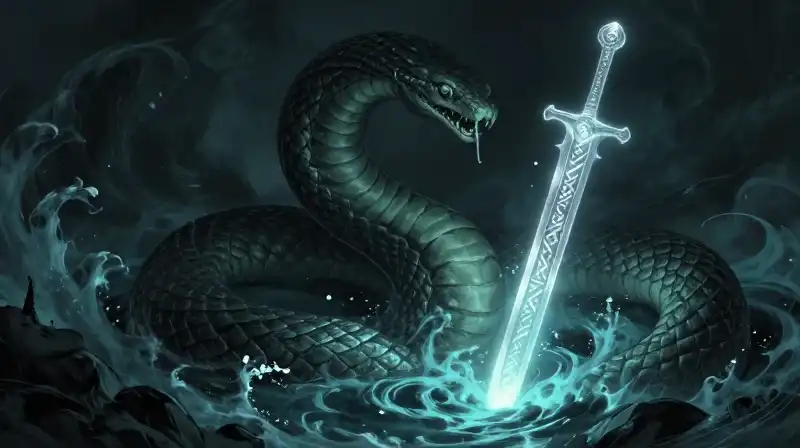
One of the most enduring questions among Norse myth enthusiasts is the physical form of the *Lævateinn*. The text does not provide a singular, definitive visual, which is typical of complex folklore. Early interpretations included the object as a *spiculum* (a type of dart or arrow) 1. Other, more modern interpretations identify it as a sword or a *seiðr* magic staff 1. Furthermore, some academic theories propose that *Lævateinn* might function less as a literal descriptor of a wand, and more as a “kenning” (a figurative, coded phrase) for a sword 1. An alternative, highly specific scholarly interpretation suggests that the rooster *Víðofnir* itself may not be a mere bird, but rather a specific aspect or hypostasis of the Norse deity Hœnir 1. Such an interpretation elevates the entire object and its victim into a realm of complex divine relationships rather than simple action.
Lævateinn versus Leviathan: A Clarification of Tradition
The confusion between the *Lævateinn* and the term “Leviathan” in modern pop culture is widespread 1. This conflation is a critical misunderstanding of distinct cultural traditions. The Leviathan originates from the Hebrew Bible and represents a vast, powerful sea creature or monster in that religious narrative 1. In contrast, the *Lævateinn* belongs specifically to the Norse mythological cycle, detailed in sources like the Poetic Edda 1. 2 clarifies that the modern use of the term “Leviathan” often represents a contemporary anglicization of the original concept, stripping it of its specific Norse roots and applying it to disparate myths globally (1, 2). To properly understand Norse mythology, it is essential to keep these two tradition-specific entities separate.
The Significance of Destructive Power in Norse Lore
While the *Lævateinn* is depicted as a formidable and potentially destructive weapon, its presence in the narrative serves to showcase the immense powers held by the gods and, crucially, the tricks of characters like Loki 1. The weapon is used to effect a profound, irreversible change in the cosmological order—the forced migration of a creature like *Víðofnir* to the shadowy realms of Hel 1. The object stands as a powerful symbol of focused, magical energy—whether that energy is represented by a wand, a dart, or a sword. Its guarded nature and the shifting meanings of its name highlight a recurring theme in Norse heritage: power is potent, often ambiguous, and subject to cunning and manipulation.
Synthesis of Meaning
The *Lævateinn* lives in the intersection of language, magic, and fate. It is a testament to how folklore can be both deeply grounded in narrative context—a weapon crafted by Loki to perform a specific task in *Fjölsvinnsmál*—and intellectually fluid. By acknowledging the scholarly debates regarding its form (dart versus sword) and its etymological roots (cunning versus destruction), the tradition remains a vibrant area of study. Rather than being defined as a static mythical object, the *Lævateinn* is best understood as a cultural device that illustrates the sophisticated blend of destructive force and narrative ambiguity that defines much of Northern European literary heritage.
References
Footnotes
Related Articles