Woden and Odin: Tracing the Germanic Roots of the Norse Deity

Introduction
The question of whether Odin, Woden, and Wotan are all the same god touches upon one of the most fascinating areas of Germanic folklore: the deep, shared linguistic and cultural roots of Northern European spirituality. While the modern narrative often simplifies them into a single “Allfather” figure, tracing their origins reveals a complex family of deities who evolved across different regions and centuries. These names are not merely synonyms; they represent distinct spiritual traditions—the powerful, word-wise figure revered by the Saxons, and the multifaceted leader of the slain worshipped by the Vikings. To truly understand this tradition is to look at the linguistic evolution and the regional cultural shifts that transformed a local tribal deity into a supreme figure of the Norse cosmos.
The Etymological Ancestry: Lord of Frenzy
To grasp the connection between Woden and Odin, one must begin with the reconstructed Proto-Germanic language. Both figures trace their lineage to the masculine theonym *Wōðanaz*, which translated generally to “lord of frenzy” or “leader of the possessed” (1, 2). This name carries an inherent sense of powerful, ecstatic authority. Linguistically, the root of this concept leads back to the Proto-Germanic adjective *wōðaz*, which is understood to be connected to the Pre-Germanic idea of a “seer” or “prophet” 1. This initial meaning suggests a deity deeply intertwined with visions and supernatural knowledge—a figure who leads not just armies, but also minds driven by prophetic states. The shift from Wodan to Odin is primarily an internal linguistic process within the Germanic languages. Historians attribute the transition to a common sound shift in Old Norse, specifically the disappearance of the “w” sound when it preceded the letter “u.” This phonetic change mirrors other evolution patterns within the language, eventually resulting in the familiar name Odin 1. While this shift provides a clear pathway from the ancestral form to the Old Norse figure, it does not negate the regional power held by the name Wodan prior to the Viking Age.
Wodan and Wotan: Regional Context and Cultural Shifts
The distinct identities of Wodan and Wotan highlight the diverse spiritual landscape of early medieval Germanic tribes. Wodan was primarily revered by the Saxons before their conversion to Christianity, establishing a powerful presence in regional Saxon mythologies. During this period, the traditions held distinct local figures; for instance, some Saxon beliefs did not heavily feature the goddess Freya, though they did include equivalent Earth Mother figures like Nerthus, Erda, and Jord (1, 2). As the Germanic cultures expanded and consolidated, the Wodan tradition merged into the broader pan-Germanic pantheon, evolving into Wotan, the Continental figure, and eventually into the supreme deity of Norse mythology, Odin. The process of *interpretatio romana*—the tendency of cultures to map unfamiliar gods onto familiar ones—sometimes led Roman authors to associate Wodan with the Roman deity Mercury, showing how these foreign traditions intersected with established classical beliefs 1. Despite these regional variations and external mappings, the core concept of the powerful, guiding figure remained the constant thread throughout the evolution.
The Paradox of the Allfather: Wisdom versus War
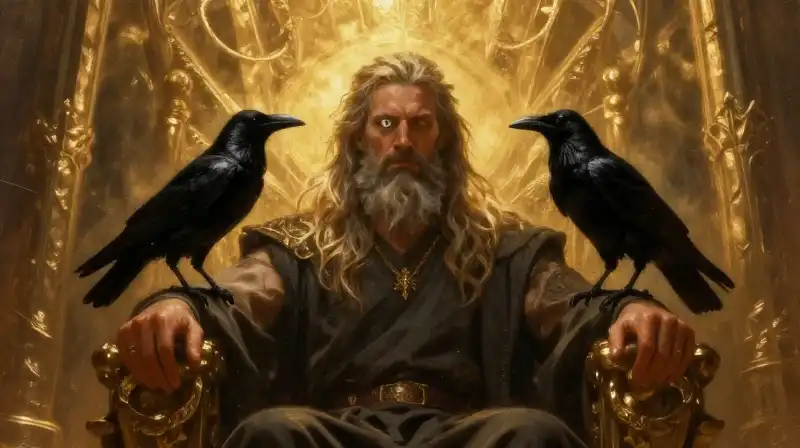
A common misconception is that Woden or Odin is simply a god of war or a god of wisdom. In truth, the tradition demands that the deity be understood as a complex, double-edged figure who embodies the tension between creation and destruction. Odin’s association with war and death is evident in his role as the bringer of conflict and the leader of the *einherjar* (the slain warriors) gathered in Valhöll (2, 3). Yet, his path to power is inherently tied to deep wisdom and intellectual pursuit. He is often depicted undergoing acts of profound self-sacrifice—such as sacrificing an eye for a drink from the well of Mímir, or hanging himself for nine days to unlock the secret of the runes 1. This narrative establishes that wisdom, for Odin, is not merely learned, but is earned through hardship and sacrifice. He is the “seeker,” navigating the chaos of existence to gain forbidden knowledge. This duality is central to the “Living Culture” of the belief: the power to destroy is matched only by the power to understand.
Shamanism, Names, and the Scope of Influence
The depth of Odin’s spiritual reach is illustrated by his vast collection of over 170 names, each representing a specific attribute or aspect of his nature (2, 3). These titles allow him to function in countless ways—from the progenitor of humanity, Ask and Embla, to the leader of the wild, unpredictable Wild Hunt. This complexity is further enhanced by the concept of ecstatic or shamanistic practices. Odin is strongly linked to the wisdom achieved through altered mystical states, suggesting potential influences from neighboring spiritual traditions, such as the Sami 1. While Roman accounts mention other figures like Tiw and Yngwi, the overarching figure of Odin serves as the nexus where regional shamanistic practice and formalized pantheon structure meet. The diverse list of names, coupled with his roles as a poet, prophet, and war leader, confirms that he represents a vast spectrum of human experience.
Understanding the Context: Addressing the Traditions
Many outside of the Germanic tradition ask specific questions regarding these figures. Regarding the nature of the deity, Woden and Odin are fundamentally the same root concept, representing the same spiritual journey of a powerful, visionary leader who sacrifices himself for knowledge. Concerning the relationship with other faiths, it is important to understand that the transition from these ancient Germanic beliefs to the Christian faith was a long process of cultural accommodation. When inquiring about what the Vikings called Jesus, it is necessary to acknowledge the profound theological and cultural divide that existed; these were separate worldviews operating within the same geographic area.
The Living Meaning of the Tradition
The enduring appeal and complexity of the Woden/Odin tradition lie in its portrayal of a leader who is neither purely good nor purely evil. He is powerful, mercurial, and profoundly intellectual. This tradition teaches that leadership and wisdom require immense personal cost—a cost that can be the sacrifice of a physical eye or the acceptance of the grim fate of the fallen. For those who study or engage with this heritage, the tradition offers a lens into the deep connection between human knowledge, the wild, untamed power of nature, and the cyclical nature of creation and death. It is a legacy of seeking the truth, even if that truth is dark, difficult, and requires a willingness to lose something of oneself to find it.
References
Footnotes
Frequently Asked Questions
What did the Vikings call Jesus?
The article notes that the Vikings held separate worldviews compared to the Christian faith, and it does not provide information on what the Vikings called Jesus.
Who is the Norse god Woden?
Woden was primarily revered by the Saxons as a powerful, word-wise figure and a deity connected to being a seer or prophet. Linguistically, he is understood as the lord of frenzy, representing a visionary leader who sacrifices himself to gain knowledge.
Is Woden a god of war or wisdom?
Woden is a complex, double-edged figure who embodies the tension between creation and destruction, rather than being solely a god of war or wisdom. He is associated with conflict as the leader of slain warriors, yet his path to power is inherently tied to deep wisdom and intellectual pursuit.
Related Articles