Amun-Ra: From Local Theban God to Egyptian Supreme Deity

Introduction
In the heart of ancient Egypt, certain deities did not merely occupy a place in the pantheon; they shaped the very architecture of civilization, politics, and piety. Amun, a god whose original title meant “the hidden one” or “the invisible,” was perhaps the most dynamic and transformative figure in Egyptian religious history. Far from being a static concept, the tradition of Amun represents a living process of cultural absorption and creative power, evolving from a modest local protector to the supreme, universal “one one” creator. To understand Amun-Ra is to understand the complex mechanisms by which regional traditions rise, merge, and define the global scope of a civilization’s spiritual reach.
From Local Protection to Universal Dominion
The journey of Amun begins not with celestial grandeur, but with the intimate relationship between a city and its guardian. In his earliest form, he was a local deity of Thebes, serving as a tutelary protector of the city and its people (1, 2). However, his rise to national prominence was a gradual affair, accelerated by political upheaval, particularly the Hyksos rebellion and the subsequent reign of Ahmose I in the 16th century BC 1. This expansion was not simply a matter of increased worship; it required Amun to reconcile his identity with more established, powerful forces within the Egyptian spiritual landscape. The divine narrative of Amun is fundamentally one of assimilation. According to 1 and 3, he absorbed and merged with various other significant deities over time. The most pivotal event in this evolution was the process of syncretism, which identified him with the great Sun god, Ra. This fusion birthed Amun-Ra, a deity who transcended local borders and assumed a position of transcendental importance (1, 2). This merger established him as a supreme creative figure, the “one one,” capable of unifying the disparate elements of existence.
The Symbolism of the Creator: Amun-Ra and Ra
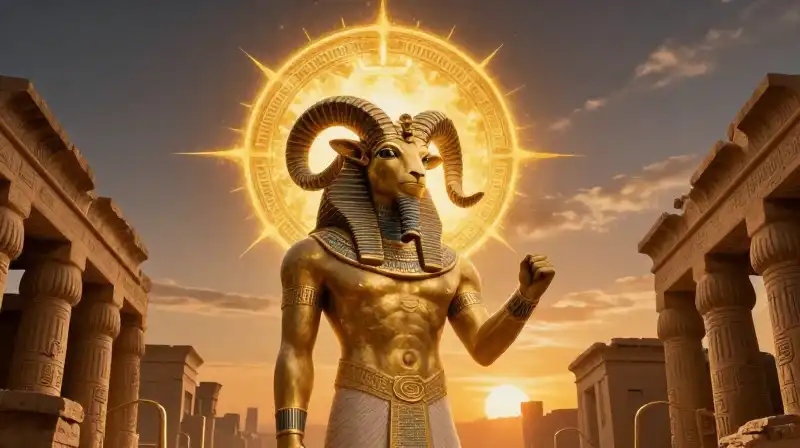
The transformation into Amun-Ra fundamentally altered the Egyptian view of the cosmos. While many gods, including Atum and Ra, were considered paramount at different times and in different regions, Amun-Ra became the central pillar of the New Kingdom 1. He was seen as the ultimate champion—not only a force of creation but also a defender of the common Egyptian, a figure of intense personal piety (1, 2). His identity is richly symbolic. Amun was often associated with the Theban Triad, a divine family unit consisting of his wife, Amunet, and his son, Khonsu (1, 2). Symbolically, he is depicted in various forms, including the ram, known as the criosphinx, the goose, and occasionally with ape or lion heads. This rich iconography usually presented him as a man with dark blue or black skin, reflecting his deep connection to the fertile earth and the cycles of life 1.
The Divine Relationship: Kings and the Gods
The presence of Amun-Ra in Egyptian life was inseparable from the throne. Culturally, his identity solidified his role as the cornerstone of royal legitimacy. The pharaoh was no longer merely a human ruler; he was part of the divine order, often depicted in temple frescos as Amun-Ra’s son 1. This bond was publicly affirmed through profound civic and religious events, most notably the Opet Festival, a grand celebration that marked the sacred marriage between the god and the reigning queen 1. The Amun-Ra cult was the epicenter of political life. Its immense power gave the priesthood of Thebes unparalleled influence, making them powerful players in Egyptian society (1, 2). However, the sheer scale of this power eventually became a source of significant tension. The accumulated might of Amun’s priesthood, coupled with the divine authority of the god himself, eventually contributed directly to the radical theological shift initiated by Pharaoh Akhenaten in his pivot toward the singular Aten, an attempt to challenge the established power structures of the Amun cult (1, 2).
Cultural Echoes: From Thebes to the Mediterranean and Nubia
The power of Amun-Ra resonated far beyond the borders of Egypt, demonstrating the tradition’s lasting cultural footprint. His influence extended into Nubia (Kush), where his ram-headed form integrated with the local deity Min. This assimilation led to a powerful new regional tradition that linked Amun to fertility and virility (1, 2). This global appeal continued into the classical Mediterranean world. Amun-Ra’s universal significance was so profound that he was later equated with Zeus in Greece and Jupiter in Rome (1, 2). This syncretism shows that Amun-Ra was not just a regional myth, but a powerful archetype of the universal king, a concept that bridged diverse cultural divides across ancient trade routes.
The Living Mystery of the Amun Pantheon
Navigating the ancient Egyptian pantheon is often a source of confusion, especially for outsiders. It is essential to understand that the complexity of Egyptian belief requires nuance; figures like Amun, Ra, and Atum were often simultaneously regarded as the dominant heads of the pantheon, but this status shifted across different historical eras and regional boundaries 1. Amun-Ra, however, stands out as the embodiment of a singular, dynamic evolution—a god who represents the ultimate successful synthesis of local heritage and cosmic authority.
Conclusion: The Enduring Cultural Legacy
Amun-Ra’s tradition is a testament to the power of cultural synthesis. He reminds us that identity and meaning are rarely fixed; they are forged in the crucible of interaction—between a local protector and a universal sun god, between a ruling king and a transcendental deity, and between different cultures across the vast expanse of the ancient world. For those wishing to understand the soul of Egyptian heritage, Amun-Ra provides a powerful lens into how local beliefs can achieve cosmic status, shaping art, politics, and the spiritual lives of millions for millennia.
References
Footnotes
Related Articles