
The Grifinn: Origins, Symbolism, and Art Across Ancient Cultures

Introduction
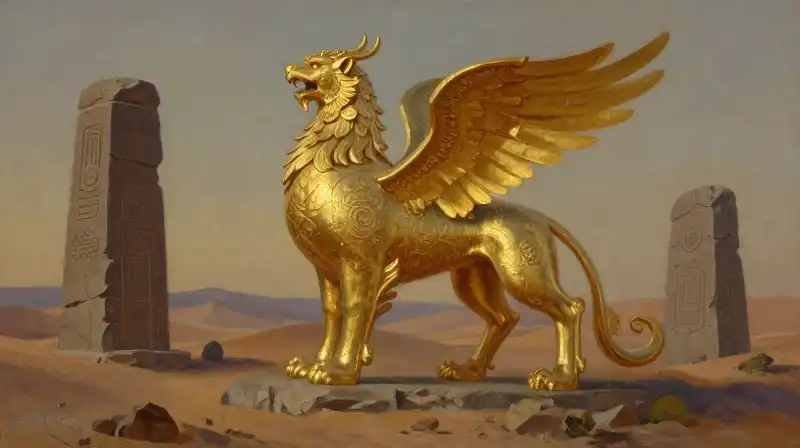
The griffin—a magnificent, composite creature often depicted with the body of a lion and the head and wings of an eagle—is far more than a mere mythological beast. It is a potent symbol of duality, straddling the realms of strength and swift vision. Tracing its lineage across the ancient Near East, through the Mediterranean, and into the medieval European imagination reveals a creature whose meaning is as diverse as the cultures that embraced it. From a fierce protector guarding precious gold to a profound emblem of fidelity, the griffin’s journey offers a window into the varied preoccupations of human communities, embodying qualities sought by their kings, scholars, and gods alike.
The Shifting Shapes of Antiquity
Early researchers place the origins of the griffin in either the Middle East or Asia, suggesting its roots may even be inspired by the fossilized remains of the protoceratops of Central Asia 1. Across these early civilizations, the griffin underwent significant artistic transformation. One common depiction features the lion’s body paired with the eagle’s head and wings 1, but artistic variation proves the concept was fluid. Some older illustrations even show lion forelegs instead of bird-like talons 1. Furthermore, regional traditions emphasized different visual nuances. In Iranian (Uratrian) art, a hallmark of the griffin’s early prototypes included “tendrils” or curled “spiral-locks” 1. In contrast, Classical Greek artifacts, such as cast bronze cauldron figurines, show a highly stylized version: a squat face, a short open-mouthed beak, and a distinct “top-knob” between the brow 1. This variability in form suggests that the creature was not dictated by a singular biological blueprint, but by the symbolic needs of the artists and the cultures commissioning them.
Guardians of Power and Prestige
In ancient communities, the griffin was rarely a benign figure; its function was consistently tied to vigilance and defense. For the Persians, the creature served as a protective figure meant to guard community boundaries and assets 1. The Greeks also adopted the griffin into their lore, primarily associating it with fiercely guarding gold and treasure 1. Early Greek myths connected the griffin to the mountainous region of Scythia, where it was said to keep large quantities of gold secure from a group known as the Arimaspians 1. The concept of guardianship also manifested in the rituals of other civilizations. The ancient Egyptians, for example, integrated the griffin into their pantheon of power, portraying them as powerful steeds that pulled the chariots of pharaoh gods 1. By appearing in different ancient cultures—from protective spirits to divine steeds—the griffin’s essential role as a keeper of value—whether material wealth, divine authority, or national identity—became firmly established.
A Symbol Transformed: From Beast to Virtue
As cultural narratives evolved, the griffin’s meaning deepened, shifting from a physical guardian of goods to a spiritual emblem of character. The symbol adapted dramatically in the medieval Christian tradition, where it acquired specific, higher symbolic meaning: it represented the concepts of fidelity and monogamy 1. A parallel evolution occurred in European heraldry. During the medieval period, the griffin became a crucial piece of symbolic language on coats of arms. It was utilized to embody complex qualities such as bravery, strength, endurance, and alertness 1. This late adoption allowed the griffin to function as a living, recognizable badge of a knight’s or house’s desirable traits.
Mythology and Linguistic Roots
The breadth of the griffin’s cultural adoption is also confirmed through language. The Persian term *šērdāl* is a linguistic example that translates the creature directly as “lion-eagle” 1. However, the nature of the griffin remains a point of scholarly debate regarding its original form. Early Greek texts described the creature as wingless “hounds of Zeus that have no bark,” while later, more common descriptions confirmed its powerful, winged nature (1, 2). This duality in description reflects the complex process of how a powerful myth is observed, interpreted, and eventually standardized across vast cultural landscapes. The constant presence of the griffin—or *gryphon* or *gryphon*—in myth highlights its versatility. Whether asked about the griffin creature symbol, the creature’s meaning, or its powers, the shared answer across cultures is one of immense, focused power.
The Enduring Legacy of the Grifinn
The griffin survives into modern tradition not merely as a curiosity of the past, but as a powerful, living archetype. It persists because it encapsulates a profound duality: the grounded, earth-bound strength of the lion combined with the visionary, aerial dominance of the eagle. It teaches us about the human need to find symbols for complex virtues, like loyalty and courage. For those who study these ancient traditions, the griffin is a lesson in how a simple, potent idea—a fusion of the strongest creatures—can traverse millennia, adapting its symbolism from the guard of a golden pile to the heraldic sign of unwavering character.
References
Footnotes
Related Articles