Ancient Egypt Pharaoh Names: Origins and Historical Context

Introduction
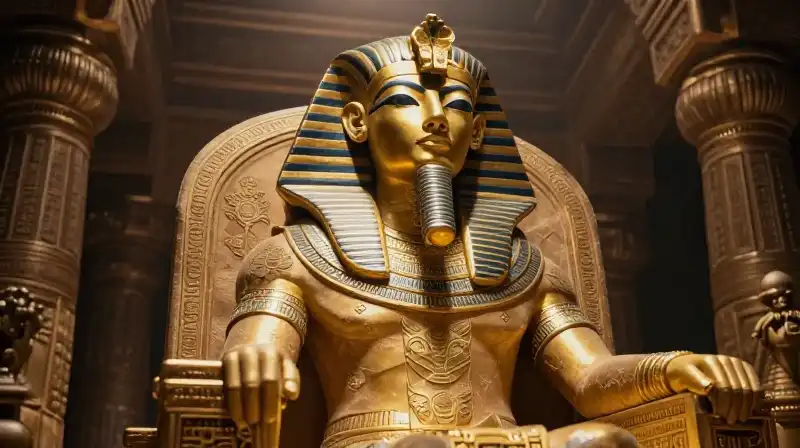
The title “pharaoh” (pr-ꜥꜣ) represents far more than a chronological designation of a ruler; it is the culmination of a profound cultural tradition concerning the divine king. To understand Ancient Egypt pharaoh names is to understand a vast system of belief where the ruler served as the bridge between the mortal world and the gods. While the term itself is sometimes applied broadly to all Egyptian monarchs, its formal utilization in written records is specifically linked to the New Kingdom, beginning around 1400 BC. However, the cultural weight of “pharaoh” extends far beyond this period. For modern scholars and enthusiasts, the title has become a retrospective lens through which they view the long history of Egyptian kings, a practice that highlights a specific modern interpretation of their foundational myths and administrative lineage 1. In reality, the narrative of Egyptian leadership begins long before the formalized title, encompassing early kings who ruled over territories preceding the unification of Upper and Lower Egypt.
The Seeds of Leadership: Pre-Dynastic Roots
The transition to the centralized power we recognize in the pharaonic era was a gradual process, beginning with a series of early rulers sometimes grouped as “Dynasty 0.” These foundational kings laid the groundwork for the political and architectural sophistication that defined the civilization. While the precise order and specific names of these early figures remain subject to scholarly uncertainty 1, their influence is evident in the monumental achievements of subsequent dynasties. The historical framework often used to map these early eras, such as those originally formulated by the priest Manetho, provides a structure for modern study. Nevertheless, these ancient frameworks must be approached with caution, as scholars note the potential for mythological blending and historical corruption over thousands of years (1, 2). Nonetheless, historical centrality is often attributed to names like Djoser, Khufu, and Sneferu, whose achievements in stone architecture and political consolidation shaped the narrative of the Egyptian state (2, 3).
The Evolution of the Royal Concept: From King to Divine Patron
As the historical period advanced, the concept of the ruler evolved from a localized chieftain into a figure of immense cultural and religious significance. One notable shift occurred in the figure of Amenhotep I, who transcended the typical monarch by being revered by the populace not just as a ruler, but as a god and a patron of the Theban necropolis 1. This evolution demonstrates how Egyptian history is woven directly into its religious practices. The continuity of this divine kingship tradition was so powerful that its influence survived even periods of foreign rule. Even when the territory fell under Roman or other foreign powers, the populace continued to recognize and address rulers with pharaonic titles until the final days of this era, culminating in the reign of Maximinus Daza in 313 AD 1. This demonstrates the deep-seated cultural tenacity of the idea of the divine king.
The Spectrum of Influence: Beyond the Military Narrative
When examining a list of Ancient Egypt pharaoh names, many popular historical accounts often highlight figures like Ramses II due to his perceived military might and political influence 1. However, to truly grasp the breadth of Egyptian traditions, one must also look at figures whose influence was profoundly cultural and administrative. The cultural tradition of female leadership, for instance, is powerfully represented by figures such as Hatshepsut and Nefertiti. Their roles were not merely symbolic; they were instrumental in shaping Egyptian traditions, expanding trade, and influencing the course of their history 1. Furthermore, cultural achievements outside of war, such as the establishment of the sophisticated pyramid texts or the legendary expeditions to Punt led by Sahure during the 5th and 6th Dynasties, mark the depth of pharaonic culture 1.
Navigating the Labyrinth of Names and Chronology
For those interested in Ancient Egypt pharaoh names in order, or seeking the historical context of specific reigns, the subject presents complex scholarly debates. The meticulous ordering of dynastic names is often complicated by factors such as:
- The lack of standardized recording in early scripts. The transcription of Egyptian royal names into Greek and subsequent scripts introduced “corrupted names” and variant spellings into later historical documents (1, 2).
- Scholarly discrepancies. Modern historians are still grappling with the exact chronology of various accessions. For example, dating certain rulers, such as Senusret III, involves conflicting calculations derived from both astronomical observations and radiocarbon dating 1.
- The diversity of influence. Later dynasties, such as the 5th and 6th, are noted for specific cultural achievements, while the final traditional phase of the 30th Dynasty concluded with Nectanebo II, marking the cultural shift as Egypt fell to the Persians (1, 3).
How the Tradition Transformed Under Foreign Conquest
One of the most fascinating aspects of the pharaonic tradition is its adaptability. Even when foreign powers took control of the land, the core concept of divine kingship proved resilient. The Ptolemies, who ruled Egypt as a Hellenistic dynasty, successfully adopted the pharaonic titulature. This adoption shows that the idea of the divinely sanctioned leader was so ingrained in the cultural psyche that even foreign rulers embraced the role to maintain legitimacy and local continuity (2, 3).
Living Significance and Context
The discussion of Ancient Egypt pharaoh names and their history is not merely an academic exercise; it concerns a living tradition of historical memory. It reminds us that the power of an Egyptian ruler was rooted not in mere authority, but in a shared religious and cultural contract with the people and the gods. As we look for Ancient Egypt pharaoh names and meanings, we are essentially mapping a complex cultural history. The primary takeaway is the distinction between the *title* and the *office*. The term “pharaoh” is a modern label that we apply to a vast, multifaceted system of leadership that predates the name itself, stretching across millennia. Whether you are looking for a list of pharaoh names or the deeper cultural context of their reign, the tradition proves that the Egyptian concept of kingship was dynamic, adaptable, and profoundly sacred.
References
Footnotes
Related Articles