The Original Jack-O-Lantern: Tracing its History and Roots

Introduction
The practice of carving faces into lanterns—the ubiquitous jack-o’-lantern—is more than a modern seasonal ritual; it is a deeply rooted piece of cultural heritage connecting ancient European belief systems to immigrant narratives. To understand the jack-o’-lantern is to trace a line through the folklore of the British Isles, the natural mysteries of swampy marsh gas, and the necessity driven by migration. Far from being a simple pumpkin-carved gourd, its earliest iteration was a humble root vegetable, a tangible piece of a tradition that predates widespread commercial pumpkin use by nearly three centuries.
Precursors: The Whispers of Foolish Fire
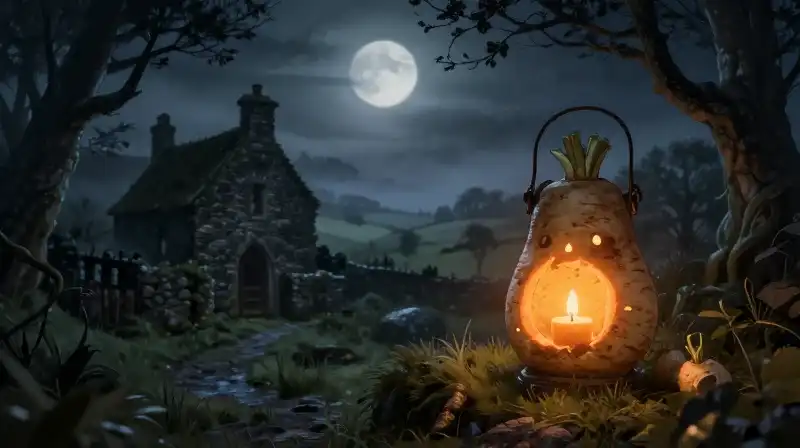
> The concept of light used to ward off darkness began long before the stylized Halloween we know today. Early references to “jack-o’-lantern” are not tied to a carved vegetable, but to the visual spectacle of *ignis fatuus*, or “foolish fire” 1. These ethereal, flickering lights—the natural combustion of marsh gas in swampy areas—were historically attributed by locals in the British Isles to the “Jack-o-lantern” figure (2, 3). The roots of the practice of carving from sturdy root vegetables trace directly back to Gaelic traditions in Ireland and Britain (1, 2). Instead of the whimsical orange gourd of today, the original lanterns were carved from materials such as turnips, mangelwurzel, or rutabaga. These early lanterns served a dual purpose: they could be used to represent the supernatural beings encountered during the turning of the year, or conversely, they could be strategically placed on windowsills as potent protective symbols against harmful spirits (1, 3).
The Dual Function: Protection and Representation
> A key aspect of this tradition is the ambiguity of the carved face. The jack-o’-lantern did not simply serve as a light source; it served as a cultural interface. Early folklore suggests these creations functioned both as vessels for supernatural representation and as protective charms (1, 3). Some cultural interpretations suggest that the intent of these frightening faces was not necessarily to honor a specific spirit, but rather to actively frighten away other wandering evil spirits and potentially mischievous travelers—a practice that speaks to the deep-seated need to control the unseen forces that became more active during the winter months of Samhain 1. In this light, the lantern became a symbolic sentinel, allowing the community to acknowledge the powerful, wild nature of the spiritual world while maintaining a barrier of light and fear.
The Narrative of Stingy Jack: A Foundation for the Folkloric
> The most enduring narrative associated with the lantern is that of Stingy Jack, a blacksmith whose trickery against the Devil forms the core legend (2, 3). The story typically revolves around Jack’s refusal to give the Devil a promised portion of his soul, leaving him a fate of eternal wandering. This legend provides the foundational character for the lantern. The narrative dictates that due to his unholy bargains, Jack is condemned to wander the Earth, always carrying a hollowed vegetable to provide for light (2, 3). However, the history of the tradition is complex regarding the origin of the story itself. Scholarly debate persists over whether the folkloric story of Stingy Jack was created specifically to provide a narrative explanation for the act of carving vegetable lanterns, or if the carving practice was already in place and the tale was later developed to explain its purpose 1. The varying accounts of Jack’s encounters with the Devil highlight the fluid and adaptable nature of the folklore, which allows the tradition to evolve across different communities (2, 3).
From Root Vegetable to the Pumpkin Gourd
> One of the most frequent questions regarding the original jack-o’-lantern is what vegetables were used before the modern orange gourd. The primary answer is the hardy root vegetable, specifically turnips, along with mangelwurzel and rutabaga. The shift from these dense, traditional European roots to the large, easy-to-carve pumpkin was a powerful reflection of global migration and agricultural change 1. This large-scale adoption of pumpkins was heavily influenced by immigrant communities, particularly those arriving in North America after the devastating Great Potato Famine of the 1840s 1. As immigrants brought their Samhain and Jack-o’-Lantern customs, they encountered a new, readily available, and more accessible material—the pumpkin—for creating their lanterns (1, 2). While the term “jack-o’-lantern” has been linked to the carved vegetable since 1837 in some historical texts 1, the specific, mass association of the carved gourd with Halloween solidified only in the late 19th century as the tradition spread across the continent 1.
The Symbolism of Liminal Spaces
> The folklore surrounding the jack-o’-lantern often points to a profound symbolic meaning regarding life’s transitional states. The figure of Jack, being unable to enter either heaven or hell, is frequently interpreted by cultural scholars as a symbol of the state of Purgatory (1, 3). This suggests the lantern itself represents a liminal space—a place between worlds, a threshold where light and shadow, the living and the dead, meet. Therefore, when we ask “Who is the real jack-o’-lantern?” the answer is not a singular entity, but a multifaceted metaphor. It represents the boundary between the mundane and the mythical, the known and the unknowable. It carries the weight of ancient protections against dark spirits, the narrative of eternal wandering, and the adaptation of culture in a new land. It stands as a powerful reminder that the tradition is less about the vegetable and more about the enduring human relationship with mystery, death, and the forces beyond our control.
Conclusion
> The original jack-o’-lantern was never a purely decorative object; it was a living cultural response to the mysteries of the season and the spiritual landscape. Whether carved from a hard turnip to ward off local spirits, or later transformed into a pumpkin by adapting to new lands and immigrant traditions, the essence of the lantern remains the same: it is a container for history. To appreciate the tradition is to look past the surface—the cheerful carving and the fall decorations—and recognize the long, winding road from the “foolish fire” of the marsh to the deep-seated, enduring narrative of Stingy Jack.
References
Footnotes
Frequently Asked Questions
What vegetables before pumpkin?
The original jack-o-lantern was carved from various root vegetables including turnips, mangelwurzel, and rutabaga.
Who is the real jack-o-lantern?
The real jack-o-lantern is not a singular entity, but a multifaceted metaphor representing the boundary between the mundane and the mythical. It carries the weight of ancient protections against dark spirits, the narrative of eternal wandering, and the adaptation of culture in a new land.
Related Articles