Halloween History: The Evolution of Samhain and Modern Traditions

Introduction
The modern celebration of Halloween, with its vibrant costumes, carved pumpkins, and trick-or-treating, is often viewed simply as a seasonal carnival. Yet, to understand the holiday is to understand a vast cultural crossroads—a place where ancient Celtic harvest rituals, Christian religious traditions, and the migration patterns of immigrant communities have converged. Far from being a modern invention, Halloween is a living archive of folklore. It is a holiday defined by its boundary-breaking nature: a time when the veil between the physical world and the supernatural world is perceived to be thin. To truly grasp how this tradition lives today is to trace it back to its deepest roots, starting nearly two millennia ago. The holiday is not a singular celebration but an evolution, a layered history that reveals how communities have negotiated the relationship between the sacred, the harvest, and the mysterious.
Roots in Samhain: The Veil Between Worlds
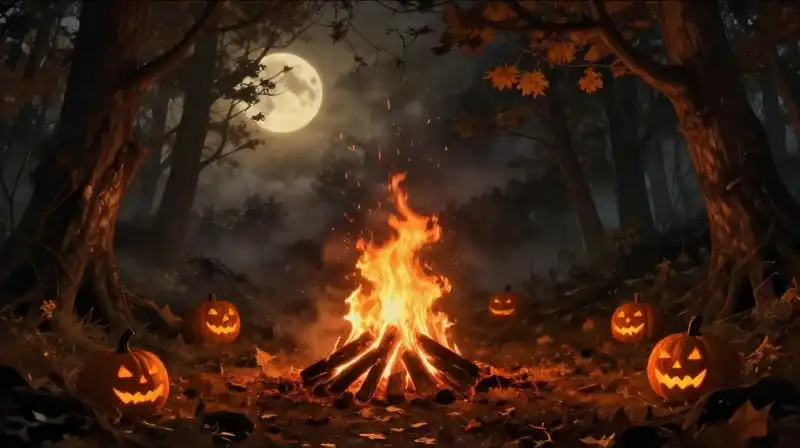
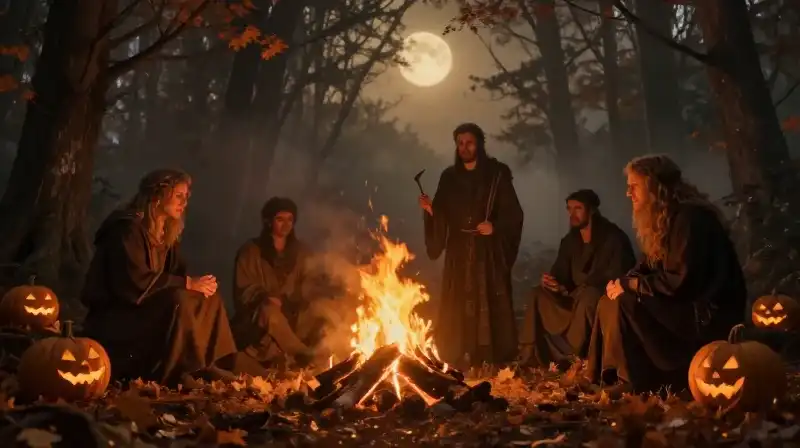
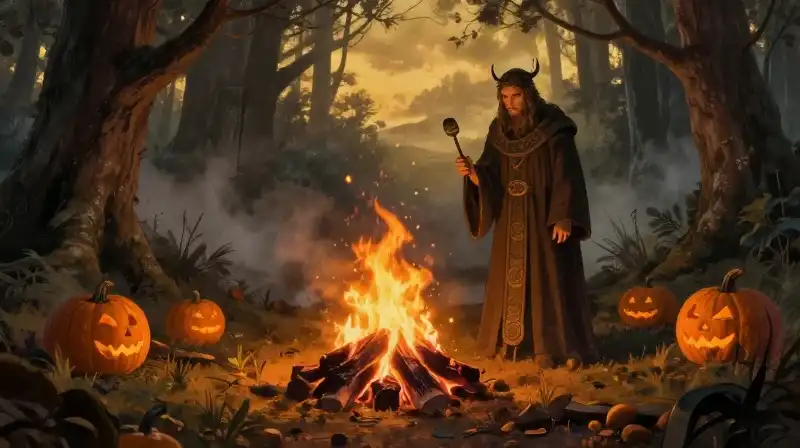
The earliest cultural ancestor of Halloween is Samhain. Roughly 2,000 years ago, the Celtic people, who lived in areas that now comprise modern-day Ireland, observed this yearly festival 1. Samhain was not simply a festive occasion; it was a profound turning point in the Celtic year, marking the end of the harvest and the commencement of winter. Because this was a time of scarcity and the transition into darkness, the boundary between the world of the living and the realm of the spirits was believed to be at its weakest 1. For the Celts, Samhain served as a necessary ritual of protection. The belief was that wandering ghosts and spirits might cross over during this time. Consequently, dressing in costumes was part of the observance, serving a practical purpose: to disguise oneself and ward off any supernatural entities that might be roaming the earth 1. Interestingly, the historical perception of the “witch” in this context was far different from modern anxieties. The word “witch” derives from “wicca,” a term denoting a “wise one,” illustrating that ancient practices were often rooted in reverence for the natural and spiritual world, rather than the modern concept of malevolent evil 1.
The Convergence: From Samhain to All Saints’ Day
The transition from a purely pagan observance to the more widely known “All Hallows’ Eve” is a complex historical narrative. Historians propose two main theories regarding this merging. One suggests that it was a deliberate Christian effort to establish a vigil or a new holy observance. The other theory posits that the Christian Church eventually absorbed the existing Samhain festival, effectively Christianizing its pagan framework 1. This naming convention itself is a key part of the tradition’s evolution. The celebration derives its modern name, Halloween, from “All Hallows’ Eve,” which is the evening immediately preceding “All Hallows’ Day,” a name later generalized into “All Saints’ Day” (1, 2). This blending meant the holiday took on a dual meaning—it was simultaneously a commemoration of the departed and a celebration tied to the Christian calendar. A critical factor in the spread and ultimate popularization of the holiday was the movement of people. The traditions, customs, and rituals brought by Irish and Scottish immigrants to North America in the 19th century played a pivotal role in its transformation and subsequent global diffusion through American cultural influence 1.
The Living Traditions: Souling, Soul Cakes, and Stingy Jack
As the practice evolved, specific traditions developed, reflecting both spiritual beliefs and the socio-economic realities of the time. The tradition of “souling,” which predates the modern practice of trick-or-treating, originated in the 15th century 1. In this practice, impoverished individuals and often children would travel from house to house, asking for “soul cakes.” These cakes were exchanged for prayers offered for the dead, tying the act of seeking gifts directly to the spiritual duties of the holiday 1. Similarly, the iconic jack-o’-lantern finds its origin in Irish folklore. It is linked to the myth of “Stingy Jack,” a man who was cursed to wander the earth eternally. To light his way, he was granted a carved turnip that he lit with a burning coal 1. Because pumpkins are a far more modern invention in this tradition, the original use of the turnip is a vital piece of the holiday’s history (1, 2).
When Pranks Were Genuine: The Early 20th Century Culture
The activities associated with Halloween in its early historical stages, particularly through the early 20th century, reveal a different cultural landscape than the sweet and playful image often presented today. Historical accounts confirm that customs involving “tricks” were a genuine component of the holiday 1. These early forms of pranks often involved practical mischief, such as tying shut door handles or opening windows to create the illusion that the home was haunted, playing into the historical fear of roaming spirits 1. This sense of the supernatural was not always viewed through a lens of fear. The cultural practice of costuming itself has deep roots, reaching back to the Middle Ages 1. People dressed up either as saints (in churches that lacked relics) or wore masks to avoid being recognized by the vengeful souls believed to be active on All Hallows’ Eve 1. The consumption of food on All Hallows’ Eve also carried traditional weight, sometimes reflecting historical Christian observances of abstinence from meat. Foods like apples, potato pancakes, and the ceremonial “soul cakes” offered to the departed were integral to the community’s spiritual and domestic life 1.
The Evolution into Modern Practice
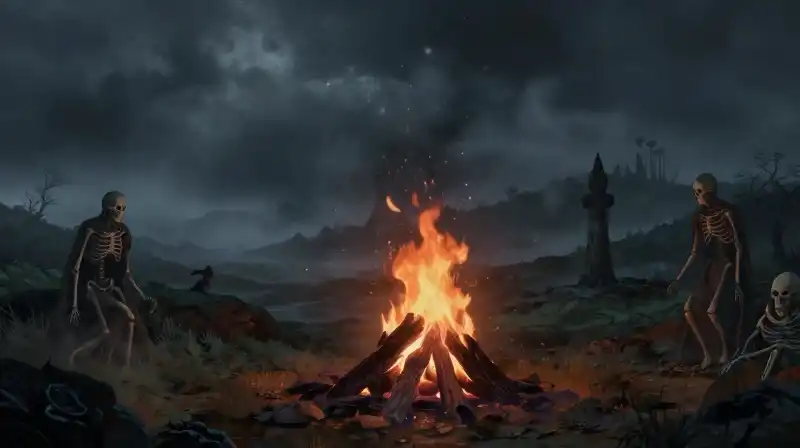
Modern Halloween is a synthesis of these disparate elements. The shift from the utilitarian turnip to the commercially accessible pumpkin, the expansion of pranks into candy-based trick-or-treating, and the widespread commercialization of costumes have all been parts of this long evolution (1, 2). The core meaning of the holiday, however, remains deeply rooted in the concept of communal remembrance and the acknowledgment of the cycles of life and death. Whether one views the celebration through the lens of its Celtic origins, its later Christian adaptation, or its modern, secular interpretation, the tradition acts as a powerful cultural touchstone, allowing communities to participate in a shared narrative that connects the ancient agricultural rhythms of the past with the present complexities of modern life. The living culture of Halloween is not just a collection of costumes and sweets; it is a sustained, annual dialogue between the living and the memory of the dead.
References
Footnotes
Related Articles