From Samhain to Halloween: Tracing the Ancient Celtic Origins

Introduction
To understand Halloween is not simply to learn about costumes and candy; it is to trace a profound, ancient observance known as Samhain. Samhain was not merely a day of celebration, but a foundational Gaelic festival that marked the critical transition from the richness of the harvest season into the deepening dormancy of winter. Occurring on November 1st, it stood as one of four major seasonal celebrations within the Gaelic calendar 1. At its core, Samhain was a time of transition, a liminal period where the traditional boundaries of the physical world and the mystical Otherworld were believed to blur. This observance served as a crucial pivot in the agricultural and spiritual lives of communities across ancient Ireland and the British Isles.
The Liminal Threshold and the Spiritual World
The most defining characteristic of Samhain was the belief in the heightened presence of the spiritual world. According to historical understanding 1, this period made the souls of the dead and various other spirits likely to revisit the mortal realm. This presence was not always interpreted as benign. For ancient Celtic communities, the boundary was thin, and there was a need for precautions against potential encounters with spirits they wished to avoid, protect themselves from being terrorized or consumed by these forces (2, 1).
The inherent uncertainty and the perceived danger of these spirits necessitated specific cultural behaviors. To maintain a degree of safety and confuse the spirits during this heightened state of spiritual activity, it was a common practice for people to wear disguises and elaborate costumes 1. This cultural tradition was deeply rooted in the belief that the dead were actively roaming the Earth at the peak of the season, requiring the living to adopt disguises that would prevent supernatural identification.
Ritual, Hospitality, and Protection
The observance of Samhain was rich with rituals that addressed both the spiritual and practical concerns of the community. These rituals focused on appeasing the spirits, ensuring a good harvest for the coming year, and guiding the seasonal change. Hospitality played a central, generous role in this cultural exchange. Families would actively welcome the visiting spirits, often leaving out food and drink or setting specific places at the table reserved for the souls of deceased kin (1, 2).
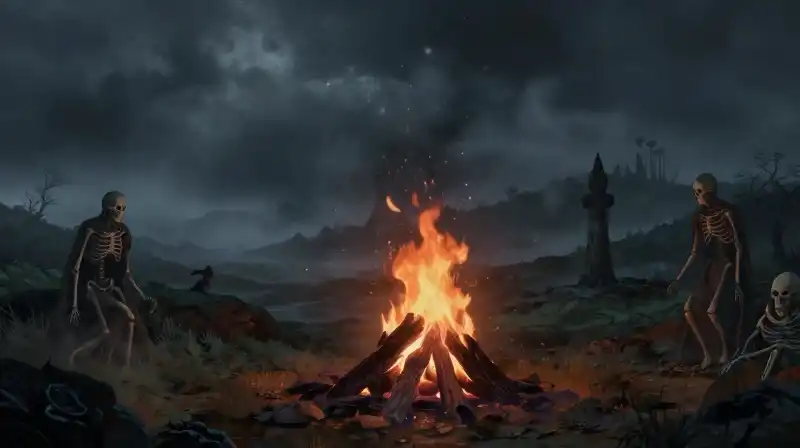
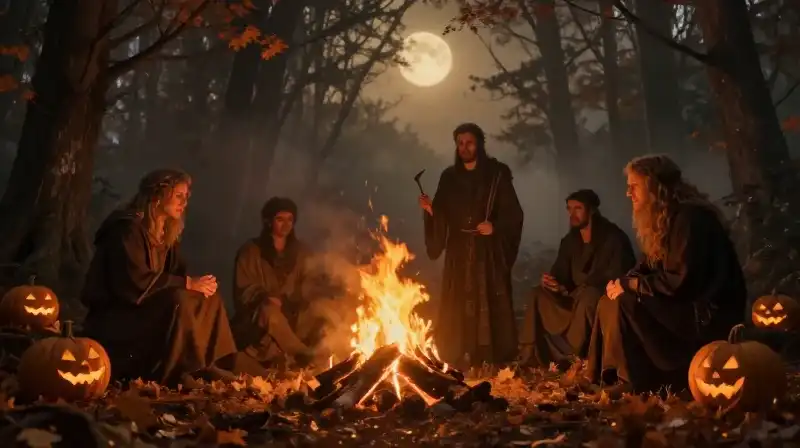
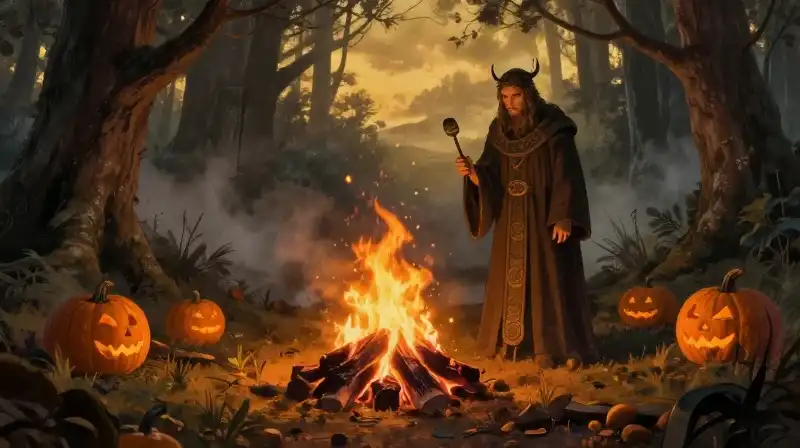
The massive communal fires—the bonfires—were equally significant. These fires served multiple protective functions. They acted as cleansing mechanisms for the community, purifying the land and people in preparation for winter. Furthermore, they functioned as massive, guiding lights meant to either guide the spirits safely through the Earth during the festival or actively ward them off (1, 2). Beyond the large communal rites, smaller, more intimate practices were central to daily life. Divination, often involving items like nuts and apples, allowed community members to seek insights into the future, a practice integral to the pre-Christian festival 1.
From Agricultural Cycles to Modern Customs
Historically, Samhain was intrinsically linked to the rhythm of pastoral and agricultural life. It marked the end of the summer grazing period and the movement of livestock, serving as a final accounting of the year’s bounty 1. The cultural practices of Samhain provided a framework that would evolve over time. The ancient practice of children and adults gathering door-to-door, both to offer prayers and to receive provisions, is a direct precursor to modern customs. This tradition of gathering for sustenance and interaction eventually morphed into what we recognize today as trick-or-treating (2, 1).
The modern global festival of Halloween, however, is a composite of many historical layers. Its association with the dead was significantly reinforced by the subsequent imposition of Christianity, particularly the designation of November 1st as All Saints’ Day 1. Further additions, such as the association of black cats with witchcraft, are later developments rooted in medieval European superstitions, not in the initial Samhain traditions 1.
Unpacking the Echoes: Tradition and Debate
When modern individuals inquire about the specific origins of the holiday, several myths and debates arise. The origins of specific modern practices, such as “trick-or-treating,” remain subjects of scholarly discussion 1. Theories about its inception range from simple appeasement of traveling spirits to the later medieval European customs known as “souling” or “guising” 1. It is also important to note that the core of the Samhain tradition was also a period of intense social activity. Early literature frequently describes Samhain as a time of great social gathering, feasting, and contests, serving as a central stage for early Irish tales and community bonding 1.
Linguistically, the name Samhain itself provides insight into the cultural concept. Some studies suggest the name may derive from a proto-Celtic word meaning “reunion” or “assembly,” which could refer to the perceived “assembly of the living and the dead” 1. While modern celebrations often focus on frightening imagery, the cultural roots encompass a much broader spectrum, including the harvest, community feasting, and spiritual transitions.
Conclusion: The Living Culture of Samhain
The story of Samhain is one of profound continuity, demonstrating how ancient human attempts to understand the cyclical nature of life and death persist in modern traditions. It moves beyond the simplistic idea of a “scary holiday” to reveal a tradition centered on liminality—the respectful acknowledgement of the powerful, unseen forces that govern the transition of seasons and the veil between worlds. Modern Halloween traditions, whether through the gathering for treats or the burning of communal bonfires, are echoes of this ancient practice, offering a shared cultural space where the past and the present meet.
For those interested in the genuine meaning of the holiday, the significance of Samhain lies in its function as a cultural reminder that life is a cycle, that transitions require both celebration and caution, and that community bonds are strengthened when acknowledging the spiritual complexity of the world they inhabit.
References
Footnotes
Frequently Asked Questions
What Celtic festival became Halloween was celebrated at the end of the season?
The ancient Gaelic festival that became Halloween was Samhain. It marked the critical transition from the richness of the harvest season into the deepening dormancy of winter.
What did the Celts hold a festival on October 31st?
The provided article does not specify what the Celts did on October 31st; however, it notes that Samhain, a major Gaelic festival, occurred on November 1st.
What Celtic festival inspired Halloween?
The ancient Gaelic festival that inspired Halloween is Samhain, a foundational observance whose cultural practices provided the framework that would evolve over time.
Related Articles