Lugh: The Jack of All Trades in Celtic Mythology

Introduction
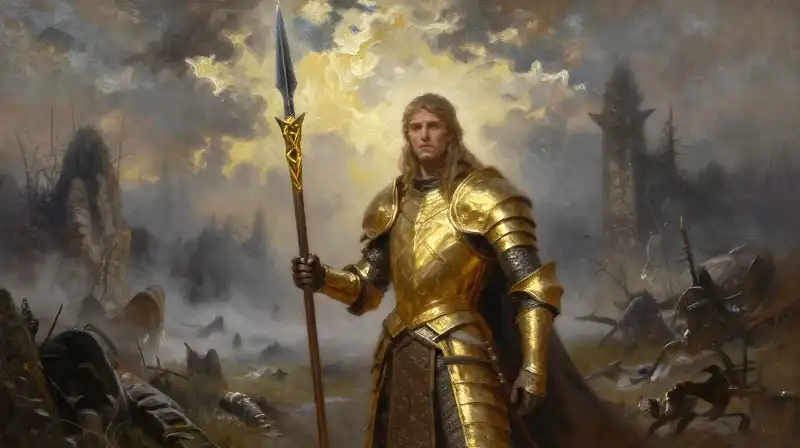
The figure of Lugh in Irish mythology is rarely defined by a single characteristic. Unlike deities who embody a singular force—such as the storm or the deep—Lugh is described as the ultimate synthesis of skills and societal roles. He is widely known as the embodiment of competence, a figure whose power stems not merely from superhuman strength, but from his total mastery across diverse human endeavors. He holds the moniker *Ollamh Érenn*, signifying his standing as the Chief Ollam of Ireland, a title that commands expertise in poetry, law, and governance. For the communities that share this heritage, Lugh represents the pinnacle of organized civilization: a king who is simultaneously a brilliant strategist, a master craftsman, a fierce warrior, and a protector of the law. This complexity makes him one of the most potent and fascinating archetypes in the entire Celtic pantheon.
The Master of Many Domains
The “Jack of all trades” description, though common, only scratches the surface of Lugh’s true role. His epithets give insight into this sprawling set of responsibilities. For instance, *Lámfada*, meaning “Of the Long Arm,” might refer to his skill with a spear in battle, or it may signify his exceptional dexterity and skill in crafting beautiful implements (1, 2). Lugh is not just a figure of martial power; he is a patron of specialized skill. His domains encompass nobility, merchant patronage, healing, and warfare, demonstrating a breadth of influence that integrates spiritual and secular life. His cultural significance is also evidenced by his role in the development of early societal pleasures and skills. Lugh is linked to important games, including *fidchell*, the precursor to chess, and practices like horse racing. By linking himself to the cultivation of merit and sophisticated play, he elevates mere prowess into a cultural mandate.
Lughnasadh: The Blessing of the Harvest
To understand Lugh is to understand the cycle of nature and human community. The most important traditional tie to the deity is the harvest festival of Lughnasadh. This celebration is observed not only across Ireland but also within the traditions of Scotland and the Isle of Man. Lugh is viewed as the blessed entity that brings abundance to the first fruits of the autumn harvest (1, 2). Lughnasadh is more than an autumnal gathering; it is a celebration of fruition and skill, mirroring the breadth of Lugh’s own capabilities. It represents the successful transition from the wild growth of the summer to the measured, cultivated sustenance of the harvest. In this context, Lugh’s “blessing” is the assurance that through skilled labor and adherence to communal rhythms, the community will thrive.
The Riddle of Light and Power
One of the most common questions regarding the *meaning* of Lugh involves his perceived connection to the sun. Historically, there has been suggestion that Lugh shares attributes with figures like the Greek god Apollo, lending the idea that he is a solar deity. Furthermore, some ancient Irish texts document his mythical appearance in relation to the setting sun’s radiance 3. However, modern Celtic scholars approach this with caution. They note that while Lugh is undeniably linked to concepts of “light,” the etymology that would specifically derive from a word meaning “light” is phonologically problematic for linguists 3. Therefore, Lugh’s attributes are far more ambiguous than the “sun god” label implies. His identity is a cultural negotiation; some narratives link him to the sun, while others emphasize his association with the elemental forces necessary for harvest, such as the storm and the rain that precede the yield 3.
Synthesis: Law, Lineage, and Ethical Integrity
Lugh’s complexity is rooted in the structure of early Irish society. He embodies sophisticated ethical principles. He is deeply associated with the establishment of the law and the concept of rightful kingship, placing him not just as a heroic figure, but as a guarantor of social order 3. He even represents adherence to oaths and the pursuit of truth. His character, however, is not one of simple, unchallenging goodness. His narrative often involves ambition and a capacity for strategic ruthlessness, exemplified in his conflicts, such as his quest for justice against the sons of Tuireann (3, 2). Lugh’s lineage itself reflects a period of cultural merging in early Ireland, as he is described as having a hybrid heritage—the son of a Tuatha Dé Danann figure (Cian) and a Fomorian (Ethniu) (1, 2). This hybrid birth symbolizes the necessary mingling of different cultural traditions to form a cohesive, strong new identity.
Lugh’s Enduring Cultural Significance
Ultimately, the enduring legacy of Lugh is his role as an ideal of balanced capability. He teaches that true power is not found in a single, specialized gift, but in the comprehensive mastery of diverse talents. He is the archetype of the leader, the artist, and the protector who must be all things at once. For the people who hold this tradition, Lugh reminds them that a successful culture—whether in governance, art, or farming—requires the equal dedication to law, craft, and the cyclical, essential rewards of the land. He is not a distant, abstract divinity, but a living representation of the total potential of human excellence and the interconnectedness of all skill.
References
Footnotes
Frequently Asked Questions
Who is the god Lugh equivalent to?
Historically, there has been suggestion that Lugh shares attributes with figures like the Greek god Apollo. This comparison has led to the idea that he is a solar deity.
Related Articles