Celtic Mythology: The Nature and Realms of the Otherworld

Introduction
To approach the concept of the Otherworld in Celtic traditions is not merely to explore a fantasy of eternal life; it is to engage with a profoundly integrated worldview where the spiritual and physical realms exist in dynamic conversation. Unlike many traditions where the afterlife is a definitive destination, the Celtic Otherworld operates as a celestial domain—a realm of abundance, enduring youth, and divine presence. For those who hold these narratives sacred, it is not solely a place for the deceased, but the vibrant home of the gods themselves, such as the Tuatha Dé Danann, alongside heroes like Fionn and Bran 1.
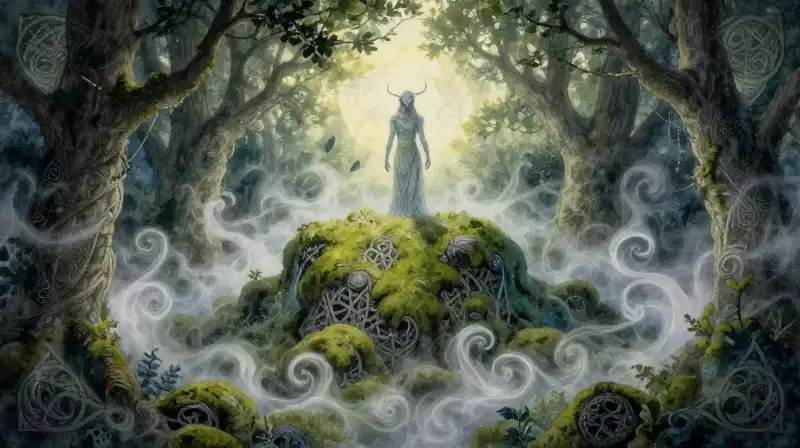
This realm is far more than a geographic location; it represents a state of being. It is characterized by vitality, beauty, and a harmonious existence that contrasts sharply with the mortal cycles of growth and decay. In the spiritual geography of the Celts, the boundary between this world and the supernatural is porous, often experienced through liminal journeys—travel across the western seas, immersion in ancient sites like burial mounds (sídhe), or traversing the deep waters 1.
The Nature of Celestial Realms: Youth and Abundance
The foundational characteristic of the Celtic Otherworld is its idealized nature. In both Gaelic and Brittonic traditions, the realm is often described as a paradise characterized by unending health, immense joy, and perpetual springtime. It is a place where time may move differently, or not at all 1. This rich tapestry of existence gives rise to several distinct names, depending on the regional tradition and the particular quality the realm embodies. For instance, the Irish tradition utilizes Tír na nÓg, meaning the “land of youth,” and Mag Mell, the “plain of delight” (1, 2).
These domains represent more than mere leisure; they are places of profound symbolic power. The archetypal journey into the Otherworld is rarely simple, typically involving a passage facilitated by magical mists or mythical figures. The traveler who returns from such a passage is often fundamentally changed, carrying the essence of the supernatural realm back into the mundane world 1. This inherent connection suggests that the Otherworld is not merely a place one goes, but an experience one undergoes, resulting in a transformation of the self.
Mapping the Celestial Landscape: Regional Variants
It is crucial to understand that “the Otherworld” was not a monolithic concept across all Celtic groups. While shared themes of divinity and transcendence existed, the structure of the universe varied regionally, reflecting distinct cultural priorities. The Gauls, for example, structured their cosmos into three definitive zones: Albios, the “upper-world”; Bitui, the “world of the living”; and Dubnos, the “lower-world” 1. This tripartite structure provided a sophisticated framework for understanding the relationship between the known earth and its parallel realms.
In later Irish mythology, specific destinations are formalized based on purpose. While some realms evoke eternal youth, others are linked to the journey of the soul. Tech Duinn, the “House of Donn,” is a specific destination for the dead, often tied to the voyages across the sea under the guidance of the god Donn (1, 2). Additionally, scholarly categorization recognizes various subtypes of these realms, including specialized “Underground,” “Island,” “Underwater,” and realms that are “Co-extensive with this world” 1.
The Symbolic Language of the Otherworld
The richness of these traditions is best understood through their symbolism. Certain objects and motifs serve as powerful markers of the boundary between worlds. Most notably, the apple holds an exceptional symbolic weight across many cultures, and in Celtic narratives, apples are frequently used as tokens of the Otherworld—gifts offered by divine beings to heroes (1, 3). This artifact serves as a tangible reminder of the intersection between mortal and immortal life.
The passage to and from these mythical lands was deeply tied to geography. In both Irish and Continental Celtic myths, the western lands and the sea are consistently identified as the direction leading toward the mythical supernatural realm. This consistent geographical emphasis underlines the spiritual connection between the coast and the divine, making the act of sailing or wandering near the water a potent, semi-sacred endeavor (1, 3).
Clarifying the Cycle: Soul and Reincarnation
The relationship between the Celtic Otherworld and the soul is complex, moving beyond a simple one-time afterlife. Continental Celtic sources, such as those noted by classical writers like Diodorus and Julius Caesar, document belief in the immortality and reincarnation of the soul among the Gaulish Celts 1. However, historical analysis adds a crucial layer of nuance. While reincarnation was believed to occur, the primary focus of the Celtic myth often rested on the “new body” assumed within the Otherworld, rather than the relentless cycle of rebirth on Earth 1.
Ultimately, the Otherworld functions as a critical node in the spiritual life of these traditions—a place where souls transit between the earthly plane and the supernatural. In some cycles, this journey facilitates a renewed existence, suggesting that death in this context is less a final termination and more a profound transition into a more potent state of being 1.
Living Heritage and the Modern Search
When people ask about the Celtic Otherworld today, they are often looking for more than a definition; they are seeking the cultural resonance of these ancient beliefs. The “Celtic Otherworld” is not a single mythological beast or a singular divine figure (though gods like Donn or the Tuatha Dé Danann inhabit it), but a living concept representing cosmic balance and the enduring power of the natural world. Related searches often point to mythical creatures, but the true essence of the tradition lies in its *structure*: the way these realms relate to the physical earth, the sea, and the human experience of transformation.
While some traditions attribute specific gods to the Otherworld, the concept itself acts as a collective spiritual space, a place of “delight” and “promise” that sustains the human narrative. Understanding the tradition requires looking beyond a list of names and acknowledging the deep spiritual significance of the transition—the journey, the change, and the enduring cycle between the mortal and the immortal 1.
The true power of the Otherworld mythology lies in its capacity to frame life itself as a vibrant, interconnected transit between worlds. It teaches that the hidden and the sacred are not external to us, but merely shifted beyond the ordinary veil, waiting to be found in the depths of the sea and the turning of the seasons.
References
Footnotes
Frequently Asked Questions
What is the Otherworld in Mythology?
The Celtic Otherworld is a celestial domain and a state of being characterized by abundance, enduring youth, and divine presence, serving as the vibrant home of gods and heroes. It represents a spiritual paradise and a vital transit point where souls move between the earthly plane and the supernatural realms.
Who is the Celtic god of the Otherworld?
The Celtic Otherworld is not a singular mythological beast or a singular divine figure, but a collective space that serves as the vibrant home of gods such as the Tuatha Dé Danann and Donn.
What religions have an Otherworld?
The concept of the Otherworld is discussed across various Celtic traditions, including the Irish, Gaulish, Gaelic, and Brittonic traditions. In the Irish tradition, this realm may utilize names like Tír na nÓg or include the specific destination Tech Duinn.
How many Celtic Otherworlds are there?
The text does not provide a specific total number, but it states that the concept of the Otherworld gave rise to several distinct names depending on the regional tradition and the quality it embodied. Examples of these distinct names include Tír na nÓg and Mag Mell, as well as various scholarly subtypes like Underground or Island.
Related Articles