Hermes: Greek God, Messenger, and Master of the Divine Boundaries

Introduction
In the rich tapestry of ancient myth, few figures are as multifaceted or as pivotal as Hermes. Often reduced to a simple definition of a swift messenger, Hermes embodies a much deeper cultural function. He is not merely an Olympian herald of Zeus; he is, fundamentally, a powerful mediator—a psychopomp who guides souls across the threshold of the afterlife and a cunning innovator who binds the mortal and divine realms together. To understand the tradition of Hermes is to understand the necessary intersection of commerce, communication, chaos, and the spiritual journey.
The Archetype of the Boundary Crosser
The character of Hermes is ancient, likely predating the formalized Olympian structure. His origins suggest a connection to early, localized, and pre-Hellenic traditions, perhaps even linked to the Arcadian deity Pan 1. This early form often depicted him not as a youth, but as an older, bearded man—a traveler or a shepherd. This foundational imagery grounds him in the physical landscape of ancient Greece and the human necessity of traversing distances. His cultural significance began with the concept of the boundary marker. In this capacity, he is connected to the herma, a stone road-marker that served a dual purpose: it delineated pathways and acted as a roadside shrine (1, 2).
This early role established him as a god of transition. He was the keeper of thresholds, whether between places, between life and death, or between the human and divine spheres. His later iconography, though shifting to the athletic, youthful figure we often recognize, retained this essential role of movement and boundary management.
The Duality of the Divine Missions
One of the most striking aspects of Hermes’ narrative is his radical duality, which leads directly to the common question of whether he is a hero or a villain. The tradition holds that he can embody both cunning ingenuity and necessary guidance. As a messenger, his tasks are vital to maintaining the cosmic order; he carries the decrees of Zeus. Yet, his role as a psychopomp, guiding souls into the unknown, places him in a realm that is inherently ambiguous and sometimes challenging (1, 2). His capacity for rapid travel, aided by winged sandals known as talaria, physically symbolizes his ability to exist effortlessly across the divide between the mortal and the supernatural 1.
His early mythological exploits, such as the theft of Apollo’s cattle, are foundational tales that illustrate this clever nature. This act is not merely mischief; it is a narrative proof of his resourcefulness and later capacity for innovation, which is famously demonstrated through the invention of the lyre 1. He is the god who can operate within the rules, but also thrive outside of them.
Trade, Oratory, and the Underworld
Hermes’ domain extends far beyond mere speed; it governs the systems by which human civilization operates. He is widely considered the patron of commerce. His protection was offered to merchants engaged in trade, ensuring safe passage for goods and prosperity for those involved in buying and selling (1, 2). Crucially, this patronage was not strictly limited to legal trade; he also protected those involved in illicit activities, such as thieves, acknowledging the necessary reality of both the legitimate market and the shadows it creates (1, 2). This broad tolerance for diverse human endeavors—from honest orators to those engaged in subterfuge—is what makes him such a vital, multifaceted figure to the ancient Greeks.
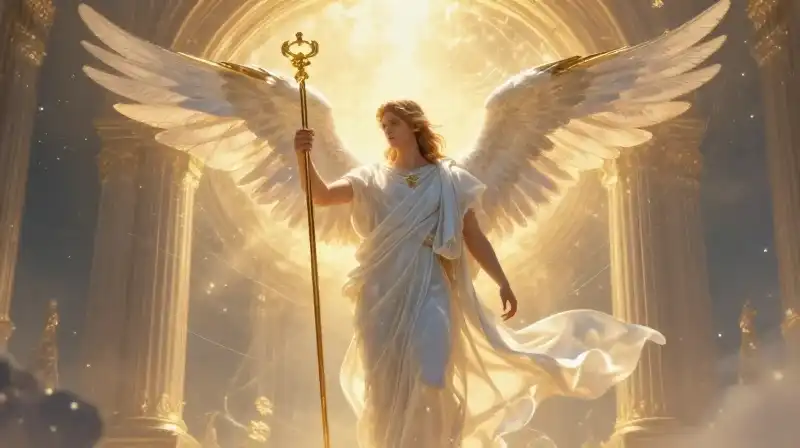
Furthermore, he oversaw the intellectual and physical pursuits of humanity. He was associated with gymnasiums and athletic contests, reflecting his youthful energy and agility. He was also linked to the study of astronomy, a discipline requiring both observational skill and a keen understanding of celestial movements. His attribute of the caduceus—a winged staff intertwined with two snakes—reinforces this blend of authority and natural wisdom, signifying reconciliation and guidance across the messy terrain of human life (1, 2).
Global Echoes: From Thoth to Mercury
The reach of the Hermes tradition demonstrates how fundamental his archetypal role was across disparate ancient cultures. His influence was recognized far beyond the boundaries of the Hellenic world. Scholars have noted strong parallels between Hermes and figures in other cultures, such as the Egyptian god Thoth, who shares roles related to knowledge and communication, and the Mesopotamian mediator god Ningishzida 1. These comparisons underline the universal need for a figure who can manage boundaries and transmit essential information across systems.
This cross-cultural adaptability resulted in his integration into Roman tradition. The characteristics and duties of Hermes were absorbed by the god Mercury. This syncretism shows not a dilution of his power, but rather a widespread recognition of his archetype: the ultimate facilitator of movement, whether it be the movement of physical goods, souls, or ideas 1.
Living Significance: The Enduring Archetype
Hermes endures in cultural memory because he mirrors essential human experiences: the risk of travel, the complexity of trade, the necessary ambiguity of transition, and the constant struggle between law and innovation. He is not a simple god of speed, but a profound symbol of the transition—the one who makes the impossible passage possible. He reminds us that in the cultural landscape, mediation is as vital as conquest, and that the person navigating the boundaries between chaos and order is often the most powerful figure of all.
References
Footnotes
Frequently Asked Questions
Is Hermes a hero or a villain?
Hermes is characterized by a radical duality, as tradition holds that he embodies both cunning ingenuity and necessary guidance. He functions fundamentally as a powerful mediator, bridging the gap between the mortal and divine realms and navigating the intersection of order and chaos.
Related Articles