Greek Titans: Origins, Key Figures, and Their Role in Myth

Introduction
For the modern reader, the image of the Greek Titans might initially conjure a simplistic list of colossal monsters from ancient battle narratives. However, in the context of “Living Culture,” the Titans represent something far deeper: a “pre-Olympian order” (1, 2). These deities were not merely characters in a myth; they were foundational figures in the Greek cosmic timeline, embodying the primordial state of the world before the rise of the Olympians. Their mythology provides a rich, complex narrative for understanding how power shifts, how celestial order was established, and how the fundamental mechanisms of divine authority came to be 1. The Titan tradition serves as a cultural mechanism for explaining the history of the universe itself, suggesting that the world moved through stages of authority—from the wild power of the primordial forces to the structured rule of the new gods. Understanding the Titans is therefore not just about names and genealogies; it is about understanding the foundational grammar of ancient Greek thought regarding time, law, and supreme power.
The Roots of Primordial Authority
To understand the Titans, one must look back to the absolute beginning of the Greek cosmos. According to the lineage recounted by Hesiod, the Titans originated as the twelve children of Uranus (the Sky) and Gaia (the Earth) 1. This foundational family represents the raw, generative forces of the Earth and the Heavens in their first configuration. Yet, the origins of the Titans are not monolithic. Scholarly variation exists within the tradition, with later texts suggesting a more ancient layer of existence. Some traditions reference earlier, even more primordial figures, such as Oceanus and Tethys, as the original progenitors (1, 3). These figures represent the deepest, most elemental forms of watery and earthly existence, providing a sense of an ancient, eternal chaos that precedes even the Titans themselves. The Titanesses, known as the Titanides, further embody these original elements of the earth. They are celebrated for representing various aspects of the natural world—from the nurturing side of Rhea and Tethys to the abstract concepts of natural order and intellectual insight embodied by Phoibe 1.
The Narrative of Cosmic Change
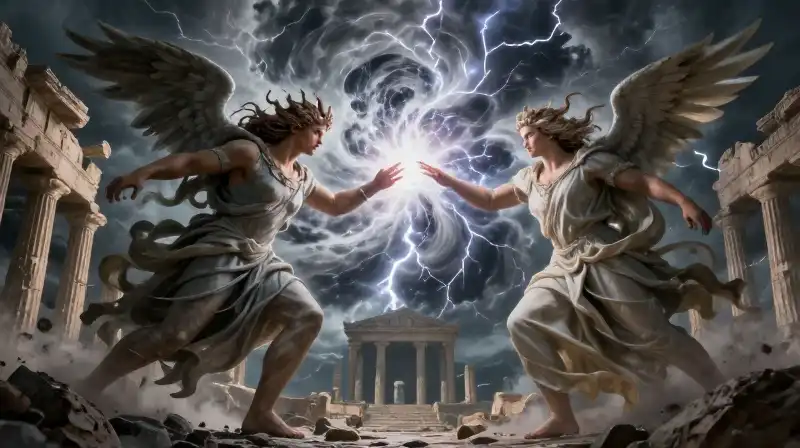
The core of the Titan tradition lies in its dynamic nature; it is a story of change and overthrow. The narrative of the Titanomachy—the War of the Titans—is the primary event that defines their cultural significance. This conflict describes the violent transition of power from the “old gods” (the Titans) to the “new gods” (the Olympians). At the center of this shift is the Titan Cronus. As told by the myths, Cronus, driven by fear of being overthrown by his own offspring, devoured his children as they were born (2, 3). The pivotal moment of rebellion involves the Titaness Rhea, known as the Queen of the Titans 1. Rhea undertook the crucial task of hiding and eventually rescuing her son Zeus from his father’s digestive fire. This act of defiance and maternal protection initiated the chain of events that would eventually lead to the Titanomachy and the eventual victory of the Olympian generation. The consequences of this revolution were profound. The Titans who stood in opposition to Zeus faced severe punishment. Cronus was cast down by his own son, and many other major figures, such as Hyperion and Iapetus, were banished (1, 2). They were often cast into Tartarus—the deepest subterranean realm—ensuring the establishment of a new, albeit often unstable, celestial order.
Roles Beyond the War: The Archetypes of the Titans
While the Titanomachy provides the dramatic narrative, the individual Titans often carry specialized roles that transcend the combat, grounding them in specific aspects of cosmic law and suffering. Figures like Atlas are remembered not as warriors, but as figures of intense suffering; they were condemned to bear the immense weight of the heavens themselves 1. Similarly, Prometheus is a figure defined by his defiance of divine order, chained to an eagle for challenging the established norms of the gods 1. However, the concept of “Titan” was sometimes used more broadly, not only for the original primordial generation but also for descendants who inherited these qualities. Figures such as Atlas, Helios, and Prometheus were occasionally referred to as Titans, suggesting a broader, evolving theological status associated with immense power and ancient lineage 1. In terms of cultural law and order, the Titaness Themis is a vital figure. She embodies natural order and divine law, and she is culturally recognized as the mother of the Fates, illustrating the connection between the Titans and the establishment of predictable, structured existence (1, 3). She represents the necessary laws that the Titans sought to enforce, even if they were prone to the violent change that defined their age.
The Geography of Titan Power
In the ancient cultural view, the Titans were often linked to the “chthonic” or subterranean realm. They were viewed as gods “who dwell beneath the earth” 1. This geography is significant; it symbolizes the link between the divine and the physical world of the earth itself. This connection between the deep earth and cosmic power is why they are sometimes conflated in ancient lore with the Gigantes (Giants), who were sometimes portrayed as supporters of the deposed Titan Cronus 1. Furthermore, certain figures maintained a strong presence in earthly, prophetic traditions. Dione, for instance, is noted as a prophetic Titan-goddess who presided over the Oracle at Dodona, linking the Titans to divine inspiration derived from the earth’s own mysteries (2, 3). These figures demonstrate that even after the Titanomachy, their influence continued through oracles and earth-bound rituals.
The Enduring Resonance of the Titans
The narratives of the Titans continue to offer a useful lens through which to view ancient understandings of power and governance. They are not simply a prehistoric list of names; they are the cultural ancestors of the Olympian structure. They explain why a stable order (the Olympians) was necessary, but they also represent the powerful, chaotic, and sometimes necessary turbulence that precedes new systems. For those studying this tradition, it is important to view the figures not as singular entities, but as archetypes: the relentless mother (Rhea), the devour of order (Cronus), the bearer of the burden (Atlas), and the preserver of law (Themis). The Titans remind us that the foundations of any society or cosmic order are built upon prior, sometimes violent, struggles between forces of change and forces of established law. Whether you are exploring the family trees of the classical literature or seeking to understand the concept of primal authority, the Titans serve as a profound reminder of the complexity inherent in the transition from wild power to structured civilization.
References
Footnotes
Frequently Asked Questions
Who are the 12 Titans in Greek mythology?
The Titans originated as the twelve children of Uranus, the Sky, and Gaia, the Earth. However, the article does not provide a list of their names, though it mentions figures such as Cronus, Rhea, Hyperion, and Iapetus.
Who are the 7 Titans in Greek mythology?
The provided article does not list or identify a specific group of 7 Titans, but it notes that the Titans originated as the twelve children of Uranus and Gaia. It also mentions prominent figures such as Cronus, Rhea, Atlas, and Themis who carry specialized roles within the tradition.
Who was the most beautiful woman in myth?
The provided article does not specify who was the most beautiful woman in myth.
Do the Titans have names in Greek mythology?
Yes, the article details many names within the Titan tradition, such as Cronus, Atlas, Themis, and Prometheus. Foundational figures mentioned include Uranus, Gaia, Oceanus, and Tethys.
Related Articles