Uatchit: The Egyptian Goddess of the Marshes and Her Role

Introduction
The ancient Egyptian pantheon was not a static list of eternal forces; it was a living, breathing reflection of the land itself. Every riverbend, fertile flood plain, and unpredictable swamp fostered deities that were intimately tied to their immediate environment. While some gods were cosmic figures governing the sun or the underworld, others, like Uatchit, were deeply regional, governing the complex ecosystems of the marsh and the Delta. Exploring the traditions of these regional gods reveals how the physical geography of the Nile fundamentally shaped the spiritual life of the people. To truly understand the role of Uatchit, one must consider the tradition of localized worship. Uatchit, identified as the goddess of the marshes, represents the rich, sometimes difficult, life found in the wetlands of the Delta. Her story highlights the duality of Egyptian nature: the fertile abundance of the marsh and its moments of disruptive chaos. Her existence provides a profound cultural lens through which to view the environmental concerns and regional beliefs of early Egyptian communities, particularly in the vital region of Lower Egypt.
Uatchit: The Divine Embodiment of the Wetland
Uatchit holds a unique and specific place in the early Egyptian tradition. She is known specifically as the goddess of the marshes, a domain defined by the wetland ecosystem, where wild grasses flourished and populations of insects thrived 1. This association places her not merely as a general fertility deity, but as a protector and manifestation of the marsh itself. According to historical accounts, Uatchit was sometimes characterized as a “Humiliated Egyptian Deity” 1. This description is not necessarily one of divine shame, but reflects the complex relationship between the highly organized, cultivated society of the Nile and the wild, untamed nature of the marsh. The marshes were a source of life and resources, but they were also unpredictable, subject to floods, and defined by chaotic natural cycles. The mention of her status during the plague of flies 1 suggests that she was a focus of worship or concern when environmental hardships—pest control, resource management—became critical community concerns.
The Parallel Traditions: Wadjet and Lower Egypt
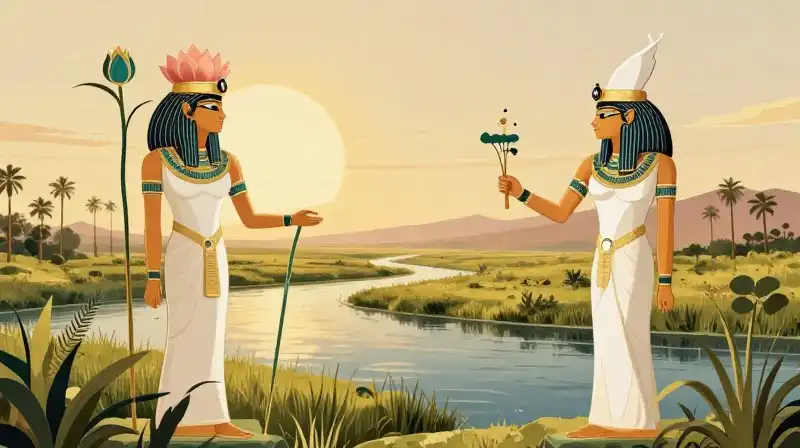
Uatchit’s regional focus gains context when compared to other deities of the Nile Delta, most prominently Wadjet. Wadjet, originally a local goddess of the city of Dep or Buto in Lower Egypt, embodied the protective spirit of the land itself 1. Her name is derived from the term for the papyrus, a defining symbol of Lower Egypt’s landscape, which suggests a powerful connection between the marsh-like environment of the Delta and her identity 1. Wadjet was primarily revered as the matron and protector of Lower Egypt. This protection was broad, covering the safety of royalty and women during childbirth from harm 1. Her visual representation reinforced her powerful domain. She was frequently depicted as the Egyptian cobra, the uraeus, a potent symbol of protection. She was also intrinsically linked to the powerful Eye of Ra and the Eye of Horus, further establishing her role in maintaining cosmic and societal order 1. The vibrant blue and green colors used in her amulets and ceramics also reflect this connection to the fertile, marsh-adjacent environment 1.
The Cosmic and Protective Roles of Wadjet
Beyond local city protection, Wadjet’s influence extended into the great narratives of Egyptian mythology, particularly those concerning the god Ra. According to 2, Wadjet was described as Ra’s daughter, and in his narrative, she was depicted as his seeing eye. Her specific divine task was crucial: to seek out and find Shu and Tefnut for her father. In more intense mythological episodes, Wadjet assumed the form of a serpent to aggressively strike any enemies who threatened Ra, and she was responsible for carrying out his divine orders 1. This role as a fierce, mobile protector contrasts with her serene role as a matron, demonstrating the versatility of the divine in Egyptian thought.
The Symbolism of Joint Patronage
The divine reach of Wadjet was cemented through her relationship with her counterpart, Nekhbet, the Goddess of Upper Egypt 1. By serving as a joint patron of all of Egypt alongside Nekhbet, Wadjet and Nekhbet symbolized the union and protection of the entire kingdom. This union is ritually immortalized in art; scenes depicting the two deities as intertwined cobras can be observed in King Sety I’s tomb in the Valley of the Kings 1. This dual protection—the green, marsh-adjacent protective power of Wadjet in the north, and the robust protective power of Nekhbet in the south—represents the holistic safeguarding of the nation’s identity.
Connecting the Marshes to the Crown
The shared cultural space of Lower Egypt, and the life within its marshes, forms the bridge between the local importance of Uatchit and the national importance of Wadjet. 1 notes the established cultural link between marsh deities, like Uatchit, and the land of the Nile Delta. This suggests that while Uatchit may have been a localized figure representing the chaos and abundance of the wetland, she belonged to the same cultural stream as Wadjet—the primary divine representation of that powerful, vital Delta region. While Uatchit might be the fierce spirit of the muck and the weeds, Wadjet is the codified, royal manifestation of that same fertile power, elevated to a major state deity. Both traditions acknowledge the sheer life-giving nature of the Delta’s water and flora, but they express that relationship through different divine roles: one focused on the natural, sometimes humbling, power of the marsh, and the other focused on the protective, orderly authority of the crown.
Ultimately, the study of deities like Uatchit and Wadjet moves beyond a simple mythological catalog. It offers a profound window into how ancient Egyptian communities interpreted their environment. The gods were not abstract concepts; they were the tangible forces—the protective snake, the vibrant papyrus, the teeming marsh—that allowed society to thrive along the fertile, yet constantly changing, edge of the great Nile.
References
Footnotes
Related Articles