Sleipnir: Odins Eight-Legged Steed and the Norse Myth of the Realms

Introduction
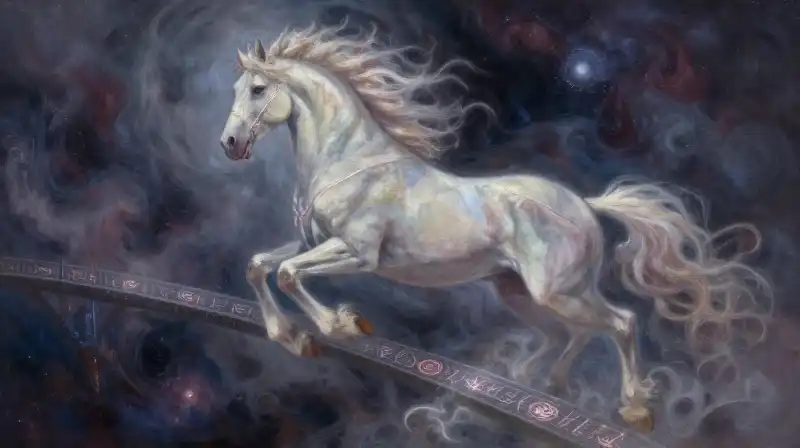
In the vast tapestry of Norse cosmology, few figures possess the sheer, myth-defining utility of Sleipnir. Far from being a mere mode of transportation, this grey steed serves as a bridge—a powerful, eight-legged embodiment of the interconnected realms that define the Norse universe. Sleipnir functions as the central steed of Odin, the All-Father, and he is consistently described across various sources as the finest of all horses 1. For a reader interested in the traditional narratives of the Norse people, Sleipnir offers a profound look at the relationship between mastery and boundary-crossing; the horse is not simply a mount, but a vehicle for spiritual and cosmic traversal.
The Origin of the Great Steed
The narrative surrounding the birth of Sleipnir is tied intimately to the divine chaos and human endeavor within Asgard. The creation of the horse is linked to Loki’s famous trickery, a common motif in Norse folklore where cunning leads to unforeseen results. According to traditional accounts, Sleipnir was conceived during an attempt to complete the great fortress of Asgard. The foal was born after the death of one of the builders, resulting in the remarkable creature—a grey, eight-legged horse—that immediately earned a place in the pantheon of great beasts (1, 2). This origin story suggests that even the most magnificent aspects of the gods’ life are often forged in the fires of dramatic, unpredictable events within the cosmic order.
The Cosmology of the Eight Legs
Sleipnir’s singular physical feature—the eight legs—is not an arbitrary mythological flourish, but is theoretically rooted in the fundamental structure of the Norse cosmos. Scholarly interpretations have posited that Sleipnir’s octagonal gait and anatomy represent the eight directions of the known universe. These directions include north, south, east, west, as well as the “internal” and “external” realms 1. This configuration allows Odin, while astride his steed, to navigate every corner and boundary of existence 1. The horse’s agility thus becomes a map of the world. It is through this eight-fold capacity that Odin achieves the rare status of being able to traverse all realms, from the realms of men to the territories of the giants, Jötunheimr (1, 2).
Navigating the Edge: Odin, Hel, and the Journey of Wisdom
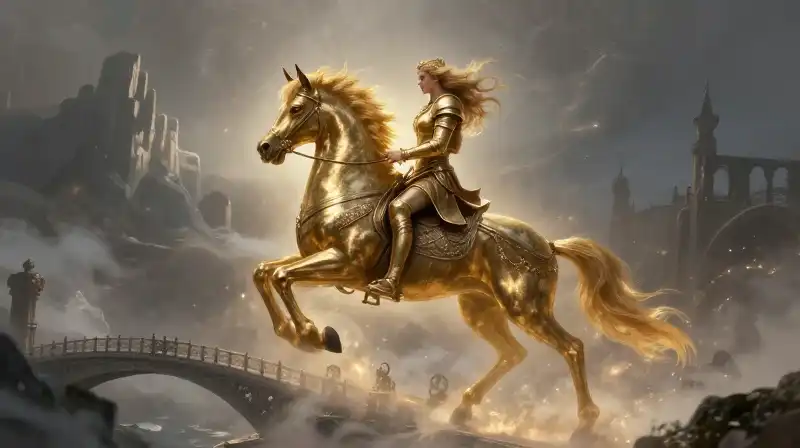
The most culturally significant application of Sleipnir is when Odin must venture beyond the known boundaries of the living world. He is ritually depicted riding the eight-legged steed when undertaking perilous journeys into Hel, the land of the dead, or seeking critical information from otherworldly entities. These trips are rarely for casual sightseeing; they are missions to retrieve forgotten wisdom or to offer ransoms for the return of lost gods, such as Baldr (1, 2). The horse’s capacity to gallop across ‘sky and sea’ and into these mysterious territories exemplifies its power 1. The narrative of Odin mounting Sleipnir and passing through the crucial boundary-crossing mechanism of the Gjöll bridge illustrates a specific cultural model for bridging the distance between life and death 1.
Symbolism of Speed and the Shamanic Quest
While his role as a conveyance is practical within the myths, Sleipnir’s deeper meaning lies in what he represents: speed, agility, and unmatched power. Beyond physical might, the horse has long been theorized to possess a ceremonial depth, potentially connecting to the shamanic practices of the Norse pagans. The relationship between Odin and the horse is therefore less of a simple ownership and more of a symbiotic bond necessary for achieving transcendent states of knowledge 1. The ability of Sleipnir to move between realms symbolizes the ultimate mastery of knowledge itself—the ability to see and understand all perspectives and directions of existence.
The Language and Image of the Steed
Sleipnir’s influence extends far beyond the action of the sagas. The creature is frequently referenced and woven into the fabric of Old Norse language and early art. In the intricate linguistic structures of the sagas, the horse serves as a “kenning,” a poetic metaphor used to describe large entities such as ships or the vast, open expanse of the sea itself 1. Furthermore, material culture provides historical evidence of the horse’s reverence. The 8th-century Gotlandic image stones, for instance, have been interpreted as depicting the eight-legged steed, demonstrating that the concept of Sleipnir was not limited to high mythology but manifested in the cultural art and visual memory of the people who upheld the tradition 1.
A Symbol of Cosmic Traversal
Sleipnir is more than a magnificent mythical creature; he is a living symbol of cosmic capability. The detailed narratives of Odin riding his steed—from his encounters with the giants in Jötunheimr to his vital treks into the dead realms—provide a continuous cultural framework for how humans understand the passage between worlds. Through Sleipnir, Norse mythology articulates the idea that true power is not found in stasis, but in the ability to travel, to seek knowledge, and to bridge the gaps between all that exists (1, 2).
References
Footnotes
Frequently Asked Questions
Does Odin ride Sleipnir?
Yes, Sleipnir functions as the central steed of Odin, the All-Father. He is ritually depicted riding the eight-legged steed to traverse all realms or venture into the land of the dead.
Who gave birth to Odin's horse Sleipnir?
According to traditional accounts, Sleipnir was conceived during an attempt to complete the great fortress of Asgard, and his creation is linked to Loki’s famous trickery. The foal was born after the death of one of the builders.
Related Articles