Zheng: A Formidable Mythical Creature in Ancient Chinese Lore

Introduction
In the vast cultural lexicon of Chinese mythology, some creatures function merely as exotic beasts, while others serve as potent symbols of the wild and dangerous fringes of the known world. The Zheng (狰) belongs to the latter category. Identified in the foundational text of the pre-Qin dynasty, the Classic of Mountains and Seas, the Zheng is more than a mere mythical creature; it is an archetype of elemental peril. It embodies the untamed regions, signaling to those who ventured near the edge of civilization that they had entered territory governed by fierce, primordial powers 1. To understand the Zheng is to understand the ancient Chinese relationship with the “untamed”—the places that were formidable, mysterious, and utterly indifferent to human presence.
The Ecology of Danger: Where the Zheng Resides
The home of the Zheng is defined by its stark opposition to human settlements. According to the classical descriptions, the creature makes its abode upon Zhang’e Mountain, a desolate environment devoid of typical vegetation, lacking both grass and trees (1, 2). This barren landscape is not merely scenic; it is fundamental to the creature’s character and symbolic function. The mountain itself is described as being incredibly rich in rare gems like jasper and green jade, suggesting a place of intense, raw natural power (2, 1). The Zheng thrives in these severe conditions, specifically in high mountain regions where the atmospheric pressures and conditions are traditionally difficult for most other creatures to endure 1.
Historically, the Zheng was used by cartographers and navigators as a crucial topographical indicator. It functioned as a standardized marker of danger, appearing on ancient maps to signify territories that were either uncharted, exceptionally hazardous, or believed to be beyond the boundaries of conventional knowledge 1. Its presence marked a boundary between the orderly, settled world and the unpredictable wilderness.
A Beast of Paradox: Form and Function
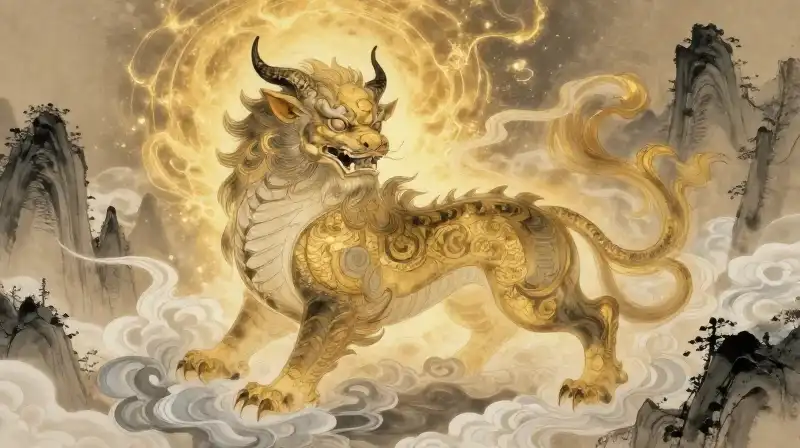
The morphology of the Zheng is striking and deliberately formidable. It is depicted as resembling a red leopard or panther, possessing a powerful crimson body. Distinct from typical predators, it is equipped with a singular, pronounced horn centered on its face, coupled with a remarkable five tails (1, 2, 3). This combination of powerful predator and mythical anomaly elevates its status far beyond a simple feline.
Beyond its appearance, the Zheng is defined by its immense power. Its vocal presence is noted for its resonant call, a sound likened to the sharp striking of stones—a sound suggesting violence and overwhelming physical force (1, 2). Further details from less formalized lore suggest that these five tails serve multiple purposes, perhaps providing balance in its harsh habitat, or more dramatically, acting as a tactical element to confuse, distract, and disorient potential prey 1.
Adding to the creature’s supernatural nature is the suggestion that the Zheng possesses incredible vitality, with some narrative accounts attributing to it the ability to sustain life without the need for breathing for undetermined periods 1. This enduring, nearly elemental quality reinforces its status as a divine, rather than just animal, beast within the cultural narrative.
More Than a Myth: The Zheng in Traditional Practice
For communities that held these legends, the Zheng’s status as a powerful entity extended into cultural and ritual practices. The creature was viewed as a being of immense, albeit dangerous, strength. Consequently, the highly prized pelt of the Zheng was recorded in cultural texts as being utilized in specific traditional practices—namely, the crafting of potent potions. These elixirs were believed to grant human subjects abilities resembling the supernatural resilience and strength attributed to the creature itself 1.
This usage highlights the dual nature of the Zheng in ancient thought: it represents ultimate danger, but also ultimate power. The pursuit of its pelt was, therefore, a mythological quest, representing the human desire to harness power derived from the most formidable forces of nature. The Zheng, placed within the broader category of fierce beasts of the western wilderness, serves as a powerful symbol of the immense, uncontrollable energy of the natural world 1.
The Scope of Influence: Regional Context and Origins
When examining the origins of the Zheng, it is important to note that this creature is deeply rooted in classical Chinese mythology. The *Classic of Mountains and Seas* provides its initial documentation, firmly placing it within the broader Chinese cultural landscape 1. Its traits and descriptions align with the traditional taxonomy of fierce beasts found in that specific tradition.
While various mythical creatures exist across East Asia, the Zheng is intrinsically tied to the specific lore of Chinese mythological beasts. It does not originate in Japanese mythology; its defining characteristics, its placement within the *Classic of Mountains and Seas*, and its specific use in cultural practices place it firmly in Chinese tradition. Its legend represents a distinct cultural observation of the wild places encountered during ancient explorations 1.
Navigating the Unknown
The legacy of the Zheng today exists primarily as a powerful literary and mythological construct. Contemporary knowledge regarding the creature remains uncertain; there are no modern sightings or definitive population studies to ground it in the modern natural world (1, 2). The Zheng remains a figure of the past, a magnificent symbol of the wild, rather than a living part of the local fauna.
For the reader who seeks to truly understand this tradition, the Zheng offers a window into an ancient worldview. It is a reminder that long ago, the vast, unforgiving wilderness was not simply a place—it was a powerful, sentient entity, marked by unique beasts whose existence represented the very boundaries of human civilization. The Zheng thus functions as a sophisticated cultural symbol of the sublime, reminding us of the mysterious power contained within the mountains and the deep, untamed spaces of history.
References
Footnotes
Frequently Asked Questions
Is Zheng Chinese or Japanese?
The Zheng is deeply rooted in classical Chinese mythology and is specifically documented in the Classic of Mountains and Seas. The article states that it does not originate in Japanese mythology, placing it firmly in Chinese tradition.
Related Articles