The Morrígan: Defining the Goddess of Fate and Irish Battle

Introduction
The Morrígan, or *An Mórrígan*, occupies a powerful and often misunderstood space within the intricate tapestry of Irish mythology. She is far more than a simple “Celtic Goddess”; she is a deeply specific, culturally vital figure native to the Tuatha Dé Danann, a supernatural race documented in Early Irish texts (1, 2). To understand the Morrígan is not merely to learn a definition, but to engage with a living tradition—one that personifies the volatile intersection of war, sovereignty, prophecy, and life itself. She is the embodiment of fate, a deity whose influence shapes the destinies of heroes and the trajectory of battle, serving as a powerful reminder that conflict, creation, and decline are inextricably linked.
The Weight of the Name: Defining Identity and Meaning
A crucial distinction in understanding the Morrígan is her identity. The term is not a generalized descriptor for a Celtic deity; rather, it is understood as a personal name and a specific title within the Irish mythological framework 1. The origins of this powerful name are a subject of continuous academic debate, leading to several compelling interpretations of her role. Some scholars derive it from *Mór*, suggesting a meaning of “The Great Queen,” while others favor interpretations stemming from roots associated with terror or “nightmare,” translating to “The Phantom Queen” (1, 2, 3). This dual etymological possibility—a ruler of immense power and a terrifying presence—perfectly mirrors her multifaceted mythological function.
Conflict, Sovereignty, and the Cycle of Life
While the Morrígan is perhaps most frequently associated with the gruesome and glorious aspects of battle, her cultural portfolio extends far beyond the battlefield. She functions simultaneously as a figure of death, a prophet of conflict’s outcome, and a powerful force of fertility. She embodies what many scholars refer to as the concept of Sovereignty Goddess—she is the guardian of the land and its people, embodying the enduring spirit of the Irish nation (1, 3). This connection to abundance is anchored by key cultural artifacts and associations. In various traditions, she is linked to cattle and is famously connected to the *Fulacht na Morrígan*, a mythical cooking pit 1. This presence links the destructive power of war and fate to the necessary acts of sustenance and creation. Furthermore, she is often grouped with other war and nature figures like Badb, Macha, and Nemain, forming the “Triple Morrígiu,” a trio that influences the outcomes of major skirmishes (1, 2, 3).
The Manifestation: Prophecy and the Shape-Shifter
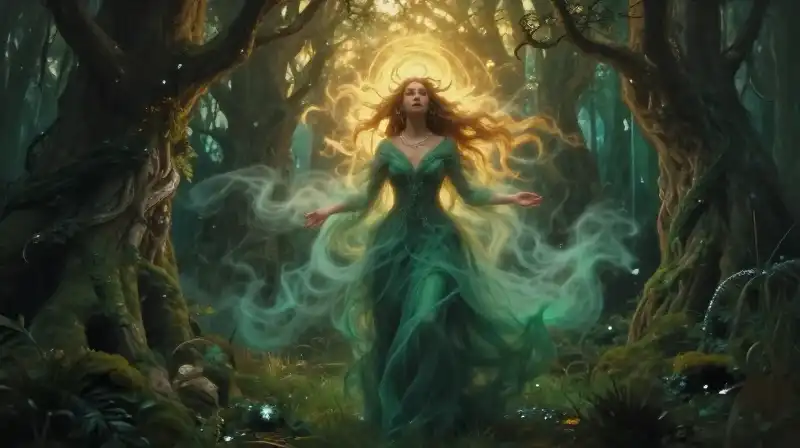
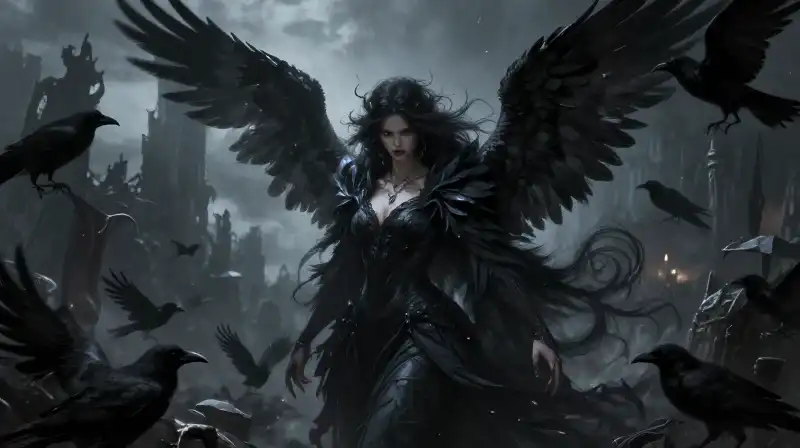
Perhaps the most captivating aspect of the Morrígan is her ability to shift form, acting as a potent omen. She is not confined to one appearance; she is a shape-shifting entity who can appear to warriors in a multitude of forms (3, 1). She might be seen as a majestic white heifer, an ancient, wise woman, or, most frequently, as a crow. This avian form, particularly when she appears as the Scald Crow, *Badb*, is highly significant. Badb is often described as flying above the fray, shrieking prophetic pronouncements—either of impending victory or utter destruction (3, 1). This function as an harbinger is vital to the narratives, such as the *Ulster Cycle*, where she frequently appears to heroes like Cú Chulainn. In these cycles, she is seldom a passive observer; she is an active agent who provides mysterious aid or, conversely, herald doom, thus placing her at the very heart of narrative destiny 1.
Fate, Protection, and the Power of Omens
When considering the question of whether the Morrígan protects, the answer is deeply contextual. Her influence is less about benevolent guardianship and more about ultimate, transformative fate. As a deity of sovereignty, she ensures that the boundaries and destinies of a community are honored, even if that destiny involves tremendous struggle. Her role is not necessarily to grant safety, but to define the necessary outcome. For the warrior or the leader, her presence is a reminder that every conflict, every life, and every death is interwoven with her power. By associating her with the successful culmination of the Tuatha Dé Danann, some traditions even hold that she may be the consort of An Dagda—a divine pairing seen as crucial to the community’s success 1. However, unlike traditional Ma/Mo/Crone archetypes sometimes presented in modern Pagan practices, Irish lore distinguishes her function as a sovereign power of fate and conflict (1, 2, 3).
The Enduring Significance of the Morrígan
The persistence of the Morrígan in Irish lore—even into medieval manuscripts after the arrival of Christianity—underscores her cultural gravity 1. She represents a profound continuity in the relationship between the people and the land. She is the fierce, uncompromising reflection of the natural world, acknowledging both the devastating power of death and the unrelenting strength of sovereignty. For those studying Living Culture, the Morrígan offers a lesson in complexity: a tradition that refuses simple definition, reminding us that the forces that bring destruction are often the same forces that bring profound, necessary change and ultimate life.
References
Footnotes
Frequently Asked Questions
Does the Morrigan protect you?
The Morrígan functions as the guardian of the land and its people, symbolizing sovereignty, but her influence is more about ultimate, transformative fate than benevolent guardianship. Rather than granting safety, her presence is to define the necessary outcome of every conflict, life, and death.
Related Articles