Chronos vs Cronus: Decoding the Myth of Time in Greek Lore

Introduction
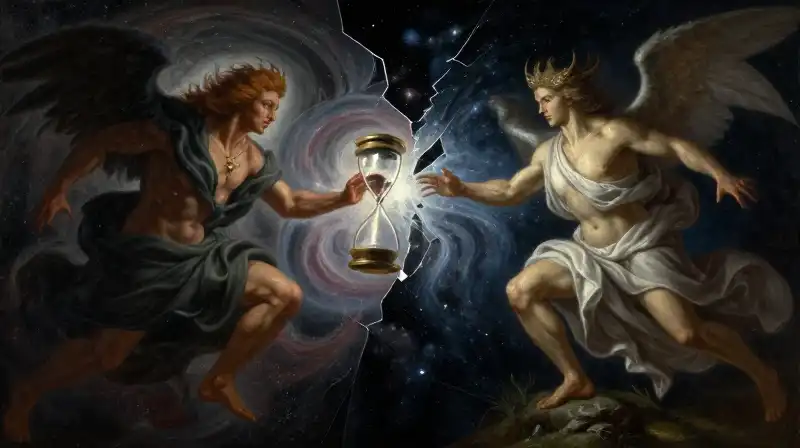
In the vast and interwoven tapestry of Greek lore, the figure of time is rarely as straightforward as the modern clock. When we encounter the names Chronos and Cronus, we are not simply dealing with two different spellings of the same concept. Instead, we are looking at a complex historical and philosophical distinction between a primordial entity—the very embodiment of the passage of time itself—and a powerful Titan associated with harvest and cycles. To truly understand this tradition, one must look past the quick definitions of Greek mythology and instead delve into the cosmic theater of the Orphic tradition, where time is not merely measured, but acted out as the fundamental force that shapes existence.
The Primordial Essence of Chronos
To clarify the core distinction, Chronos (Χρόνος), whose name literally translates to “Time,” stands in stark contrast to the Titan Cronus (Κρόνος). Chronos is the primordial personification of the concept of Time (1, 2). In the Orphic traditions, he is depicted in complex mythological roles as a fundamental deity embodying existence rather than as a ruler of harvest, which is often attributed to the Titan Cronus (1, 2).
Cosmic Act and Creation
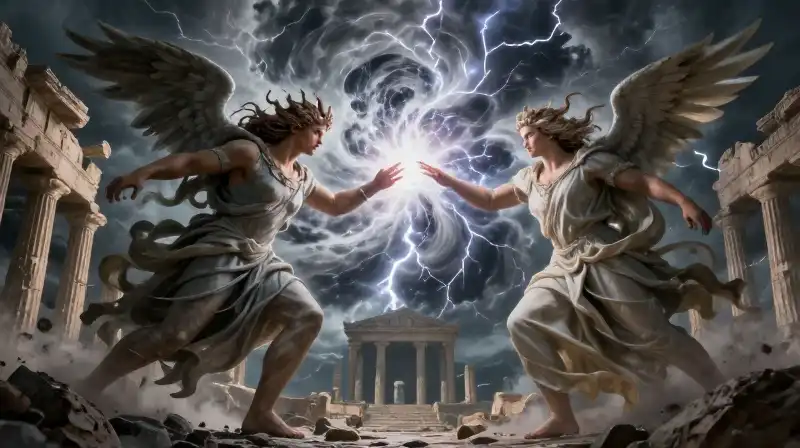
The narrative power of Chronos is felt most strongly in the Orphic cosmogony. This tradition presents Chronos as a participant in the very birth of the universe. Alongside the goddess Ananke—the inevitability of events—Chronos encircled the primordial world egg 1. This monumental, cosmic act resulted in the egg’s division, which gave rise to the earth, the sea, and the sky, initiating all of existence 1. Furthermore, Chronos was instrumental in bringing forth Aether (the upper sky) and Chaos (the void) from which the nascent gods, Phanes and Hydrus, emerged to start the universe 1.
The Three Eternal Principles
Ancient cosmologies sometimes elevate Chronos to the status of one of three eternal principles 1. In some early beliefs, Chronos functioned alongside Zas (Zeus) and Chthonie. Their seminal union in the Earth is believed to have given rise to the first generation of gods, rooting the concept of time not just in cyclical change, but in the very source of life itself 1. In this context, Chronos is not merely a god of moments, but a foundational energy that precedes all creation.
Decoding the Symbolism and Imagery
As with many powerful deities in ancient culture, Chronos’ appearance often reflects the profound philosophical weight placed upon him. He is frequently symbolized as an old, grey-bearded man 1. This specific representation reflects the destructive and stifling aspects of relentless time. Conversely, Chronos can be represented symbolically as a three-headed serpent, where each head symbolizes the rational, brave, and fertile influences that time exerts over all living beings 1.
Distinguishing Chronos from the Titan
The historical conflation between the two names is well-documented, particularly during the Renaissance and among some ancient interpreters 1. Plutarch suggests that the Greeks used Cronus as an allegorical name for Chronos 1. However, scholarly analysis reveals that the difference often lies in linguistic nuances. The Greek for “Time” () was aspirated [kʰrónos], while “Cronus” () was not 1. Despite these distinctions, Romans eventually merged the two figures into a single deity. While the Titan Cronus is famously depicted with a harvesting scythe, the Orphic Chronos is reserved for his more complex, primordial mythological roles (1, 2).
Chronos and Ananke: The Inescapable Connection
A crucial aspect of understanding Chronos is his relationship with Ananke. Their partnership is often viewed as a powerful narrative metaphor for the inherent nature of existence. The intertwined roles of Chronos and Ananke illustrate how time and fate are fundamentally intertwined; time, for Chronos, is not a flow of events but the inescapable framework of inevitability itself 1.
Addressing the Question of Chronos’ End
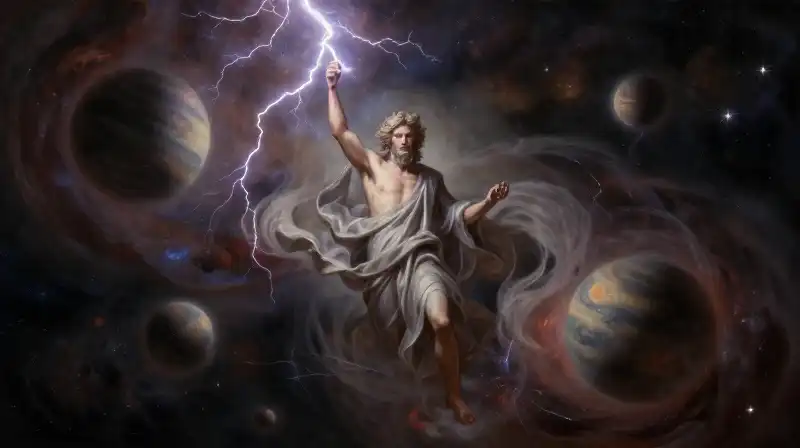
A common inquiry concerns who killed Chronos. It is vital to recognize the potential for confusion between Chronos and the Titan Cronus when answering this question. Chronos, the primordial embodiment of Time, exists as a foundational principle and is often viewed as part of the cosmos’ eternal cycle, rather than a singular figure who is decisively destroyed in a traditional sense. However, if the question refers to the Titan Cronus (the father of Zeus), his eventual fate is tied to the conflict with his children and the overthrow of the old cosmic order. The transition of power in Greek mythology typically centers on Zeus, who establishes the definitive order following the Titanomachy, effectively placing the older, primordial regimes into a subordinate or resolved position.
Synthesis: The Living Significance of Time in Greek Culture
To hold onto the tradition of Chronos is to acknowledge the deep philosophical weight the ancient world placed on time. It is not a mechanical concept, but a living, primordial force—a deity who participated in the genesis of reality and whose presence is inextricably linked to fate. For scholars of living cultures, the complexity of the Chronos/Cronus debate offers a valuable case study: how regional variations, linguistic shifts, and philosophical needs can cause different traditions to interpret a single divine concept in diverse ways. By appreciating the Orphic tradition’s focus on cosmic acts rather than just personal legends, we gain a genuine understanding of time not as a measurement, but as a fundamental, inescapable pattern of being.
References
Footnotes
Frequently Asked Questions
Which gods killed Chronos?
The article clarifies that Chronos, the primordial embodiment of Time, is a foundational principle and is not traditionally viewed as being decisively destroyed. However, regarding the Titan Cronus, his eventual fate is tied to conflict with his children, as Zeus established the definitive order following the Titanomachy.
Related Articles