Ananke: Understanding the Primordial Force of Fate and Necessity

Introduction
To understand Anankē is to understand a fundamental pillar of ancient Greek intellectual and dramatic life: the concept that some forces are absolute, beyond negotiation, and inherently unyielding. Often misinterpreted as a mere deity of “fate,” Anankē is far more profound. She is not a goddess of whims, but a primordial, unbending force—a living embodiment of inevitability, compulsion, and necessity. Her domain encompasses every form of constraint, from the physical locks of a prison to the subtle, inescapable ties of love, duty, and kin. Within the rich tapestry of Greek thought, Anankē serves as the “iron law” that governs the lives of both mortals and the gods themselves, posing one of the most enduring philosophical questions about the nature of human agency.
The Concept of Necessary Constraint
The linguistic origins of the term, derived from the common Greek noun anankē, meaning “force” or “constraint,” underscores the conceptual weight of the tradition. The idea of necessity was deeply embedded in the cultural language long before Anankē was solidified as a specific divine personification (1, 2). Unlike chaotic forces, Anankē represents the inevitable order of the cosmos—a law that must always be obeyed. This force encompasses all modes of limitation. While some traditions link her abstract celestial form to the goddess Aphrodite (especially in her role as Aphrodite Urania), her primary function remains that of the master of destiny and the architect of circumstance 1.
In certain Orphic cosmogonies, the sheer power of Anankē is demonstrated visually and physically. She and Chronos, the personification of time, are depicted as colossal serpents. Their immense, crushing pressure cracks the primordial cosmic egg, an act of necessity that gives rise to the structured, ordered universe we know (1, 3). This image shows Anankē not as a passive observer, but as an active, forceful initiator of existence.
Anankē in Philosophy: From Chaos to Order
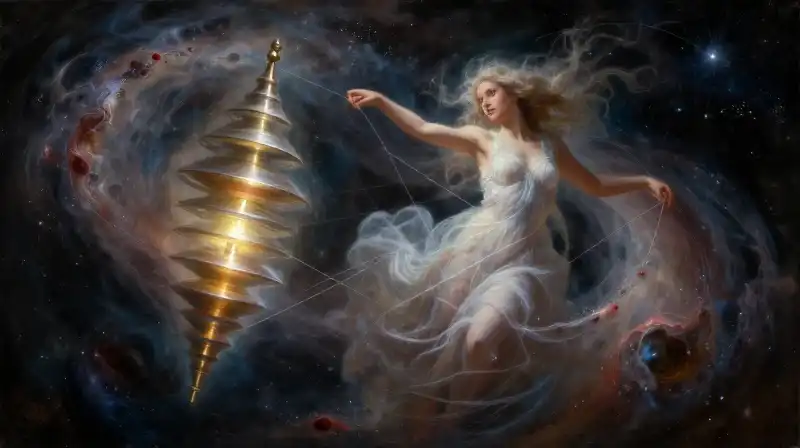
For philosophers, Anankē was a concept to be analyzed, refined, and integrated into grand systems of knowledge. Plato utilized Anankē extensively in his philosophical frameworks. In the Republic, she is portrayed as being enthroned with a cosmic spindle, governing the rotation of the celestial spheres and the stars (1, 3). However, Plato was careful to distinguish this necessity from mere cosmic chaos. In the Timaeus, he conceptually positions Anankē not as a destructive wild force, but as the raw material of necessity—the baseline reality that must be actively governed and brought into harmony by divine reason, or Nous, during the creation of the cosmos (1, 3).
This distinction—that necessity provides the boundaries within which reason must operate—is key to the tradition. The concept forces a confrontation between the deterministic power of the universe and the possibility of human reason or divine governance.
The Iron Law of Greek Tragedy
The practical cultural impact of Anankē is most visible in the dramatic arts. The weight of her power often manifested in the high stakes of Greek tragedy, forcing characters into unalterable moral dilemmas. The playwright Aeschylus frequently employed this concept in his works. In the *Prometheus Bound*, for instance, Anankē’s authority is so absolute that it dictates predetermined courses of action that even Zeus, the king of the gods, cannot escape, aligning even his reign with the will of the Moirai and the Erinyes (1, 3).
In *Iphigenia in Aulis*, the influence of Anankē is felt as a divine compulsion. The goddess forces Agamemnon into a moral choice that is fundamentally unavoidable, demonstrating how necessity compels actions. Anankē is presented not as a capricious deity, but as an inescapable “iron law” of circumstance, lending a profound gravity to the suffering and choices depicted on the stage 1.
The Eternal Tension: Free Will vs. Necessity
The cultural significance of Anankē revolves around a perpetual philosophical dilemma: where does human free will end and divine necessity begin? This question remained central to Greek thought 1. The traditions that venerated Anankē did not necessarily advocate for fatalism where all action is pointless. Instead, for some, like the Stoic philosophers, recognizing the relentless law of Anankē offered a powerful path toward wisdom 1.
The Stoics proposed that true harmony comes from accepting what must inevitably transpire. By acknowledging the boundaries set by Anankē, one finds peace and virtue within a constrained world. This perspective reframes the power of necessity from a source of despair into a guide for ethical living—a way to find agency not by changing the outcome, but by responding virtuously to the circumstances that are laid before us.
Understanding the Scope of Her Influence
When seeking to understand the traditional meaning of Anankē, it is important to grasp the breadth of her influence, extending beyond just the physical or cosmic. For the reader concerned with the power of this force, her influence operates on multiple levels: physical, moral, and existential. Anankē’s realm encompasses:
- The physical limits of the body (death and confinement).
- The subtle, social ties of human kinship and duty.
- The psychological pressure of circumstances and destiny.
In the divine hierarchy, she is often portrayed as the mother of the Moirai (the Fates), suggesting she acts as a supreme authority, a governing force that stands above even the decisions of the Moirai themselves (1, 3). This reinforces her position as the ultimate source of inescapable constraint.
Regarding the specific questions of power and offspring (the powers of a child of Anankē or her other descendants), the traditional Greek sources focus more on her fundamental nature as an archetype of unavoidable necessity than as a progenitor of personal, discrete powers. Her influence is inherently systemic and abstract, representing universal law rather than inherited magic 1. The search for her connection to LGBTQ+ identities or modern re-imaginings exists in contemporary interpretations, but her traditional role was strictly as the cosmic regulator of inescapable circumstances.
Synthesis: The Gravity of Circumstance
Ultimately, Anankē serves as a reminder of the gravity inherent in all life. She is not a benevolent guide, but a powerful, uncompromising reality—a reminder that our freedom operates within the defined constraints of the universe. The legacy of Anankē in Greek culture shifted the focus from “what *could* happen” to “what *must* happen.” Her presence transforms the narrative of human life into a complex interplay between inevitable law and a highly constrained, yet vital, human response.
The tradition teaches that true wisdom often lies in the recognition of limits. To understand Anankē is to appreciate the profound difference between the possibility of choice and the necessity of acceptance.
References
Footnotes
Frequently Asked Questions
What are the powers of Ananke?
Anankē is a primordial force embodying inevitability and necessity, serving as the iron law that governs both mortals and the gods. Her influence encompasses the physical and existential limits of life, the subtle social ties of duty, the rotation of celestial spheres, and the psychological pressure of destiny.
What powers would a child of Ananke have?
Traditional Greek sources focus on Anankēs fundamental nature as an archetype of unavoidable necessity, emphasizing her systemic and abstract influence as a cosmic regulator of inescapable circumstances. She is typically portrayed as a governing force, often depicted as the mother of the Moirai.
Who is the Greek goddess in Lgbtq?
According to the article, her traditional role was strictly as the cosmic regulator of inescapable circumstances. While the search for her connection to LGBTQ+ identities exists in contemporary interpretations, the article states her traditional function was not associated with such concepts.
Related Articles