The Main Egyptian Gods: Their Roles and Mythological Significance

Introduction
The idea of identifying a single “main” god in ancient Egypt is a profound misunderstanding of the tradition. Unlike monotheistic faiths that center on a single deity, the Egyptian spiritual landscape was a vast and layered ecosystem of beliefs, where the most important figures shifted according to the time, the region, and the purpose of a ritual. This pantheon was not a fixed list of names but a dynamic reflection of the community’s relationship with nature, law, death, and creation. To understand the divine drama of the Nile Valley is to understand a sophisticated system where power, chaos, and renewal were all personified. The deities mentioned in historical records did not exist in isolation. They were part of structural groups—such as the royal dynamic of the Ennead or the primordial figures of the Ogdoad—which served to organize the enormous array of beliefs. While deities like Bastet and Anubis were immensely popular among the common people for their protection or funerary roles, their hierarchical position within the divine structure varied significantly 1. The real focus was often not on *who* was supreme, but on the vital balance these gods maintained.
The Narrative Pillars: Life, Death, and Resurrection
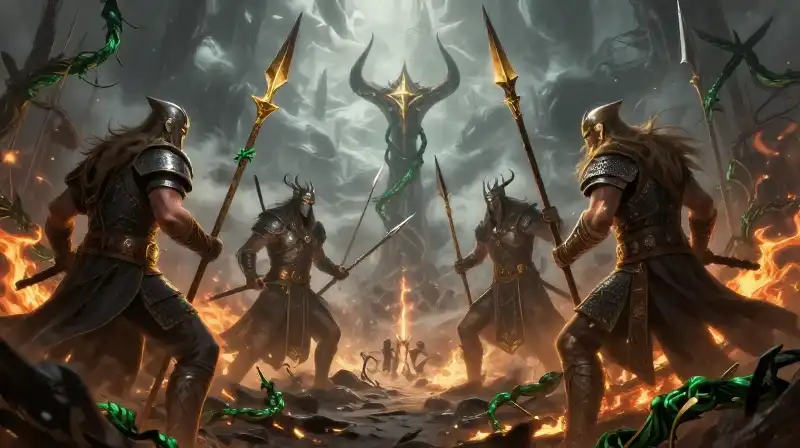
At the heart of the Egyptian mythological cycle lies a central drama involving death and rebirth. Osiris is perhaps the most culturally vital figure, but his significance transcends simple funerary rites. He represents the vital, cyclical nature of life itself—symbolizing not only the underworld but also the annual renewal brought by the flooding of the Nile 1. The story begins with Osiris, who is brought down to the realm of the dead by his murderous brother, Seth. In Egyptian cosmology, Seth embodied the forces of chaos, violence, and uncontrollable storms 1. The struggle between these two gods is the foundational myth of order versus disorder. The eventual resurrection of Osiris by his sister, Isis—a figure whose sustained worship spanning millennia speaks to her enduring cultural influence, even reaching beyond Egypt—is the narrative that explains how creation begins anew after destruction (1, 2). From this cycle emerges Horus, the divine manifestation of kingship. Associated with the sky, hunting, and war, Horus often served as a living mirror to the reigning Pharaoh, embodying the divine right and protective power of the ruling monarch 1. The dramatic family ties between these three figures—Osiris, Seth, and Isis—form the core of the Egyptian understanding of how society, nature, and the spirit operate.
Guardians of Ma’at and Cosmic Order
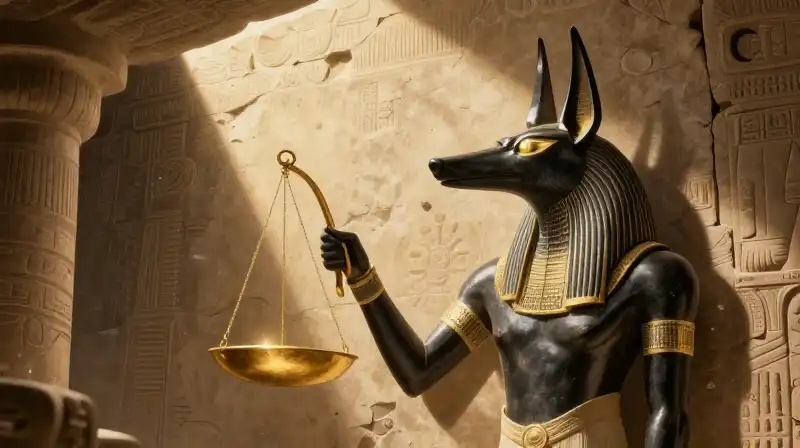
For the Ancient Egyptians, the highest cultural and theological ideal was not the singular favor of a deity, but the concept of *Ma’at*. Ma’at represents truth, cosmic order, and balance. This principle of order held such societal weight that scholars suggest its conceptual importance rivals that of some individual gods themselves 1. The embodiment of this order often took the form of Re (Ra), the powerful sun god. Ra’s daily journey across the sky is a continuous narrative of creative force battling Apopis, the snake god of primordial chaos 1. This struggle is the most fundamental representation of the human experience: the daily triumph of light and order over disruptive forces. Complementary to the principle of Ma’at are the guardians of the boundary between the worlds. Anubis holds a distinct, foundational role in funerary rites. He is the principal god of the dead, overseeing the preparation and guidance of the deceased 1. While others focused on creation or rulership, Anubis grounded the spiritual experience in the critical, life-or-death process of judgment and transition.
Local Traditions and the Everyday Deities
The complexity of the Egyptian pantheon becomes most visible at the local level, where regional spiritual focus dictated which deities were prioritized. This explains why some cities intensely focused on specific protectors over the “supreme” deities. Isis is a prime example of a goddess who evolved beyond the traditional roles of wife and mother. Her enduring presence across the Mediterranean points to a profound cultural power that sustained believers for three millennia (1, 2). Similarly, Hathor embodied deeply ingrained cultural concepts of motherhood, fertility, and protection for women in childbirth. She even held a key funerary role as the “lady of the west” 1. In contrast to the grand cosmic drama, other gods served highly specific, practical community needs. Bastet, for instance, was incredibly popular among the common people and was seen as a protector and symbol of joy. Furthermore, Ptah, associated with craftsmen and builders, presided over localized triads, particularly in the ancient city of Memphis. Some modern theories even link Ptah’s localized power to the etymological root of the name “Egypt” 1.
What Do These Gods Teach Us About Community?
The Egyptian pantheon, rather than presenting a rigid hierarchy, offers a sophisticated mirror to the cultural priorities of the society that developed it. The distinction between the popularity of a deity among the masses—like the accessible Bastet—and their conceptual necessity within the cosmic structure (Ma’at) reveals a complex spiritual culture 1. The way the gods were organized into functional groups—like the royal Ennead—suggest that the ancient Egyptian worldview was inherently structured, even when discussing the supernatural. They were a spiritual framework for organizing a vast, complex society, reflecting the desire to understand the natural cycles of the Nile, the predictable seasons, and the necessary battle between life and chaos. To genuinely understand this tradition is to move beyond listing names. It is to grasp a profound cultural system where every aspect of life—from the fertile mud of the Nile, represented by Osiris’s cycle, to the daily march of the sun, embodied by Ra—had a divine, meaningful counterpart, all existing within the ever-present framework of cosmic order, Ma’at.
References
Footnotes
Related Articles