The Aesir and Vanir Gods: War, Roles, and Mythological Unification

Introduction
The Norse mythological tradition is often seen through the lens of powerful, warring giants and formidable gods. At the heart of this elaborate tapestry are the deities known as the Æsir and the Vanir. While modern discussions frequently categorize the Æsir as the embodiment of war, law, and power, and the Vanir as figures of agrarian fertility and prosperity, this categorization is too reductive for an authentic understanding of the tradition. The relationship between these two groups is not simply a list of attributes, but a profound narrative arc—one of tribal conflict, eventual integration, and the creation of a unified pantheon that defined the mythological landscape of the Viking Age. To truly grasp these gods is to understand the cultural journey from a fractured landscape of local traditions to a centralized, harmonious religious landscape.
The Genesis of Tension: The Æsir–Vanir War
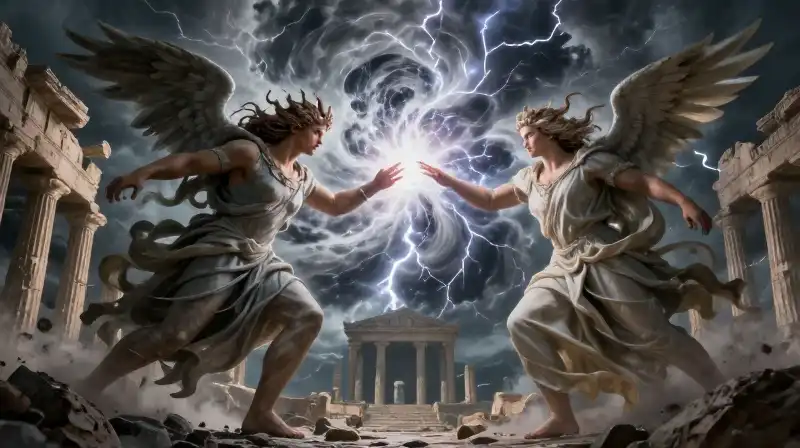
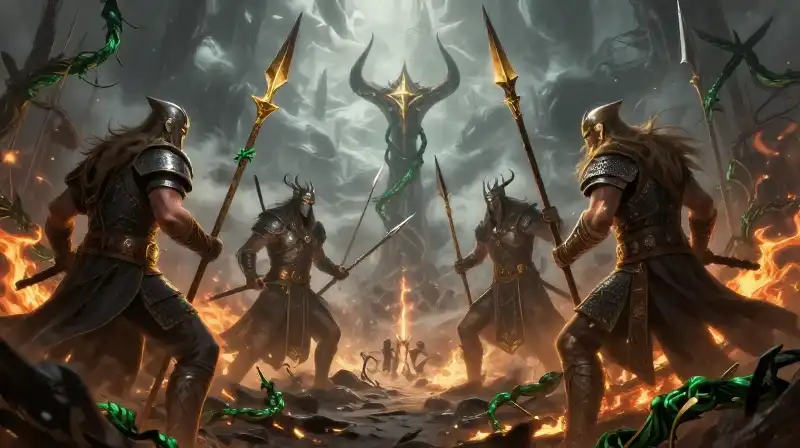
The foundations of Norse mythology are defined by the Æsir–Vanir War, a conflict documented in surviving primary sources like the *Völuspá* (Poetic Edda), *Skáldskaparmál* (Prose Edda), and the *Ynglinga saga* (Heimskringla) (Source 2). This conflict was not merely a skirmish between disparate gods; it was a foundational cultural clash that marked a pivot in the narrative of the cosmos. Scholars have interpreted this tension in several ways. One perspective suggests the war represented a struggle by the Æsir to maintain their dominance and control over the tribute of humans, seeking equal recognition from their rivals (Source 2). Another interpretation posits that the conflict reflects a broader Proto-Indo-European “war of functions,” where aggressively defined, warlike cult representatives encountered local traditions centered on fertility and agricultural prosperity (Source 2). This struggle had a resonant symbolic weight in the Viking tradition, where the very act of drawing a spear between the armies may have signified the start of real, mortal battlefield combat (Source 1).
A Peace Forged through Exchange
The narrative of the war leads inevitably to a period of intense diplomacy. In the *Ynglinga saga*, the war is recounted as a decisive invasion where the Æsir, led by Óðinn, launched an attack on Vanaheim (Source 2). However, the ultimate outcome was a peace treaty and a complex system of hostage exchange that reshaped the divine hierarchy. Key figures were interchanged, symbolizing the merging of these two traditions. Njörðr and his son Freyr, who represented the Vanir, were exchanged for figures within Asgard, such as Hœnir and Mímir (Source 2). This exchange ensured the Vanir could not be fully exiled, but rather incorporated into the larger social structure of the Asgard pantheon, allowing Njörðr, Freyr, and Freya to become integrated gods within Asgard’s social fabric (Source 2).
The Birth of Cultural Heritage: The Mead of Poetry
The unification of the Æsir and Vanir also holds a poetic significance regarding the very origins of artistic and mythological expression. In the context of the *Prose Edda*, the war and subsequent truce are poetically linked to the beginning of poetry itself (Source 2). During the peace conference that followed the conflict, a symbolic offering—a mixture of spit held within a vat—was held as the material from which the figure Kvasir was created (Source 2). Kvasir, in turn, is said to be the progenitor of the sacred Mead of Poetry (Source 2). This narrative suggests that the cultural melding born from the conflict led not only to religious unity but also to a richer capacity for myth-making and artistic expression within the society.
Understanding the Roles: Beyond Simple Categorization
When we examine the specific attributes of the deities, we must resist the temptation to place them into rigid boxes, as Source 3 emphasizes that the division is not absolute and features significant overlap between the two families (Source 3, Source 1). The Æsir pantheon is traditionally associated with knowledge, prophecy, and the defense of order.
- Odin: Associated with knowledge, wisdom, and prophecy.
- Thor: Known as the thunder god, dedicated to defending both gods and humans.
- Frigg: Presides over oaths and the sacred peace that binds kingdoms.
The Vanir pantheon, meanwhile, is closely tied to the cycles of nature, fertility, and seasonal bounty.
- Njörðr: The god associated with the rich bounty of the sea and fertility.
- Freyr: Linked to prosperity and the fruitful harvest.
- Freya: A powerful figure who spans the realms of love, beauty, and the fierce side of war (Source 3, Source 1).
The overlap, especially seen in the dual presence of powerful figures like Freya, demonstrates that the two groups shared interests in the spheres of power and war, even as their origins in fertility and militarism provided their initial distinction (Source 1).
The Synthesis: “Pretending Nothing Happened”
The successful integration of the Æsir and Vanir resulted in a unified cultural narrative. The tradition suggests that following their major conflict, the gods reached a peace that allowed them to “politely pretend nothing had happened” (Source 3). This statement is perhaps the most useful cultural takeaway for the modern reader. It indicates that in the communal memory of the time, the foundational war was not viewed as a lasting tragedy, but as a pivotal event that led to a stable, flourishing cosmic order. The memory of the conflict became part of the grand tapestry of their unity, a catalyst that facilitated the “living” harmony of the unified pantheon.
Why the Distinction Matters to the Tradition
For a reader curious about the specific gods of the Vanir, figures like Njörðr, Freyr, and Freya are key examples (Source 3). However, understanding their inclusion requires understanding the context of the entire religious landscape. The narrative of the Æsir and Vanir War reveals a crucial human struggle that many communities face: how to reconcile fundamental differences—between aggressive defense and agricultural growth, for instance—into a single, cohesive whole. The story provides a model of cultural absorption. Rather than one group destroying the other, the tension and eventual war led to a political and religious structure that incorporated the strengths of both. This blend created a robust and enduring tradition that valued both the might of the warrior and the blessings of the harvest. It teaches that unity is often achieved not through the absence of conflict, but through the careful integration of previously opposed forces. In contemporary scholarship, the narrative of the Æsir and Vanir serves as a powerful lens through which to view the development of early European spiritual systems. It is a story of complexity, showing that even within the deepest layers of ancient folklore, the lines between ‘good’ and ‘bad,’ or ‘sacred’ and ‘secular,’ are far more intricate than a simple definition allows. The true value of the tradition lies in its ability to reflect a sophisticated societal transition—one from fractured local identities to a powerful, unified cultural identity forged in the crucible of conflict and subsequent peace.
Frequently Asked Questions
Who are some gods from Vanir?
According to the article, key examples of gods from the Vanir include Njörðr, Freyr, and Freya. These deities are associated with fertility, the cycles of nature, prosperity, and the rich bounty of the sea.
Related Articles