
Norse Dog God Garmr and Fenrir: Role in Ragnarök Explained

Introduction
In the vast landscape of world folklore, few symbols are as potent or as complex as the wolf—and by extension, the dog. For those studying the traditions of Norse and Heathenry, the canine figures like Garmr and Fenrir are not merely monsters or pets; they are critical characters in the grand, inevitable narrative of Ragnarök, the twilight of the gods. These beings represent the chaotic forces of nature, the end of established cosmic order, and the powerful, sometimes terrifying, relationship between the wildness of the natural world and the structured world of humanity. To understand the Norse conception of the “dog god” requires looking beyond a simple definition and recognizing the deep currents of shared Germanic, Celtic, and regional spiritual heritage.
The Boundary Figures: Defining Garmr and Fenrir
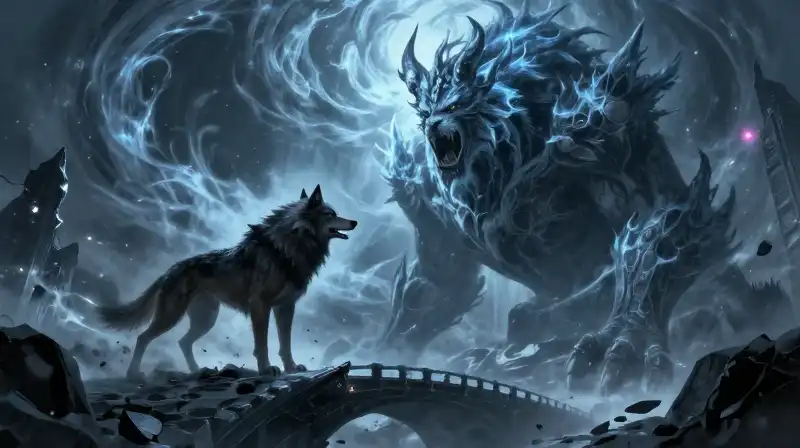
When discussing canine entities in the Norse tradition, two names frequently emerge: Garmr and Fenrir. While both are associated with powerful, destructive forces, they inhabit different mythological realms, though interpretations often link them. Garmr is specifically tied to the periphery of the divine, guarding Hel’s gate. He is described in some accounts as a blood-stained guardian of the underworld 1, existing at the very threshold between life and death. His howls, in the Eddic poems, are often linked to the foretelling of the final battle 1.
The confusion between these figures often arises because of narrative similarities. Garmr has been interpreted by scholars as potentially being identical to the Great Wolf Fenrir, or viewed as a Hellhound analogous to the Greek Cerberus 1. However, Fenrir is generally viewed as a more cosmic force—a wolf whose immense power is set against the established order of the Aesir. Garmr thus functions more as a literal gatekeeper of the transition, while Fenrir represents the ultimate, uncontrollable surge of primeval power. Despite these differences, both dogs and wolves occupy a liminal space in the mythology, symbolizing the transition between ordered society and untamed nature 1.
The Liminal Symbol: Canines as a Bridge Between Worlds
The cultural significance of the wolf and the dog in these traditions goes far deeper than their role in prophecy; they represent the complex human-nature bond. The wolf’s ability to navigate the boundaries of the forest, neither fully wild nor fully domesticated, made it a powerful symbol of change. This theme is reinforced in the broader Norse pantheon, where Odin himself holds a special connection to wolves. He is noted for his association with the Ulfhednar, the “berserkers of the wolf sort,” establishing a direct link between divine power and canine strength 1.
Similarly, in regional traditions, the presence of canine figures speaks to local syncretism—the blending of various cultural beliefs. For instance, in Low Saxon folklore, the helhond (or kardoes) is mentioned as a companion of Tamfana, one of Hel’s titles. This suggests that the fear or reverence for the underworld was often filtered through regional, tangible forms of belief, blending abstract myth with specific local customs 1.
Garmr’s Role at the Edge of the Cosmos
Garmr’s primary narrative importance lies in his position as an arbiter of fate during Ragnarök. As the dog guarding the passage into the netherworld, his role is not merely one of defense, but of ultimate engagement. In one key narrative, the bound dog Garmr is destined to engage in a fierce battle with the god Týr. Their conflict culminates in mutual destruction, illustrating the violent resolution that characterizes the end-of-the-world myth 1. This interaction highlights the narrative tension: even the strongest gods are subject to the whims and inevitable confrontation of primal, untamed forces, symbolized by Garmr.
From the modern perspective of Heathenry, figures like Garmr are understood as central to exploring the grand narrative of divine fate. They represent the necessary collapse and rebirth—the chaos that allows for a new order to emerge. The presence of Garmr at Hel’s gate serves as a powerful reminder that the line between the sacred and the wild, the gods and the beasts, is inherently porous 1.
Regional Echoes: Beyond the Eddas
The cultural influence of canine figures extends beyond strictly Norse textual sources, demonstrating a “Romanized Germano-Celtic religion” 1 where canine themes found regional expression. One such example is Nehalennia. Though she is depicted with dogs and is sometimes referenced in traditions as either Germanic or Celtic, the discovery of her temple in places like Zeeland suggests a broad, shared regional religious heritage that integrated local motifs 1. These figures, whether worshipped as protector, companion, or threat, illustrate how the powerful symbolism of the domestic and wild dog permeated the spiritual life of various communities across Northern Europe.
These diverse regional accounts show that the motif of the dog is not a localized myth, but a universal cultural language used to address transition, guardianship, and the primal power of nature, regardless of whether the community was in the heart of Scandinavia or along the coast of the North Sea 1.
The Canine Soul in Living Tradition
For modern practitioners of Norse traditions, these powerful figures are not solely historical curiosities; they are active points of meditation and understanding. When contemplating Garmr, for example, a modern adherent is engaged in a reflection on the limits of human and divine control. They are engaging with the archetype of “the great transformation”—the moment when order breaks down to make way for something new.
While there is no singular “dog god” like some pantheons might have, the figures are viewed as embodying specific aspects of the cycle: chaos (Fenrir), destiny (Garmr), and primal power. The study of these myths, therefore, serves as a mirror, reflecting humanity’s own negotiation with the wild spaces—both ecological and existential—that constantly press against the boundaries of civilization.
Conclusion: The Enduring Symbol of Transition
The narratives surrounding Garmr and Fenrir offer much more than a dramatic mythological climax; they provide a deep window into how ancient communities understood change. They conceptualized life as a continuous negotiation between the domesticated and the untamed, between the god and the wilderness. The canine figure, in its varied forms from the terrifying guard of the gates to the symbolic link to the All-Father, ultimately serves as the enduring symbol of transition itself—a necessary, powerful force that reminds us that all cycles, even those of the divine, must pass through the brink of the wolf’s howl.
References
Footnotes
Frequently Asked Questions
What Norse god had a dog?
Odin is noted for his special connection to wolves, specifically through his association with the Ulfhednar, the berserkers of the wolf sort, which establishes a link between divine power and canine strength. The article also mentions that the All-Father holds a symbolic link to the canine motif within the Norse pantheon.
Is Fenrir a wolf or a dog?
Fenrir is referred to as a canine figure in the introduction, but the article specifically views Fenrir as a wolf whose immense power is set against the established order of the Aesir.
Related Articles