The Myth of Nut and Geb: How Earth and Sky Created Egypt

Introduction
For those drawn to the deep roots of human storytelling, the myths of the ancient Egyptians offer a profound look at how a civilization viewed its own origins, its place in the cosmos, and the cycle of life itself. Central to this worldview are the divine figures of Geb and Nut. These entities are not simply characters in a religious text; they embody the fundamental, foundational dichotomy of the cosmos—the marriage of Earth and Sky. By understanding the mythology surrounding them, one gains insight into the Egyptian cultural perspective on order, creation, and the eternal balance between existence and renewal.
The Primordial Boundary: Earth and Sky
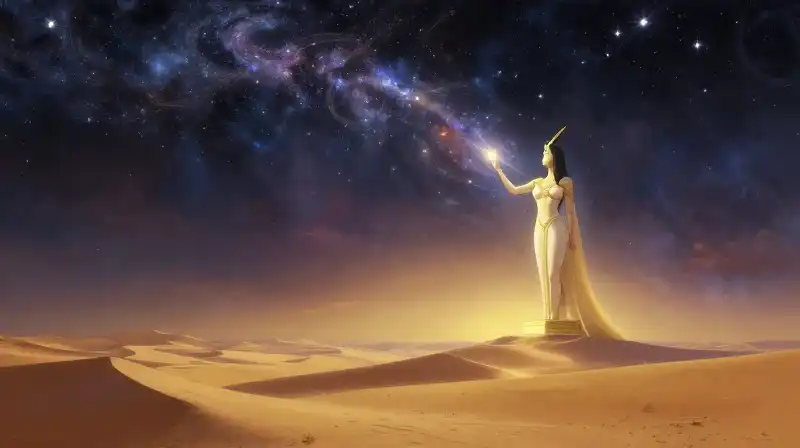
At the very beginning of the Heliopolitan Ennead, existence was a vast, formless expanse of primeval waters (Source 3). To structure this watery chaos, Geb, the personification of the earth, and Nut, the personification of the celestial sky, rose to form the initial, permanent boundary of the newly created world (Source 1, Source 3). Their relationship is often depicted as a profound physical union: Nut is traditionally shown reclining in a sweeping arch, while Geb lies beneath her, illustrating the ground encompassed by the heavens (Source 1, Source 3). This image is more than just a portrait; it represents the singular point of origin where the tangible and the infinite meet. Culturally, the Egyptian understanding placed the earth as a fundamentally masculine force, rooting Geb in the chthonic realm and connecting him to the concept of fresh waters (Source 1, Source 2). Conversely, the universal sky deities represented a feminine or overarching quality. Nut, with her titles such as “She Who Protects” and “Covering the Sky,” acted as a protective canopy, particularly safeguarding the Sun God, Ra (Source 3).
A Tapestry of Duality: Fertility and the Underworld
The significance of Geb extends beyond his role as a creator; he embodies powerful, contradictory forces, which is key to understanding ancient Egyptian belief. He is revered as a fertility god, closely associated with the green life of vegetation (Source 2, Source 1). Yet, this life-giving aspect is balanced by a much darker reality: Geb also embodies the earth’s potentially consuming power. According to Source 1, he is capable of imprisoning the dead within his “jaws,” linking him directly to the underworld and the transformative process of death. This duality suggests that the Earth was seen as both the giver of life and the repository for death, a complex relationship that defined the Egyptian experience of cycles. Nut shares this duality, as she is viewed ritually as the devour-and-rebirth element (Source 3). Her cyclical function is dramatically illustrated by her role in the celestial journey: she swallow the Sun as it travels across her body during the night, only for it to be reborn at the break of dawn (Source 3). This cosmic swallowing and rebirth mirrors the continuous, inescapable rhythm of the Egyptian calendar and worldview.
The Great Separation and the Lineage of Gods
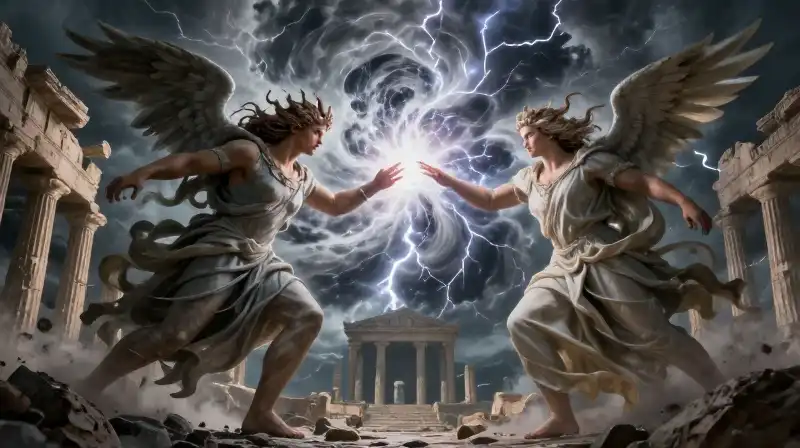
For the world to evolve beyond its primordial state, a critical narrative occurred: the separation of Geb and Nut. This cosmic divide was mediated by Shu, the god of air, whose role was to pull the celestial dome away from the earth to allow for the existence of air and space (Source 1, Source 2). This separation is a foundational act of Egyptian cosmology, allowing further complexity and creation to take place between the defined boundaries of earth and sky. From this foundational union, the next generation of gods emerged, including Osiris, Isis, Seth, and Nephthys (Source 1, Source 2, Source 3). This establishes the relationship between Geb and Nut not just as primal forces, but as the parents of the main deities who govern Egyptian life and death.
Regional Interpretations and Symbolic Forms
While the central myth remains consistent, the ways in which Geb and Nut were represented varied significantly across different regional or cultural expressions. The gods were not always depicted as humanoid figures. Source 1, Source 2, and Source 3 indicate that Geb was sometimes portrayed with animal forms, such as a ram, a bull, or a crocodile. Likewise, Nut’s celestial form could be depicted as a cow or even a giant sow (Source 1, Source 2, Source 3). Furthermore, their symbolism often carried administrative weight. Geb was sometimes equated with the divine role of a ruling king or the administrator of Egypt itself (Source 1). These variations demonstrate that the myth was a dynamic cultural tool, adaptable to different local traditions and needs.
Understanding the External Lens: Meaning and Echoes
Beyond the core Egyptian tradition, the figures of Geb and Nut found parallels in the intellectual traditions of outside cultures. Greek philosophers, such as Plutarch, viewed the Egyptian myth through an external lens, drawing connections between Geb/Nut and the Titans Cronus and Rhea (Source 3). These cross-cultural parallels show how the concept of the dual, foundational couple—the Earth and Sky—is a universal human archetype, though the specific cultural expressions, like the Egyptian mythology, are uniquely rich. The modern interpretations of the story also continue to evolve. Some scholars have examined the origin of their separation through human terms, such as divine jealousy or rivalry (Source 1). These modern re-examinations allow for a deeper look into how ancient myths are continuously re-interpreted by living communities and academics alike.
Synthesis: The Living Legacy of Geb and Nut
The myth of Nut and Geb is far more than a historical recounting of Egyptian gods; it is a profound statement on balance, permanence, and cyclical renewal. Whether viewed as a primordial couple, a divine progenitor, or a representation of the natural balance between life and death, their story defines the essential structure of the Egyptian cosmos. Their legacy resides in the enduring cultural understanding that for life (represented by Geb’s fertility) to exist, it must coexist with the potential for its return to the Earth (the chthonic aspect), all under the overarching protection of the heavens (Nut). They represent the inseparable union of the ground beneath our feet and the infinite sky above us.
Frequently Asked Questions
What is the myth of Nut and Geb?
The myth of Nut and Geb represents the fundamental dichotomy of the cosmos—the marriage of Earth (Geb) and Sky (Nut). They are depicted as the initial union that formed the permanent boundary of the newly created world.
Did Geb and Nut have children?
Yes, Geb and Nut had a next generation of gods emerge from their foundational union. These main deities included Osiris, Isis, Seth, and Nephthys.
Why were Nut and Geb separated?
The separation of Nut and Geb was mediated by Shu, the god of air, whose role was to pull the celestial dome away from the earth to allow for the existence of air and space. This cosmic divide allowed the world to evolve beyond its primordial state.
Related Articles