The Phoenix Myth: Exploring the Ancient Roots of Regeneration

Introduction
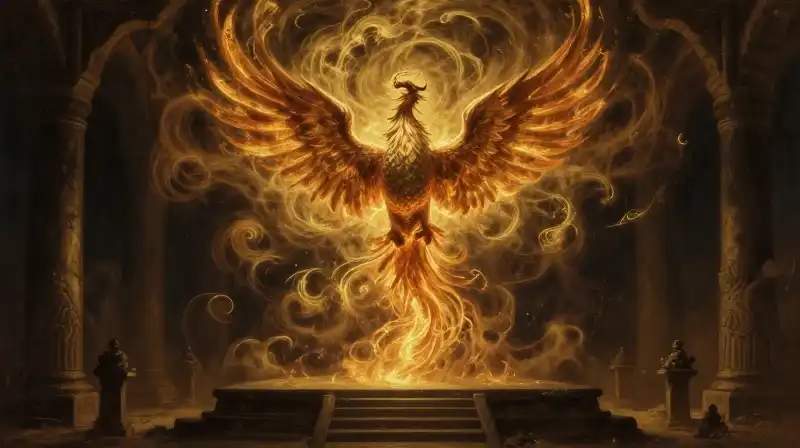
In a world defined by impermanence, the concept of the mythical phoenix stands as a profound cultural response to finitude. Far more than a simple fantasy, this legendary bird embodies a powerful human yearning for continuity—the idea that life, though it concludes, can always bloom anew. While often associated with the dramatic spectacle of rising from ashes, the phoenix is a tapestry woven from disparate cultural threads, connecting the ancient philosophical discussions of the Greeks to the solar rituals of Egypt. It is a symbol of cyclical regeneration, reminding those who study heritage that nothing is truly lost, only transformed.
The Conceptual Roots of Immortality
The core essence of the phoenix lies in its ability to endure destruction and emerge fundamentally unchanged. Across several cultural narratives, this bird is viewed as an agent of profound renewal. The concept of an immortal being is a universal one, yet the phoenix provides a specific, vivid metaphor for this idea. In classical Greek literature, the creature’s longevity is specified as being approximately 972 times the length of a human life, as recorded in the Fragment of the Precepts of Chiron 1. This incredible span of existence underpins the idea of the phoenix not just as a creature, but as a material embodiment of eternal change.
The primary narrative—that the bird dies through combustion and is subsequently reborn—is central to its identity. However, different traditions modulate this imagery. While the ashes offer the most common visual trope for rebirth, some accounts detail death purely through decomposition and fire 1. This variation shows how the tradition, while recognizable, shifted its focus across the various communities that adopted and adapted the myth.
Contested Origins: Egypt, Greece, and the Bennu
When tracing the migratory paths of the phoenix, the scholarly debate quickly centers on its geographic origins. Although it is most famously recognized in Greek mythology, many researchers look toward older traditions, particularly those in Ancient Egypt and Persia, for analogous concepts 1. One of the most persistent historical claims relates to the Egyptian “phoenix.” Herodotus’s account posits that an eagle-like, red and golden bird arrived from Arabia and was buried in the Temple of the Sun 1. However, modern scholars dispute the plausibility of this specific narrative, pointing to significant discrepancies in the accounts of its nature and arrival (1, 2).
The term “phoenix” itself may have evolved from, or been influenced by, the Egyptian Bennu—a bird often associated with the sun and regeneration. This is where the nuance of the tradition becomes vital: did the Greco-Roman world independently conceive of the phoenix, or was it an interpretation of a pre-existing Eastern concept? The consensus among some academic interpretations is that whether the Bennu directly influenced the classical version remains debatable due to differences in visual description and names 1.
Symbolism of the Solar Cycle and Time
The phoenix is intrinsically linked to the sun, a connection that ties the bird not just to natural cycles, but to philosophical ideas about the cosmos. The sun is often depicted as being endowed with a halo or nimbus, linking the bird to brilliant, solar power 1. For the Greco-Roman peoples, the phoenix transcended mere fantasy; it became a material reference point for the cyclicity of time and constant societal change 1. The idea that time did not progress linearly but returned to a point of renewal found its perfect visual representation in this magnificent creature.
This theme of unending return expanded beyond the mythical bird itself. The concept permeated civic life. For instance, Emperor Claudius famously paraded a living “phoenix” in 47 CE—a powerful symbolic gesture used to mark and celebrate a new era for the Roman Empire 1. This illustrates how, for communities who lived under the Empire, the phoenix was not just folklore, but a living emblem of stability and imperial renewal.
Variations in Form and Description
One of the most interesting aspects of exploring the phoenix tradition is the radical variation in how it is visualized. Descriptions shift wildly depending on the source, suggesting that the “phoenix” might have been a placeholder for a variety of magnificent, solar-aligned avian creatures. According to different accounts, the bird was depicted as resembling an eagle, or as similar to the Egyptian Bennu, which was more akin to a heron (1, 2). The descriptive language itself is as diverse as the regional traditions. Pliny the Elder detailed a bird with a purple body and golden accents, while the poet Claudian described it as having blue wings tipped with gold and a fiery aura 1.
Over time, these visual descriptions transitioned from biological renderings to allegorical representations. In the English language, the name evolved from describing a “purplish-red bird” to symbolizing “an excellent person”—someone who emerges improved from trial 1. This shift is reflective of how the tradition moves from the physical myth to the ethical application of its meaning.
The Phoenix in Modern and Enduring Culture
The symbolic weight of the phoenix continues to shape modern culture, moving into fields like heraldry, religious iconography, and philosophical debate. Its association extends beyond mere resurrection; it has been tied to the Roman concept of metempsychosis (the transmigration of souls) and even adopted into early Christian thought, broadening its symbolic appeal across many faith systems 1. While it represents the resurrection in a general sense, it also represents the triumph of the cyclical over the linear.
Modern interpretations acknowledge the complex interaction between these cultural traditions. Scholars continue to weigh the evidence to understand whether the Bennu or the independently developed Greek conception ultimately defined the global icon 1. Regardless of its specific origin, the phoenix remains a powerful cultural tool for articulating complex ideas about change—it provides a visually striking and narratively potent way for humanity to process loss and the possibility of rebirth.
The Enduring Meaning of Renewal
To engage with the phoenix tradition is to engage with the human need to find meaning in the pattern of loss. It is a powerful lesson in cultural endurance: that even when the structure of a society, the life of an individual, or a civilization itself seems to crumble, the core energy—the spark of creation—remains. By examining its regional forms, from the solar imagery of the East to the philosophical cycles of the West, we see that the phoenix is a universal language for hope, illustrating that in the grand tapestry of life, death is simply a preparation for a brilliant ascent.
References
Footnotes
Related Articles